Researchers offer first explanation for the near constant scale of the gas planet satellite systems
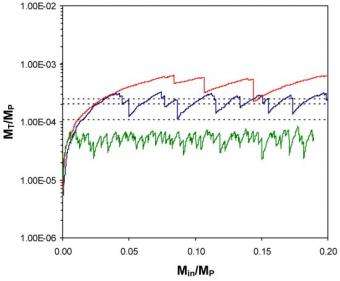
Each of our Solar System's outer gaseous planets hosts a system of multiple satellites, and these objects include Jupiter's volcanic Io and Europa with its believed subsurface ocean, as well as Titan with its dense and organic-rich atmosphere at Saturn. While individual satellite properties vary, the systems all share a striking similarity: the total mass of each satellite system compared to the mass of its host planet is very nearly a constant ratio, roughly 1:10,000.
Research by scientists at Southwest Research Institute, published in the June 15 issue of Nature, proposes an explanation as to why the gaseous planets display this consistency, and why the satellites of gas planets are so much smaller compared to their planet than the principal satellites of solid planets.
Jupiter's four Galilean satellites are each roughly similar in size, while Saturn has one large satellite together with numerous much smaller satellites. Even so, the total mass in both satellite systems is about a hundredth of one percent (0.0001) of the respective planet's mass. The Uranian satellite system structure is similar to that of Jupiter, and it also exhibits the same mass ratio. In contrast, the large satellites of solid planets contain much larger fractions of their planet's masses, with the Moon containing 1 percent (0.01) of the Earth's mass, and Pluto's satellite, Charon, containing more than 10 percent (0.1) of its mass.
Why do the gas planets, each with unique formation histories of their own, have satellite systems containing a consistent fraction of each planet's mass, and why is this fraction so small compared to solid planet satellites? Dr. Robin Canup and Dr. William Ward of the SwRI Space Studies Department propose that it was the presence of gas, primarily hydrogen, during the formation of these satellites that limited their growth and selected for a common satellite system mass fraction.
As the gas planets formed, they accumulated hydrogen gas and solids such as rock and ice. The final stage of a gas planet's formation is believed to involve an inflow of both gas and solids from solar orbit into planetary orbit, producing a disk of gas and solids orbiting the planet in its equatorial plane. It is within that disk that the satellites are believed to have formed.
Canup and Ward considered that a growing satellite's gravity induces spiral waves in a surrounding gas disk, and that gravitational interactions between these waves and the satellite cause the satellite's orbit to contract. This effect becomes stronger as a satellite grows, so that the bigger a satellite gets, the faster its orbit spirals inward toward the planet. The team proposes that the balance of two processes -- the ongoing inflow of material to the satellites during their growth and the loss of satellites to collision with the planet -- implies a maximum size for a gas planet satellite consistent with observations.
Using both numerical simulations and analytical estimates of the growth and loss of satellites, the team shows that multiple generations of satellites were likely, with today's satellites being the last surviving generation that formed as the planet's growth ceased and the gas disk dissipated. Canup and Ward demonstrate that during multiple cycles of satellite growth and loss, the fraction of the planet's mass contained in its satellites at any given time maintains a value not very different from 0.0001 across a wide range of model parameter choices.
The team's direct simulations are also the first to produce satellite systems similar to those of Jupiter, Saturn and Uranus in terms of number of satellites, their largest masses and the spacings of the large satellite orbits.
"We believe our results present a strong case that the satellite systems of Jupiter and Saturn formed within disks produced as the planet itself was in its final growth stages," says Canup. "However, the origin of the Uranian satellite system remains more uncertain, and the likelihood of our results being applicable to that planet depends on how Uranus achieved its nearly 98-degree axial tilt, which is a topic of active study."
For extrasolar systems, this research suggests that the largest satellites of a Jupiter-mass planet would be Moon-to-Mars sized, so that Jovian-sized exoplanets would not be expected to host satellites as large as the Earth. This is relevant to the potential habitability of satellites in extrasolar systems.
The NASA Planetary Geology and Geophysics and Outer Planets Research programs funded this research. The article, "A common mass scaling for satellite systems of gaseous planets," by Canup and Ward, appears in the June 15 issue of Nature.
Source: Southwest Research Institute


