John L. Hall: Long-time NIST Physicist Wins Nobel Prize
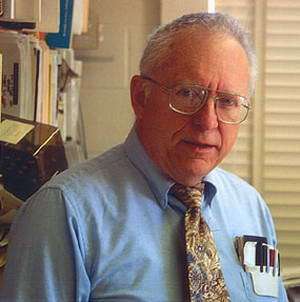
October 4, 2005 John L. Hall

John (Jan) L. Hall, a scientist emeritus of the National Institute of Standards and Technology Quantum Physics Division and a fellow of JILA, a joint institute of NIST and the University of Colorado, Boulder, has won the Nobel Prize along with Theodor W. Hänsch of the Max-Planck-Institut für Quantenoptik, Garching and Ludwig-Maximilians-Universität, Munich, Germany, and Roy J. Glauber of Harvard University.

Hall and Hänsch were awarded half the Prize for their contributions to the development of laser-based precision spectroscopy, including the optical frequency comb technique. The other half of the Prize was awarded to Glauber for his contribution to the quantum theory of optical coherence.

According to the Academy, the important contributions by Hall and Hänsch have made it possible to measure frequencies with an accuracy of 15 digits. Lasers with extremely sharp colors can now be constructed, and with the frequency comb technique precise readings can be made of light of all colors. For example, this technique makes it possible to study the stability of the constants of nature over time and to develop extremely accurate clocks and improved global positioning system (GPS) technology.

Hall began his career at NIST as a National Research Council (NRC) Postdoctoral Fellow in 1961. He joined the NIST staff as a physicist in 1962, and was named a senior scientist in 1971. In 1964, he became a Fellow of JILA. Hall retired from NIST in 2004 and currently has a part-time appointment with CU-Boulder. He has received many honors during his career, including the Department of Commerce Gold Medal (individually in 1969 and as part of a group in 1974 and 2002). He has been a member of the National Academy of Sciences since 1984.

"All of us at NIST are extremely proud to count Jan Hall as one of our own," said NIST Director William Jeffrey. "His work over the past four decades gave us a firm foundation in precision laser technology—now an essential tool of advanced physics—and has helped keep us at the forefront of the field. We are equally grateful for his life-long work in training and mentoring new generations of inspired physicists, several of whom we now include among our star researchers. On behalf of all of NIST, I congratulate Jan and his colleagues Ted Hänsch and Roy Glauber for this well-deserved recognition."

Source: NIST


print this article email this article download pdf blog this article bookmark this article     Stumble it Digg this share on Facebook retweet share on Reddit add to delicious
Rate this story - 2.4 /5 (5 votes)


October 4, 2005 all stories

Comments: 0

2.4 /5 (5 votes)
  • Stumble this up

  • Digg this

  • share this

  • hide
  • Related Stories

  • Laser light may be able to detect diseases on the breath
    created Feb 18, 2008 | popularity not rated yet | comments 0
  • Tick Tock: Who Needs an Atomic Clock?
    created Mar 08, 2006 | popularity not rated yet | comments 0
  • Physicists Turn to Radio Dial for Finer Atomic Matchmaking
    created Oct 20, 2009 | popularity not rated yet | comments 0
  • Cross-Dressing Rubidium May Reveal Clues for Exotic Computing
    created Feb 25, 2009 | popularity not rated yet | comments 0
  • Vegas 'Quantum Spookshow' Demos On-the-Fly Encryption of Streaming Video
    created Aug 06, 2008 | popularity not rated yet | comments 0


Other News

First Neutrino Events Observed at T2K Near Detector

First Neutrino Events Observed at T2K Near Detector

Physics / General Physics

created 13 hours ago | popularity 5 / 5 (14) | comments 0

(PhysOrg.com) -- Physicists from the Japanese-led multi-national T2K neutrino collaboration announced today that over the weekend they detected the first events generated by their newly built neutrino beam ...


Researchers develop virtual streams to help restore real ones

Physics / General Physics

created 9 hours ago | popularity not rated yet | comments 0

Researchers at the University of Minnesota have developed a unique new computer model called the Virtual StreamLab, designed to help restore real streams to a healthier state. The Virtual StreamLab, which demonstrates the ...


New tool for helping pediatric heart surgery

Physics / General Physics

created 23 hours ago | popularity not rated yet | comments 0

A team of researchers at the University of California, San Diego and Stanford University has developed a way to simulate blood flow on the computer to optimize surgical designs. It is the basis of a new tool that may help ...


Scientists react as they stand in front of a screen at CERN

First atoms reported smashed in Large Hadron Collider (Update)

Physics / General Physics

created Nov 23, 2009 | popularity 4.7 / 5 (26) | comments 20

Two circulating beams on Monday produced the first particle collisions in the world's biggest atom smasher, the Large Hadron Collider (LHC), three days after its restart, scientists announced.


In the Brain, Seven Is A Magic Number

In the Brain, Seven Is A Magic Number

Physics / General Physics

created Nov 23, 2009 | popularity 4.4 / 5 (29) | comments 8

Having a tough time recalling a phone number someone spoke a few minutes ago or forgetting items from a mental grocery list is not a sign of mental decline; in fact, it's natural.