How to Bake a Galaxy
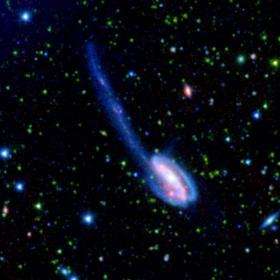
Start with lots and lots of dark matter, then stir in gas. Let the mixture sit for a while, and a galaxy should rise up out of the batter. This simple recipe for baking galaxies cannot be performed at home, but it does reflect what astronomers are learning about galaxy formation. Like baking bread with yeast, a mysterious substance in the universe called dark matter is required for a galaxy to grow.
Now, a new study from NASA's Spitzer Space Telescope is refining what is known about this essential ingredient of galaxies. It suggests that not only is dark matter necessary, but a minimum quantity of the material must be present before a galaxy can form. Any less would mean no galaxy -- the cosmic equivalent of a failed loaf of bread.
"Galaxies are born within huge clumps of dark matter," said Dr. Duncan Farrah of Cornell University, Ithaca, N.Y. "We are finding that these clumps seem to be remarkably consistent in size from galaxy to galaxy." Farrah is lead author of a paper describing this and other findings in a recent issue of Astrophysical Journal Letters.
As its names suggests, dark matter emits no light, so no conventional telescope can see it. So-called normal matter, which includes plants and people and all sorts of space objects, gives off electromagnetic radiation, or light. There is about five times more dark matter in the universe than normal matter.
Yet dark matter does have mass, which means that it can exert gravitational tugs on normal matter.
"Dark matter has gravity, so it pulls in more and more dark matter in addition to 'normal' gas," said co-author Dr. Jason Surace of NASA's Spitzer Science Center at the California Institute of Technology in Pasadena. "We know that the gas eventually condenses into the stars that make up galaxies, but the Spitzer study suggests that this doesn't happen until the dark matter has reached a critical mass."
Farrah and his colleagues used data from the Spitzer Wide-area Infrared Extragalactic survey to study hundreds of distant objects, called ultraluminous infrared galaxies, located billions of light-years away. These young galaxies are incredibly bright and filled with lots of dusty star-formation activity.
Initially, the researchers set out to better understand how the young galaxies and dark matter evolve and aggregate together into the giant clusters of mature galaxies that dominate our present-day universe. "You might think that galaxies are just distributed randomly across the sky, like throwing a handful of sand onto the floor," said Farrah. "But they are not, and the reason might be that the dark matter clumps around young galaxies are attracting each other like glue."
By determining how tightly the ultraluminous infrared galaxies had begun to bunch together, Farrah and his colleagues were able to indirectly measure how much dark matter "glue" was present. The tighter the grouping, the more dark matter there was. They did this calculation for two batches of galaxies at varying distances from Earth.
That's when they noticed something weird. For every galaxy they studied, no matter how far away, there seemed to be surrounding dark matter clumps of about the same size, the equivalent of 10 trillion solar masses. Because the astronomers did not find any galaxies coupled with less than 10 trillion solar masses of dark matter, they believe this quantity must be the minimum necessary for an ultraluminous infrared galaxy to form.
"These dark matter clumps might be like seeds that give birth to these distant galaxies," said Surace. "Similar galaxies in our nearby universe form in a completely different way, so what we are learning applies to a different epoch in our universe, far back in cosmic time."
Whether other types of galaxies might also arise in similar ways is an ongoing question in astronomy. Previous studies on highly energetic galaxies called quasars have hinted that those objects also require a minimum mass of dark matter to grow. Only in that case, the galaxies' starting "dough" wasn't quite as dense, about four to five trillion solar masses.
It seems astronomers will have to wait a bit longer before the universe gives up its best-kept family recipes.
Source: by Whitney Clavin, JPL, NASA


