What we Cannot Do Ourselves, we Cannot Understand in Others
Successful social communication is based, above all, on the ability to understand the actions of other people. But how can we imagine what other people are thinking, or what intentions they have? Psychologists and neuroscientists trace it back to a kind of simulation that goes on in our brain as soon as we observe a person acting. The actions of the observed person are, so-to-speak, internally imitated.
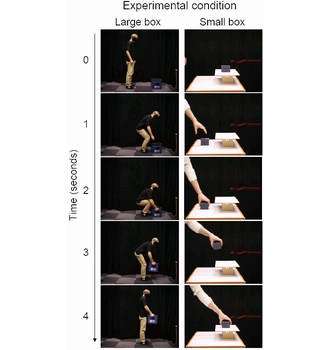
Image: Frames from the video footage: the experimental subjects are lifting boxes of various weights. Their faces are hidden, so that the patients and the control subjects can make their guess about the subject’s motions, uninfluenced by the facial expressions of the emotions portrayed by the actors (Max Planck Institute for Cognitive and Neurosciences)
Indeed, researchers at the Max Planck Institute for Cognitive and Neurosciences in Munich, in cooperation with scientists from the University of Bournemouth in England and Rutgers University in Newark, New Jersey, have shown that we understand the actions of another person, apparently, on the basis of our own "action inventory". In other words, our own mind and body give us the foundation to understand what other people are doing, thinking, or feeling. Evidence for this comes out of an experiment involving two patients that, because of an extremely rare illness, lost the ability to perceive their own body. (Nature Neuroscience, October 2005)
In the recently published study, Simone Bosbach and Wolfgang Prinz showed, with their colleagues, that two specific patients have deficits in their ability to interpret the actions of other people. These two patients are currently the only known cases worldwide with this kind of clinical picture. Its psychological consequences are dramatic. Both patients report that, at the beginning of their illness, most of all, they had the feeling that they had "lost" their entire body. Since then, they have learned to carry out simple body movements. However in order to do that they have to be able to see their body. In the dark, the patients lose complete control over their bodies, because they are no longer able to determine, for example, the position of their arms and legs relative to the body, with the help of the sensory receptor cells in the joints and muscles.
Normal people can do this without any problems, thanks to the self-perception of their own body (proprioceptive feedback). This self-perception also lets our brains know when, and in which range, muscles contract or expand, and to which extent joints bend or stretch. This sense makes us able to pose in certain body positions and to carry out movements, and it is also decisive for the psychological consciousness of having a body.
Bosbach and her colleagues confronted the patients with short video films in which people are asked to lift boxes. Each box was a different weight. Both patients were given the task, in the first part, of guessing the weight of the box that the person in the film was lifting. The patients received no other clues; they had to guess the weight of the box solely from the motion sequence of the lifter. It turned out that the patients were able to complete the task as correctly and unerringly as the control subjects. Apparently they were able solve the problem using their knowledge that, for example, a slow body movement signifies a heavy load and a faster movement, which gives the impression the subject was unloading something, suggests a lower weight.
In the second part of the task, the patients also saw videos of people who were lifting boxes. However, this time, in some cases, the people in the film were deceived about the actual weight of the boxes. So the actor, for example, received the information before lifting the box that he was lifting 18 kilograms - when indeed the box weighed only three. The patients then had to state whether the person in the video had the right or the wrong expectation regarding the weight of the box. Again, the only source of information for the patients to make their judgment was body movement. If the people in the film were deceived about the weight of the box, they tended to show a characteristic discrepancy in the movement, between the phases in which they prepared themselves to lift the box (expecting a heavy one) and the phase in which they were actually lifting the box (which was clearly lighter than expected). This discrepancy was not present when the person had a correct expectation of the weight.
In the second task, normal control subjects didn’t have a problem correctly evaluating the situation. The two patients, on the other hand, had great difficulties. They were notably poorer than the control subjects in determining whether the person in the video had guessed correctly the weight of the box correctly, or had been deceived.
Finally, in a further experiment the scientists inverted the task. They asked the patients themselves to lift boxes and filmed them while they did so. During the recording, in some cases, the patients were deceived about the weight of the box before they lifted it. Then, healthy control subjects had to judge, after they saw the video, whether the patient had expected the correct or the false weight. In this task, the control subjects failed, because the sequence of motion of the patient, in the case of the false expectations, did not show the characteristic discrepancy between the preparation for the movement and its carrying out. This means that the patients, because of their lack of self-perception, were unable to adjust their movements to their expectations of the weight of the box. In other words, the patients did not have the option to attune themselves to the weight of the box before trying to pick it up. For the same reason, they were not able to judge other people’s expectations based on their movement.
Models of movement, which are activated in the brain when we observe the actions of another person, hold information and knowledge about the way our own body functions. The possibilities and limitations of movement of our own body are the reference from which we process and interpret the actions of another person. In other words, we understand in others that which we can do ourselves, and what we cannot do ourselves, we cannot also understand in others. Feedback from our own bodies apparently plays a role in our intuitive knowledge of the intentions of other people. In this way, we can predict not only the consequences of other people’s actions, but we are able to "put ourselves in the position" of the other person. Such a mechanism is the basis for sympathy and empathy, and thus decisive for the success and continuity of social relationships.
Original work:
Bosbach, S., Cole, J., Prinz, W. & Knoblich, G.
Inferring another's expectation from action: the role of peripheral sensation
Nature Neuroscience online : 28 August 2005, Print-Version: Nature Neuroscience (2005), Vol. 8, 1295-1297
Source: Max Planck Society


