Researchers develop system to thwart unwanted video and still photography
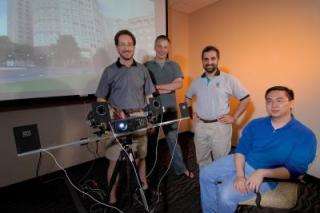
Researchers at the Georgia Institute of Technology have completed a prototype device that can block digital-camera function in a given area. Commercial versions of the technology could be used to stymie unwanted use of video or still cameras.
The prototype device, produced by a team in the Interactive and Intelligent Computing division of the Georgia Tech College of Computing (COC), uses off-the-shelf equipment – camera-mounted sensors, lighting equipment, a projector and a computer -- to scan for, find and neutralize digital cameras. The system works by looking for the reflectivity and shape of the image-producing sensors used in digital cameras.
Gregory Abowd, an associate professor leading the project, says the new camera-neutralizing technology shows commercial promise in two principal fields – protecting limited areas against clandestine photography or stopping video copying in larger areas such as theaters.
"We're at a point right now where the prototype we have developed could lead to products for markets that have a small, critical area to protect," Abowd said. "Then we're also looking to do additional research that could increase the protected area for one of our more interesting clients, the motion picture industry."
Abowd said the small-area product could prevent espionage photography in government buildings, industrial settings or trade shows. It could also be used in business settings -- for instance, to stop amateur photography where shopping-mall-Santa pictures are being taken.
James Clawson, a research technician on Abowd's prototype team, said preventing movie copying could be a major application for camera-blocking technology.
"Movie piracy is a $3 billion-a-year problem," Clawson maintains -- a problem said to be especially acute in Asia. "If someone videotapes a movie in a theater and then puts it up on the web that night or burns half a million copies to sell on the street – then the movie industry has lost a lot of in-theater revenue."
Moreover, movie theaters are likely to be a good setting for camera-blocking technology, said Jay Summet, a research assistant who is also working on the prototype. A camera's image sensor -- called a CCD -- is retroreflective, which means it sends light back directly to its origin rather than scattering it. Retroreflections would probably make it relatively easy to detect and identify video cameras in a darkened theater.
The current prototype uses visible light and two cameras to find CCDs, but a future commercial system might use invisible infrared lasers and photo-detecting transistors to scan for contraband cameras. Once such a system found a suspicious spot, it would feed information on the reflection's properties to a computer for a determination.
"The biggest problem is making sure we don't get false positives from, say, a large shiny earring," said Summet. "We need to make our system work well enough so that it can find a dot, then test to see if it's reflective, then see if it's retroreflective, and then test to see if it's the right shape."
Once a scanning laser and photodetector located a video camera, the system would flash a thin beam of visible white light directly at the CCD. This beam – possibly a laser in a commercial version – would overwhelm the target camera with light, rendering recorded video unusable.
Researchers say that energy levels used to neutralize cameras would be low enough to preclude any health risks to the operator.
Still camera neutralization in small areas also shows near-term commercial promise, Abowd said. Despite ambient light levels far higher than in a theater, still cameras at a trade show or a mall should be fairly easy to detect, he said. That's because image sensors in most cell phones and digital cameras are placed close to the lens, making them easier to spot than the deeper-set sensors of video cameras.
Camera neutralization's potential has helped bring it under the wing of VentureLab, a Georgia Tech group that assists fledgling companies through the critical feasibility and first-funding phases. Operating under the name DominINC, Abowd's company has already received a Phase 1 grant from the Georgia Research Alliance (GRA) with VentureLab assistance.
Abowd said that funding availability will likely decide which technology -- small- or large-area -- will be developed first. DominINC will apply soon for GRA Phase 2 money, Abowd said. Those funds would be used to aid anti-piracy product development, as would any funding coming from the film industry.
Other potential funding, from industry and elsewhere, would likely be used to develop anti-espionage small-area applications.
Stephen Fleming, Georgia Tech's chief commercialization officer, said motion-picture groups are actively looking for technology to foil piracy. Movie distributors might even promote camera-neutralizing systems by refusing to send films to theaters that don't install anti-piracy systems.
There are some caveats, according to Summet. Current camera-neutralizing technology may never work against single-lens-reflex cameras, which use a folding-mirror viewing system that effectively masks its CCD except when a photo is actually being taken. Moreover, anti-digital techniques don't work on conventional film cameras because they have no image sensor.
Good computer analysis will be the heart of effective camera blocking, Summet believes.
"Most of the major work that we have left involves algorithmic development," he said. "False positives will eliminated by making a system with fast, efficient computing."
Source: Georgia Institute of Technology


