Discovering How to Focus on Tiniest of the Very Small
June 19, 2006
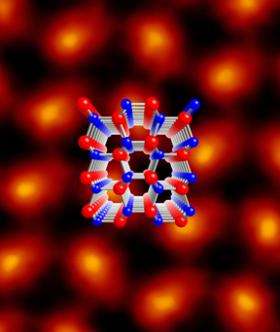
This image of a lattice crystal was captured by Cornell researchers using a scanning transmission electron microscope (STEM) at IBM. The yellow circles in the center of each pear-shaped molecule represent the stronger signal produced by a large atom; the red portions that make up the top of each pear shape show the weaker signal of the smaller atoms. The image allows researchers to see the orientation of the individual atoms within a crystal for the first time, thus giving researchers a vital tool for predicting the crystal's properties. A model of the molecular structure is superimposed on the image.
If you need a good picture of a molecule, your first job is getting its atoms to pose for you, says John Silcox, Cornell's David E. Burr Professor of Engineering and an expert in the realm of the very tiny.
But atoms are not willing subjects. They jiggle furiously, defying any microscopist who tries to catch them at a standstill. Nor are they polite: The larger atoms in a molecule typically overshadow the smaller ones, making it impossible to view the little ones.
Now, though, researchers at Cornell have developed a technique to get a closer-than-ever look at individual atoms within crystal molecules -- allowing them, for the first time, to see the polarity, or physical alignment, of those constituent atoms and to get a view of the smaller atoms.
The research -- by Cornell postdoctoral associate K. Andre Mkhoyan, Silcox and colleagues at Cornell, and Philip Batson of IBM -- is described in the June 2 issue of Science.
With the new technique, researchers can better predict the physical properties of a crystal at every point -- an advance that offers potential improvements in lasers and other devices, particularly at the nanoscale, where the structure of an individual molecule can determine a device's behavior.
To get their new and improved view, Mkhoyan's team used a scanning transmission electron microscope (STEM) at IBM on samples of aluminum nitride, gallium nitride and other crystals with particular significance in nanotechnology research, in a chamber padded and shielded to reduce potentially atom-jiggling acoustic noise and electromagnetic radiation. Fitting the STEM with an aberration corrector (a focusing device) developed at Nion Co., they directed a 0.9 angstroms-wide electron beam at tiny crystal samples, collecting the scattered electrons on a ring-shaped detector and forming an image based on the resulting scatter pattern. (An angstrom is one hundred-millionth of a centimeter). Because larger atoms deflect electrons at a larger angle than small ones, the resulting data is relatively simple to interpret.
Used on a sample of aluminum nitride, the technique, called annular dark imaging, shows pear-shaped molecule columns with the larger aluminum atoms at the thicker end and the smaller nitrogen atoms at the narrower end. It is the first time the smaller atoms in such a structure have been caught in an image.
The key, said Silcox, is the narrowness of the scanning electron beam.
"We're down to the atom size, as opposed to the atom spacing," said Silcox. "We can start to see the light atom columns; we can characterize the crystal very nicely and precisely, at every place on the structure."
Mkhoyan said the inability to capture such images in the past has been a huge hurdle for nanotechnology researchers.
"The study and application of these lattice crystals are at the core of nanotechnology. Many papers are dedicated to synthesis and application of the nanoparticles -- quantum dots, rods, wires, you name it -- based on these materials," he said. "However, the performance of the devices is highly dependent on the structural quality of these nanoparticles.
"With our STEM annular dark field imaging, we come to the rescue," Mkhoyan added. "We can zoom in, pick up any region of the structure, and see how it behaves."
Source: Cornell University
-
Researchers suspend, image single DNA molecules
Oct 31, 2011 |
4.5 / 5 (10) |
0
-
Watching nanosheets and molecules transform under pressure could lead to stronger materials
Oct 20, 2010 |
not rated yet |
0
-
Researchers are on the path to creating nano-MRI images
Dec 22, 2009 |
4.8 / 5 (10) |
1
-
New way to break some of the strongest chemical bonds
Dec 16, 2009 |
4.6 / 5 (24) |
0
-
Researcher discover two highly complex organic molecules detected in space
Apr 21, 2009 |
4.8 / 5 (16) |
10
-
Engineers build first sub-10-nm carbon nanotube transistor
Feb 01, 2012 |
4.9 / 5 (31) |
30
-
Something old, something new: Evolution and the structural divergence of duplicate genes
Jan 31, 2012 |
4.6 / 5 (7) |
1
-
The hidden nanoworld of ice crystals: Revealing the dynamic behavior of quasi-liquid layers
Jan 30, 2012 |
5 / 5 (3) |
1
-
Stock market network reveals investor clustering
Jan 27, 2012 |
3.9 / 5 (23) |
8
-
Of microchemistry and molecules: Electronic microfluidic device synthesizes biocompatible probes
Jan 26, 2012 |
5 / 5 (1) |
0
-
Liverpool vs Manchester United
1 hour ago
-
Wearing black in a desert
1 hour ago
-
Did space exist before mass?
1 hour ago
-
How can E&M Waves be polarized?
1 hour ago
-
Does light travel for ever?
2 hours ago
-
Infinity by Particles
3 hours ago
- More from Physics Forums - General Physics
More news stories
What lies beneath: Mapping hidden nanostructures
The ability to diagnose and predict the properties of materials is vital, particularly in the expanding field of nanotechnology. Electron and atom-probe microscopy can categorize atoms in thin sheets of material, ...
12 hours ago |
5 / 5 (1) |
1
New kind of solar cell could capture significantly more energy than current cells
New solar cells could increase the maximum efficiency of solar panels by over 25%, according to scientists from the University of Cambridge.
Feb 08, 2012 |
4.5 / 5 (12) |
14
|
Nanoshell whispering galleries improve thin solar panels
Visitors to Statuary Hall in the U.S. Capitol Building may have experienced a curious acoustic feature that allows a person to whisper softly at one side of the cavernous, half-domed room and for another on ...
Nanotechnology / Nanomaterials
Feb 07, 2012 |
4.3 / 5 (6) |
6
|
'Dark plasmons' transmit energy
Microscopic channels of gold nanoparticles have the ability to transmit electromagnetic energy that starts as light and propagates via "dark plasmons," according to researchers at Rice University.
Feb 09, 2012 |
5 / 5 (6) |
1
|
Revealing how a battery material works
Since its discovery 15 years ago, lithium iron phosphate (LiFePO4) has become one of the most promising materials for rechargeable batteries because of its stability, durability, safety and ability to deliver ...
Nanotechnology / Nanomaterials
Feb 08, 2012 |
5 / 5 (5) |
0
|
Google users warned of threat to smartphone wallets
Users of Google smartphone wallets were being warned on Friday that there is a way to crack pass codes intended to thwart thieves from going on illicit shopping sprees.
Anonymous knocks CIA website offline (Update)
The website of the Central Intelligence Agency was inaccessible on Friday after the hacker group Anonymous claimed to have knocked it offline.
Complex wiring of the nervous system may rely on a just a handful of genes and proteins
Researchers at the Salk Institute have discovered a startling feature of early brain development that helps to explain how complex neuron wiring patterns are programmed using just a handful of critical genes. ...
New error-correcting codes guarantee the fastest possible rate of data transmission
Error-correcting codes are one of the triumphs of the digital age. Theyre a way of encoding information so that it can be transmitted across a communication channel such as an optical fiber o ...
The power of estrogen -- male snakes attract other males
A new study has shown that boosting the estrogen levels of male garter snakes causes them to secrete the same pheromones that females use to attract suitors, and turned the males into just about the sexiest ...
Humans may have helped the decline of African rainforests 3000 years ago
(PhysOrg.com) -- Large areas of rainforests in Central Africa mysteriously disappeared over three thousand years ago, to be replaced by savannas. The prevailing theory has been that the cause was a change ...