Earliest hominid: Not a hominid at all?
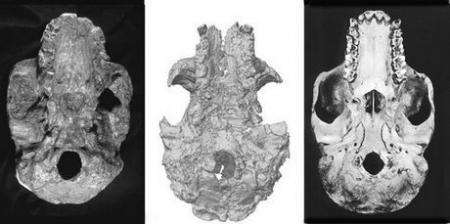
The earliest known hominid fossil, which dates to about 7 million years ago, is actually some kind of ape, according to an international team of researchers led by the University of Michigan. The finding, they say, suggests scientists should rethink whether we actually descended from apes resembling chimpanzees, which are considered our closest relatives.
U-M anthropologist Milford Wolpoff and colleagues examined images and the original paper published on the discovery of the Toumaï cranium (TM 266) or Sahelanthropus tchadensis, as well as a computer reconstruction of the skull. Two other colleagues were actually able to examine the skull, Wolpoff said, in addition to the images and the computer reconstruction.
The research team concluded that the cranium did not sit atop the spine but in front of it, indicating the creature walked on all fours like an ape. Hominids, he said, are distinguished from all other primates by walking upright. Hominids are everything on the line leading to humans after divergence with chimpanzees. Upright bipedalism is the single best way of identifying which fossils are hominids.
Researchers also examined the canine teeth and found that they were not clearly human or ape-like, but rather like most other canine fossils from the Miocene era.
"Whether or not it's a human ancestor is probably unimportant as far as the skull is concerned," Wolpoff said. "But it's very important in trying to understand where humans come from. It's the first relative we've had of the earliest hominid, or something related to it, but it's not a hominid at all."
Nor does the skull resemble a living chimpanzee—no fossil records of chimpanzees exist so it's impossible to compare to earlier descendents, Wolpff said. Genetic data puts the divergence of chimpanzees and humans at anywhere from 4 to 6 million years ago. Even though it's not a definite date, it makes it difficult to show a 7-million-year-old fossil is a hominid without overwhelming evidence, he said.
"The big message it sends us is our ancestors never looked like a chimpanzee," Wolpoff said. "This thing is clearly saying that chimpanzees are just as different from this ancestor as we are. They are just different in a different way."
Wolpoff said the skull could be a common ancestor of humans and living chimps.
"Now we have insight into what an early ape looked like, but we have no fossils of apes after it, so you can't tell clearly," he said.
Colleagues include John Hawks, Department of Anthropology of the University of Wisconsin, Madison; Brigitte Senut, Department Histoire de la Terre, Museum National d'Histoire Naturelle, Paleontology; Martin Pickford, chair of Paleoanthropologie et de Prehistoire, College de France; and James Ahern, Department of Anthropology, University of Wyoming, Laramie.
"Two people have seen it. We've all have seen pictures and read publications,"Wolpoff said. "It took us a long time to put this together because we wanted to make sure we were absolutely accurate."
Wolpoff expects that the paper, entitled "Ape or the Ape: Is the Toumai Cranium TM 266 a Hominid?" will be controversial. It was published Friday in a new online journal by the Paleoanthropology Society.
"I think some people are going to like it, and some people are going to hate it, but it will stimulate more discussion, which is important," Wolpoff said.
Source: University of Michigan


