Evidence for ultra-energetic particles in jet from black hole

June 20, 2006 C. Megan Urry

C. Megan Urry, Israel Munson Professor of Physics and Astronomy at Yale. Credit: Yale University

An international team of astronomers led by researchers at Yale has obtained key infrared observations that reveal the nature of quasar particle jets that originate just outside super-massive black holes at the center of galaxies and radiate across the spectrum from radio to X-ray wavelengths; a complementary study of jet X-ray emission led by astronomers at the University of Southampton, reaches the same conclusion.

Both studies involve the jet of the quasar 3C273, famous since its identification in 1963 as the first quasar. It now appears that the most energetic radiation from this jet arises through direct radiation from extremely energetic particles, and not in the way expected by most astronomers based on the previously available data. The two reports, available now online in the Astrophysical Journal, will appear in print in the September 10 issue.

"Quasar jets, although extremely luminous, are so distant as to be relatively faint and difficult to observe. Thanks to the sensitivity of NASA's Great Observatories, we have been able to map the 3C273 jet in infrared, visible light and X-rays," said C. Megan Urry, Israel Munson Professor of Physics and Astronomy at Yale, and an author on one study. "These combined data strongly suggest that ultra-energetic particles in the 3C273 jet are producing their light via synchrotron radiation."
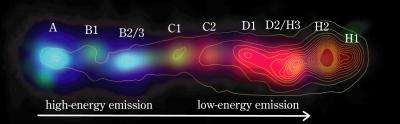
Composite false-color image of the quasar jet 3C273

Composite false-color image of the quasar jet 3C273, with emission from radio waves to X-rays extending over more than 100,000 light years. The black hole itself is to the left of the image. Colors indicate the wavelength region where energetic particles give off most of their energy: yellow contours show the radio emission, with denser contours for brighter emission (data from VLA); blue is for X-rays (Chandra); green for optical light (Hubble); and red is for infrared emission (Spitzer). The jet suddenly becomes very bright at A, where the high-energy X-ray emissions dominate; moving further away from the quasar, progressively lower-energy emissions dominate. Letters label individual jet features. Credit: Y. Uchiyama, M. Urry, H.-J. Rцser, R. Perley, S. Jester

There have been two competing theories of how emissions arise from the particles -- the "Inverse-Compton" theory proposing that the emissions occur when jet particles scatter cosmic microwave background photons, and the "Synchrotron Radiation" theory postulating a separate population of extremely energetic electrons or protons that cause the high-energy emission.

"The Yale team used the Spitzer Space Telescope to observe 3C273 because it is located in space and is more sensitive to faint infrared jet emission than any previous telescope," said Yasunobu Uchiyama, a team leader and former postdoctoral fellow at the Yale Center for Astronomy. Spitzer observations enabled the team, with collaborators at Stanford, University of Southampton, Goddard Space Flight Center, and the Brera Observatory in Milan, to determine the infrared spectrum for the first time and thus to realize its close connection to the X-ray emission.

Sebastian Jester, now at the University of Southampton, led a complementary study that used the Chandra X-ray Observatory. This team, with collaborators at MIT Kavli Institute for Astrophysics and Space Research and the Smithsonian Astrophysical Observatory (SAO) in Cambridge, MA, and at the Max Planck Institute for Astronomy in Heidelberg, obtained the first detailed study of energy distribution of X-rays from the jet, which also supported the synchrotron theory.

According to the researchers, while the lifetime of the X-ray producing particles is only about 100 years, the data indicate that the visibly brightest part of the jet has a length of about 100,000 light years. Since there would be insufficient time for the particles to shoot out from the black hole at close to the speed of light and then release their energy as radiation as far out as they are seen, the particles have to be accelerated locally, where they produce their emission.

Both teams also used data from the third of NASA's Great Observatories, the Hubble Space Telescope, and the radio telescopes of the Very Large Array (VLA). The three space telescopes and the VLA "see" emission of different wavelengths from celestial objects, and the combined data was essential to reveal the new comprehensive perspective on the jets.

"The new observations show that the flow structure of this jet is more complicated than had been assumed previously," Jester explains. "That the present evidence favors the synchrotron model deepens the mystery of how jets produce the ultra-energetic particles that radiate at X-ray wavelengths."

"Our results call for a radical rethink of the physics of relativistic jets that black holes drive," said Uchiyama. "But, we now have a crucial new clue to solving one of the major mysteries in high-energy astrophysics."

Source: Yale University


print this article email this article download pdf blog this article bookmark this article     Stumble it Digg this share on Facebook retweet share on Reddit add to delicious
Rate this story - 4.4 /5 (31 votes)


June 20, 2006 all stories

Comments: 0

4.4 /5 (31 votes)
  • Stumble this up

  • Digg this

  • share this

  • hide
  • Related Stories

  • A long night falls over Saturn's rings
    created Oct 24, 2009 | popularity not rated yet | comments 0
  • Cassini Reveals New Ring Quirks, Shadows During Saturn Equinox
    created Sep 21, 2009 | popularity not rated yet | comments 0
  • NASA's A-Train of satellites 'on track' with hurricane research
    created Aug 20, 2009 | popularity not rated yet | comments 0
  • Superfast airplanes through super tiny technology
    created Jul 13, 2009 | popularity not rated yet | comments 0
  • Scientists bid adieu to plucky solar probe
    created Jun 30, 2009 | popularity not rated yet | comments 0


  • hide
  • Relevant PhysicsForums posts

  • Semi-major axis from cartesian co-ordinates
    created 10 hours ago
  • Primary Mirror grinding
    created 12 hours ago
  • dark energy can escape black holes.
    created 21 hours ago
  • Are there green, purple and pink stars?
    created Nov 22, 2009
  • Sideral question
    created Nov 21, 2009
  • Doppler shifted blackbody spectrum
    created Nov 21, 2009
  • More from Physics Forums - General Astronomy

Other News

New computer-developed map shows more extensive valley network on Mars

New computer-developed map shows more extensive valley network on Mars

Space & Earth / Space Exploration

created 11 hours ago | popularity 4.6 / 5 (7) | comments 0

New research adds to the growing body of evidence suggesting the Red Planet once had an ocean.


Supervolcano eruption -- in Sumatra -- deforested India 73,000 years ago

Supervolcano eruption -- in Sumatra -- deforested India 73,000 years ago

Space & Earth / Earth Sciences

created 13 hours ago | popularity 4.3 / 5 (10) | comments 2

A new study provides "incontrovertible evidence" that the volcanic super-eruption of Toba on the island of Sumatra about 73,000 years ago deforested much of central India, some 3,000 miles from the epicenter, ...


Is global warming unstoppable?

Space & Earth / Environment

created 22 hours ago | popularity 3.9 / 5 (25) | comments 24

In a provocative new study, a University of Utah scientist argues that rising carbon dioxide emissions - the major cause of global warming - cannot be stabilized unless the world's economy collapses or society builds the ...


Spitzer Telescope Observes Baby Brown Dwarf

Spitzer Telescope Observes Baby Brown Dwarf

Space & Earth / Astronomy

created 10 hours ago | popularity 4.9 / 5 (8) | comments 0

(PhysOrg.com) -- NASA's Spitzer Space Telescope has contributed to the discovery of the youngest brown dwarf ever observed -- a finding that, if confirmed, may solve an astronomical mystery about how these ...


Scientist: Leak of climate e-mails appalling

Space & Earth / Environment

created 16 hours ago | popularity 3.2 / 5 (10) | comments 8

(AP) -- A leading climate change scientist whose private e-mails are included in thousands of documents that were stolen by hackers and posted online said Sunday the leaks may have been aimed at undermining next month's ...