Synchronising the Swarm
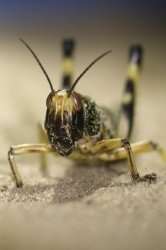
Models from theoretical physics, which are normally used to plot the motion of particles, are beginning to shed light upon the mass migration of living organisms as well. These include swarms of locusts, which begin to migrate as wingless juveniles or nymphs and often devastate crops in sub-Saharan Africa and Asia.
Oxford zoologists have described in the journal Science how they employed a mathematical model to reveal the densities at which the swarms first fix upon one direction of migration.
Dr David Sumpter, from the Zoology Department, said: ‘The key to the control of these swarms is better understanding how they form. We showed that at a critical density these insects will spontaneously adopt a common direction of travel. This transition to ordered motion could explain the often sudden emergence of hopper bands in Africa.’
The zoologist and his colleagues discovered that when a swarm contains between 25 and 74 locusts per square metre, the locusts are almost always aligned but exhibit rapid and spontaneous changes in direction. There were almost no directional changes above that range of densities.
‘The study is one of the first examples of an animal group dramatically changing its behaviour as it reaches a critical mass,’ said Dr Sumpter. ‘By drawing a parallel between locusts and the behaviour of physical systems, we showed that the complex dynamics of moving animal groups can be captured by a very simple mathematical model.
‘The model, which was based on the alignment of ‘self-propelled particles’ (SPPs), predicted unstable switching of group direction. We observed such switching in the laboratory, possibly explaining the highly unpredictable collective motion of locusts in the field. Since SPP models underlie many theoretical predictions about how groups form complex patterns, avoid predators, forage, and make decisions, these results have fundamental implications for how we understand all aspects of the motion of animal groups.’
Source: University of Oxford


