Scientists find the reason behind black holes' light shows
June 21, 2006
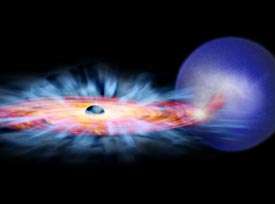
Black holes grow by drawing gas from nearby objects such as stars into an accretion disk. Credit: NASA/CXC/M.Weiss
A team of astronomers led by the University of Michigan may know how black holes are lighting up the Universe. New data from NASA's Chandra X-ray Observatory show, for the first time, that powerful magnetic fields are the key to these brilliant and startling light shows.
It is estimated that up to half of the total radiation in the universe since the Big Bang comes from material falling towards super-massive black holes, including those powering quasars, the brightest known objects. For decades, scientists have struggled to understand how black holes, the darkest objects in the Universe, can generate such prodigious amounts of radiation.
New X-ray data from Chandra give the first clear explanation for what drives this process: magnetic fields. Chandra observed a black hole system in our galaxy, known as GRO J1655-40 (J1655, for short), where a black hole was pulling material from a companion star into a disk.
"By intergalactic standards, J1655 is in our backyard so we can use it as a scale model to understand how all black holes work, including the monsters found in quasars," said Jon Miller, assistant professor at U-M, whose paper on these results appears in this week's issue of the journal Nature.
If gas in a disk around a black hole loses energy, it will swirl toward the black hole, generating light along the way. Scientists have long thought that magnetic fields may drive this energy loss by generating friction in the gas and driving a wind from the disk that carries momentum outward, in an example of conservation of momentum.
By using Chandra spectra, that is, the amount of X-rays at different energies, Miller and his team showed that the speed and density of the wind from the disk in J1655 corresponded to computer simulation predictions for winds driven by magnetic fields. The spectral fingerprint also ruled out the two other major competing theories to magnetically-driven winds.
"In 1973, theorists came up with the idea that magnetic fields could drive the generation of light by black holes," said co-author John Raymond of the Harvard-Smithsonian Center for Astrophysics (CfA) in Cambridge, Mass. "Now, over 30 years later, we finally may have proof."
This deeper understanding of how black holes accrete matter also teaches astronomers about other properties of black holes, including how they grow.
"Just as a doctor wants to understand the causes of an illness and not merely the symptoms, astronomers try to understand what causes phenomena they see in the Universe," said co-author Danny Steeghs also of the CfA. "By understanding what makes material fall onto black holes and its energy released, we may also learn how it plunges onto other important objects."
In addition to accretion disks around black holes, magnetic fields may play an important role in disks detected around young Sun-like stars where planets are forming as well as ultra-dense objects called neutron stars.
Source: University of Michigan
-
Black hole jets
Jan 16, 2012 |
4.6 / 5 (7) |
6
-
Radio stars: Caltech's astronomy professor searches for cosmic radio waves
Feb 03, 2012 |
not rated yet |
0
-
Can solar flares hurt astronauts?
Jan 24, 2012 |
4.7 / 5 (3) |
0
-
Exploring space burps
Jan 16, 2012 |
4.1 / 5 (10) |
7
-
NASA's Rossi X-Ray Timing Explorer completes mission operations
Jan 09, 2012 |
not rated yet |
0
-
Engineers build first sub-10-nm carbon nanotube transistor
Feb 01, 2012 |
4.9 / 5 (31) |
30
-
Something old, something new: Evolution and the structural divergence of duplicate genes
Jan 31, 2012 |
4.6 / 5 (7) |
1
-
The hidden nanoworld of ice crystals: Revealing the dynamic behavior of quasi-liquid layers
Jan 30, 2012 |
5 / 5 (3) |
1
-
Stock market network reveals investor clustering
Jan 27, 2012 |
3.9 / 5 (23) |
8
-
Of microchemistry and molecules: Electronic microfluidic device synthesizes biocompatible probes
Jan 26, 2012 |
5 / 5 (1) |
0
-
Never ending outer space.....
3 hours ago
-
Neutron Star fragments?
5 hours ago
-
stationary or not?
9 hours ago
-
Scale of the Universe
Feb 10, 2012
-
Titan's lack of impact craters
Feb 09, 2012
-
Real pictures of black hole eating a star?
Feb 08, 2012
- More from Physics Forums - General Astronomy
More news stories
Europe stakes billion-dollar bet on new rocket
A pencil-slim rocket is scheduled to lift into space from South America on Monday, carrying a billion-dollar bet that Europe can grab a juicy slice of the market to place satellites in low orbit.
Space & Earth / Space Exploration
16 hours ago |
3.5 / 5 (2) |
0
Political leaders play key role in how worried Americans are by climate change: study
More than extreme weather events and the work of scientists, it is national political leaders who influence how much Americans worry about the threat of climate change, new research finds.
Feb 06, 2012 |
5 / 5 (6) |
72
NASA budget will axe Mars deal with Europe: scientists
US President Barack Obama's budget proposal to be submitted next week for 2013 will cut NASA's budget by 20 percent and eliminate a major partnership with Europe on Mars exploration, scientists said Thursday.
Space & Earth / Space Exploration
Feb 10, 2012 |
5 / 5 (3) |
48
Humans may have helped the decline of African rainforests 3000 years ago
(PhysOrg.com) -- Large areas of rainforests in Central Africa mysteriously disappeared over three thousand years ago, to be replaced by savannas. The prevailing theory has been that the cause was a change ...
Could Venus be shifting gear?
(PhysOrg.com) -- ESAs Venus Express spacecraft has discovered that our cloud-covered neighbour spins a little slower than previously measured. Peering through the dense atmosphere in the infrared, the ...
Space & Earth / Space Exploration
Feb 10, 2012 |
5 / 5 (8) |
10
|
Walney offshore wind farm is world's biggest (for now)
(PhysOrg.com) -- The Walney wind farm on the Irish Sea--characterized by high tides, waves and windy weather--officially opened this week. The farm is treated in the press as a very big deal as the Walney ...
GPS court ruling leaves US phone tracking unclear
A US Supreme Court decision requiring a warrant to place a GPS device on the car of a criminal suspect leaves unresolved the bigger issue of police tracking using mobile phones, legal experts say.
Europeans protest controversial Internet pact
Tens of thousands of people marched in protests in more than a dozen European cities Saturday against a controversial anti-online piracy pact that critics say could curtail Internet freedom.
Study finds that anti-diabetic medication can prevent the long-term effects of maternal obesity
In a study to be presented today at the Society for Maternal-Fetal Medicine's annual meeting, The Pregnancy Meeting, in Dallas, Texas, researchers will report findings that show that short therapy with the anti-diabetic medication ...
Netflix settlement trims 14 pct off 4Q earnings
(AP) -- Netflix pressed the rewind button on its fourth-quarter earnings after settling allegations that the video subscription service violated a consumer-privacy law.
Navy to begin tests on electromagnetic railgun prototype launcher
The Office of Naval Research (ONR)'s Electromagnetic (EM) Railgun program will take an important step forward in the coming weeks when the first industry railgun prototype launcher is tested at a facility ...