The Da Vinci Glow
October 6, 2005
Five hundred years ago, Leonardo Da Vinci solved an ancient astronomical riddle: the mystery of Earthshine.
When you think of Leonardo Da Vinci, you probably think of the Mona Lisa or 16th-century submarines or, maybe, a certain suspenseful novel. That's old school. From now on, think of the Moon.
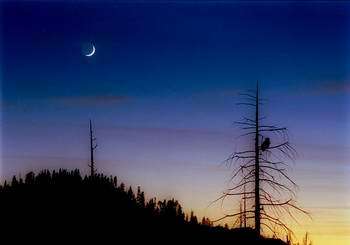
Image: A crescent moon with Earthshine over Yosemite National Park in October 2004. Photo credit: Andy Skinner.
Little-known to most, one of Leonardo's finest works is not a painting or an invention, but rather something from astronomy: He solved the ancient riddle of Earthshine.
You can see Earthshine whenever there's a crescent Moon on the horizon at sunset. Thursday, Oct. 6, is a good night: sky map. Look between the horns of the crescent for a ghostly image of the full Moon. That's Earthshine.
For thousands of years, humans marveled at the beauty of this "ashen glow," or "the old Moon in the new Moon's arms." But what was it? No one knew until the 16th century when Leonardo figured it out.
In 2005, post-Apollo, the answer must seem obvious. When the sun sets on the Moon, it gets dark--but not completely dark. There's still a source of light in the sky: Earth. Our own planet lights up the lunar night 50 times brighter than a full Moon, producing the ashen glow.
Visualizing this in the 1500s required a wild kind of imagination. No one had ever been to the Moon and looked "up" at Earth. Most people didn't even know that Earth orbited the sun. (Copernicus' sun-centered theory of the solar system wasn't published until 1543, twenty-four years after Leonardo died.)
Wild imagination was one thing Leonardo had in abundance. His notebooks are filled with sketches of flying machines, army tanks, scuba gear and other fantastic devices centuries ahead of their time. He even designed a robot: an armored knight that could sit up, wave its arms, and move its head while opening and closing an anatomically correct jaw.
To Leonardo, Earthshine was an appealing riddle. As an artist, he was keenly interested in light and shadow. As a mathematician and engineer, he was fond of geometry. All that remained was a trip to the Moon. It was a mental journey:
In Leonardo's Codex Leicester, circa 1510, there is a page entitled "Of the Moon: No Solid Body is Lighter than Air." He states his belief that the Moon has an atmosphere and oceans. The Moon was a fine reflector of light, Leonardo believed, because it was covered with so much water. As for the "ghostly glow," he explained, that was due to sunlight bouncing off Earth's oceans and, in turn, hitting the Moon.
He was wrong about two things:
First, the Moon has no oceans. When Apollo 11 astronauts landed at the Sea of Tranquility, they stepped out onto rock. Lunar "seas" are made of ancient hardened lava, not water.
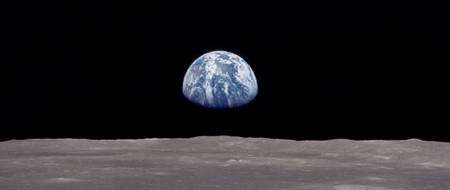
Image: A picture of Earth taken by Apollo 11 astronauts. From the Moon, Earth is 4 times wider than the sun and about 50 times brighter than a full Moon.
Second, Earth's oceans are not the primary source of Earthshine. Clouds are. Earth shines because it reflects sunlight, and clouds do most of the reflecting. When Apollo astronauts looked at Earth, the oceans were dark and the clouds were bright.
But these are quibbles. Leonardo understood the basics well enough.
In the decades ahead, humans are going to travel in person where Leonardo's imagination went 500 years ago. NASA plans to send astronauts back to the Moon no later than the year 2018. Unlike Apollo astronauts, who stayed for a few days at most, these new explorers will remain on the Moon for weeks and months. In the process, they'll experience something Apollo astronauts never did: nightfall. A lunar "day" is 29.5 Earth-days long: about 15 Earth-days of light, followed by 15 Earth-days of darkness. Apollo astronauts always landed in daylight and took off again before sunset. Because of the bright sun, they never saw the soft glow of Earthshine at their feet. But the next generation of astronauts will.
And just maybe, on a late-night stroll behind the outpost, guided by the soft light of Earth, one of them will bend over and scratch something in the moondust:
"Leonardo was here."
Source: Science@NASA (by Dr. Tony Phillips)
-
Huge chest of drawers hoisted aboard space station
Aug 31, 2009 |
4.3 / 5 (3) |
0
-
Crescent Moon Alert
Apr 07, 2008 |
4.1 / 5 (25) |
1
-
Space Tourism to Rocket in 21st Century, Researchers Predict
Feb 22, 2008 |
4 / 5 (6) |
0
-
Physicists detail Earthshine's role in planet hunting and climate variables
May 19, 2006 |
5 / 5 (3) |
0
-
China unveils high resolution global moon map
8 hours ago |
4.5 / 5 (4) |
0
-
Engineers build first sub-10-nm carbon nanotube transistor
Feb 01, 2012 |
4.9 / 5 (30) |
30
-
Something old, something new: Evolution and the structural divergence of duplicate genes
Jan 31, 2012 |
4.6 / 5 (7) |
1
-
The hidden nanoworld of ice crystals: Revealing the dynamic behavior of quasi-liquid layers
Jan 30, 2012 |
5 / 5 (3) |
1
-
Stock market network reveals investor clustering
Jan 27, 2012 |
3.9 / 5 (23) |
8
-
Of microchemistry and molecules: Electronic microfluidic device synthesizes biocompatible probes
Jan 26, 2012 |
5 / 5 (1) |
0
More news stories
New views show old NASA Mars landers
(PhysOrg.com) -- The High Resolution Imaging Science Experiment (HiRISE) camera on NASA's Mars Reconnaissance Orbiter recorded a scene on Jan. 29, 2012, that includes the first color image from orbit showing ...
Space & Earth / Space Exploration
20 hours ago |
4.9 / 5 (7) |
8
|
Deconstructing a mystery: What caused Snowmaggedon?
In the quiet after the storms, streets and cars had all but disappeared under piles of snow. The U.S. Postal Service suspended service for the first time in 30 years. Snow plows struggled to push the evidence ...
Space & Earth / Earth Sciences
12 hours ago |
4.7 / 5 (3) |
1
|
Black holes and star formation
(PhysOrg.com) -- It has long been recognized that galaxy mergers or even close interactions can play a vital role in shaping the morphology of galaxies. One way they can do so, it is thought, is by triggering ...
19 hours ago |
4.1 / 5 (7) |
5
|
Ocean microbe communities changing, but long-term environmental impact is unclear
As oceans warm due to climate change, water layers will mix less and affect the microbes and plankton that pump carbon out of the atmosphere but researchers say it's still unclear whether these processes ...
Space & Earth / Earth Sciences
14 hours ago |
5 / 5 (2) |
2
|
Researchers create 3-D laser maps that show how earthquake changes landscape
Geologists have a new tool to study how earthquakes change the landscape down to a few inches, and it's giving them insight into how earthquake faults behave. In the Feb. 10 issue of the journal Science, a team ...
Space & Earth / Earth Sciences
14 hours ago |
5 / 5 (4) |
0
|
'Dark plasmons' transmit energy
Microscopic channels of gold nanoparticles have the ability to transmit electromagnetic energy that starts as light and propagates via "dark plasmons," according to researchers at Rice University.
FDA-approved drug rapidly clears amyloid from the brain, reverses Alzheimer's symptoms in mice
Neuroscientists at Case Western Reserve University School of Medicine have made a dramatic breakthrough in their efforts to find a cure for Alzheimer's disease. The researchers' findings, published in the journal Science, show t ...
Hydrogen from acidic water: Researchers develop potential low cost alternative to platinum for splitting water
A technique for creating a new molecule that structurally and chemically replicates the active part of the widely used industrial catalyst molybdenite has been developed by researchers with the Lawrence Berkeley ...
Ultraviolet protection molecule in plants yields its secrets
Lying around in the sun all day is hazardous not just for humans but also for plants, which have no means of escape. Ultraviolet (UV) radiation from the sun can damage proteins and DNA inside cells, leading ...
Soraa LED light may dim 50-watt halogen rivals
(PhysOrg.com) -- Soraa, a Fremont, California company founded in 2008, this week launched its first product, a light that uses LEDS (light emitting diodes). The "Soraa LED MR16 lamp" is the "perfect" replacement ...
Anyone can learn to be more inventive, cognitive researcher says
There will always be a wild and unpredictable quality to creativity and invention, says Anthony McCaffrey, a cognitive psychology researcher at the University of Massachusetts Amherst, because an "Aha moment" is rare and ...