Robotic fish in action at London Aquarium
October 6, 2005
Robotic fish in action at Aquarium

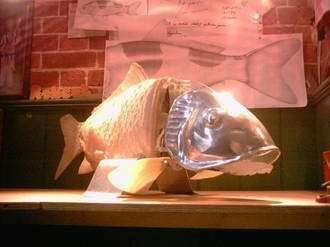
There may be a different fish to see for every day of the year at the London Aquarium at County Hall, but there’s a new variety that has never swum any of the world’s oceans. From 6 October the Aquarium’s unique robotic fish will be swimming in a specially-designed tank, open to the public for the first time ever.

Three stunningly beautiful robotic fish have been created with jewel-bright scales and sinuous, astonishingly life-like movements. They have been produced by Professor Huosheng Hu and his human-centred robotics team of the Department of Computer Science at the University of Essex.

Professor Hu’s team have been working with the London Aquarium for three years to develop a biologically inspired robotic fish which mimic the undulating movement of nature’s fish species – aiming for the speed of the tuna; the acceleration of a pike, and the navigating skill of the eel.

The robotic fish have sensor-based controls and autonomous navigation capabilities – they can find their own way around the tank safely, avoiding the objects, and react to their environment. The results of years of painstaking work can now been seen in freshwater tanks next to the London Aquarium’s Atlantic tanks.

Professor Hu is an expert in the field of robotics and was the mastermind behind the Essex robotic football team who won the 3rd prize in the RoboCup simulation league in 1999. The robotics group at Essex is one of the largest in the UK and is at the cutting edge of research into human-centred robotics.

According to Professor Hu, the aim of the project is to bring the public in direct contact with robots, increasing their understanding of science and technology: 'This work has many real-world applications including seabed exploration, detecting leaks in oil pipelines, mine countermeasures, and improving the performance of underwater vehicles.'

The Aquarium’s marine experts have worked with the robotics team to share their knowledge of the behaviour and movement of a wide variety of fish, and have provided the facilities within the Aquarium for the robotics team to study many species in great detail.

'Our robotic fish are really wonderful to look at and very entertaining. It’s amazing how beautiful and graceful their movements are – they’re going to be incredibly popular with our visitors,' Foster Archer, Director of the London Aquarium said.

Source: University of Essex

4.2 /5 (9 votes)  

Rank 4.2 /5 (9 votes)
Tags

Related Stories
Relevant PhysicsForums posts

More news stories

Google to make home entertainment system: report

Google will mirror Apple's winning hardware-software formula with an Android-powered entertainment system that wirelessly streams content through homes, the Wall Street Journal reported on Thursday.

Electronics / Consumer & Gadgets

created 4 hours ago | popularity 4.5 / 5 (2) | comments 0

New Kindle Touch is an impressive e-reader

When it comes to reading digital books, tablets are all the rage. But there's a lot to like about simple e-readers, which over the past year have become both a lot cheaper and a lot less clunky.

Electronics / Consumer & Gadgets

created 10 hours ago | popularity 5 / 5 (2) | comments 1

Apple to debut 'iPad 3' in March: report

Apple will unveil a new version of its market-ruling iPad table computer in March, according to a report in Dow Jones-owned technology blog All Things D.

Electronics / Consumer & Gadgets

created 11 hours ago | popularity 2.1 / 5 (18) | comments 0

Barriers fall between TV, Internet

You say TV, I say Internet. Toe-mate-o, toe-mah-to.

Electronics / Consumer & Gadgets

created 7 hours ago | popularity not rated yet | comments 0

Google rumored to have built Heads-Up-Display glasses prototype

(PhysOrg.com) -- 9to5Google is reporting that they have received a tip from someone they believe to be a reliable source saying that Google is working on a Heads-Up-Display (HUD) pair of eye-glasses. The per ...

Electronics / Consumer & Gadgets

created Feb 08, 2012 | popularity 4.3 / 5 (8) | comments 2 | with audio podcast weblog


'Dark plasmons' transmit energy

Microscopic channels of gold nanoparticles have the ability to transmit electromagnetic energy that starts as light and propagates via "dark plasmons," according to researchers at Rice University.

Hydrogen from acidic water: Researchers develop potential low cost alternative to platinum for splitting water

A technique for creating a new molecule that structurally and chemically replicates the active part of the widely used industrial catalyst molybdenite has been developed by researchers with the Lawrence Berkeley ...

Ultraviolet protection molecule in plants yields its secrets

Lying around in the sun all day is hazardous not just for humans but also for plants, which have no means of escape. Ultraviolet (UV) radiation from the sun can damage proteins and DNA inside cells, leading ...

FDA-approved drug rapidly clears amyloid from the brain, reverses Alzheimer's symptoms in mice

Neuroscientists at Case Western Reserve University School of Medicine have made a dramatic breakthrough in their efforts to find a cure for Alzheimer's disease. The researchers' findings, published in the journal Science, show t ...

Anyone can learn to be more inventive, cognitive researcher says

There will always be a wild and unpredictable quality to creativity and invention, says Anthony McCaffrey, a cognitive psychology researcher at the University of Massachusetts Amherst, because an "Aha moment" is rare and ...

Cell biologists describes mechanism by which some people may be more susceptible to colon cancer

An international research team led by cell biologists at the University of California, Riverside has uncovered a new insight into colon cancer, the third leading cause of cancer-related deaths in the United ...