Researchers reveal insights on silicon semiconductors
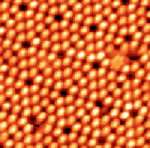
June 23rd, 2006 7x7 Si (111) reconstruction

7x7 Si (111) reconstruction

"Smaller. Faster. Wildly complex." This could easily be the motto for semiconductors-the materials that, among lots of other advances in electronics, allow cell phones to continuously shrink in size while increasing the number of their mind-boggling functions.

While exceptionally tiny, semiconductors possess the ability to enable a multitude of complex functions, making them an invaluable ingredient in electronics technology. But, while the computer age is in full bloom, knowledge of semiconductor nanostructures is still relatively young; and research seeking to answer essential and sometimes-basic materials questions is occurring at breakneck speed.

As part of this race to understand semiconductors better, a team of researchers from the University of Wisconsin-Madison has revealed valuable information about silicon and it's surface structure. In particular, the researchers, who did much of their work at the Synchrotron Radiation Center, examined the inimitable 7 x 7 surface structure of Si(111), the most stable surface of silicon.

"Surfaces and interfaces dominate in today's silicon devices, since the surface to volume ratio goes up in small structures. These two-dimensional structures are difficult to study, and the SRC work explores an aspect that has remained unexplored on semiconductors so far," says physicist Ingo Barke, who, along with UW-Madison collaborators, published results in a June 2006 issue of Physical Review Letters.

"Our results reveal a very unusual surface band structure, which can be best explained by a mechanism called 'electron-phonon interaction,'" Barke continues. "Phonons are vibrations of the atoms, which are surrounded by electrons. By shaking the surface atoms the orbiting electrons 'feel' these vibrations and change their movement in a characteristic way. Our work connects two intensively studied fields: electron-phonon interaction which causes conventional superconductivity, and semiconductor surfaces which are of great importance for electronic devices and semiconductor technology."

While similar research has been done on metal surfaces, the current study is the first example of such examination on a semiconductor surface. History has shown that these interesting jumps in basic knowledge about materials such as semiconductors can have significant practical impacts down the road-and this is particularly true in the case of silicon, which itself has become so inextricably important in modern society that it is credited with its own "silicon age."

"Electron-phonon interaction itself is of great scientific and practical interest because it is the key mechanism for conventional superconductivity," Barke notes, adding that the ultimate goal lies in the possibility of tailoring materials for a new generation of "designer superconductors."

Source: University of Wisconsin


print this article email this article download pdf blog this article bookmark this article     Digg this Stumble it share on Facebook share on Reddit add to delicious save to Yahoo! bookmarks
4.2/5 after 22 votes


June 23rd, 2006 all stories
Physics / Condensed Matter

Comments: 0
Rank: 4.2/5 after 22 votes

  • Stumble this up

  • Digg this

  • Share it:
  • share on Facebook
  • share on MySpace
  • share on Slashdot
  • rss-newsfeed
  • share on Google
  • share on Reddit
  • add to delicious
  • save to Yahoo! bookmarks
  • share on Windows Live
  • Add to Mixx!
Rating: 4.2/5 after 22 votes

  • Related Stories

  • Researchers discover new fluorescent silicon nanoparticles
    created Jun 30, 2009 | popularity not rated yet | comments 0
  • Fitting squares into circles
    created Jun 25, 2009 | popularity not rated yet | comments 0
  • A promising niche for nanotech
    created Jun 24, 2009 | popularity not rated yet | comments 0
  • New exotic material could revolutionize electronics
    created Jun 15, 2009 | popularity not rated yet | comments 0
  • Researchers create freestanding nanoparticle films without fillers
    created Jun 09, 2009 | popularity not rated yet | comments 0

Tags


  • Physicists Demonstrate Quantum Memory with Matter Qubits
    Physicists Demonstrate Quantum Memory with Matter Qubits
    Physics / General Physics
    created Jul 03, 2009 | popularity 4.4 / 5 (17) | comments 1
  • 'Holey' Nanosheets for Wastewater Dye Removal
    Nanotechnology / Nanomaterials
    created Jul 01, 2009 | popularity 5 / 5 (5) | comments 1
  • Jellyfish Robot Swims Like its Biological Counterpart
    Jellyfish Robot Swims Like its Biological Counterpart
    Electronics / Robotics
    created Jun 26, 2009 | popularity 4.4 / 5 (8) | comments 1
  • Could Maxwell's Demon Exist in Nanoscale Systems?
    Could Maxwell's Demon Exist in Nanoscale Systems?
    Physics / General Physics
    created Jun 24, 2009 | popularity 4.4 / 5 (18) | comments 29
  • Living Safely with Robots, Beyond Asimov's Laws
    Living Safely with Robots, Beyond Asimov's Laws
    Electronics / Robotics
    created Jun 22, 2009 | popularity 4.6 / 5 (53) | comments 40
  • Other News

    UQ researchers break the law -- of physics

    Physics / General Physics

    created 4 hours ago | popularity 4.6 / 5 (8) | comments 0

    (PhysOrg.com) -- Two UQ Science researchers have proved two famous physical laws that have been widely used for the past 25 years do not always work.


    Scientists create first electronic quantum processor

    Scientists create first electronic quantum processor

    Physics / General Physics

    created Jun 28, 2009 | popularity 4.8 / 5 (54) | comments 41

    A team led by Yale University researchers has created the first rudimentary solid-state quantum processor, taking another step toward the ultimate dream of building a quantum computer.


    Science journals

    How to Spot an Influential Paper Based on its Citations

    Physics / General Physics

    created Jul 04, 2009 | popularity 3.9 / 5 (10) | comments 6

    (PhysOrg.com) -- At first it may seem that the number of citations received by a published scientific paper is directly related to that paper's quality of content. The higher the quality, the more people read ...


    Fermilab's CDF observes Omega-sub-b baryon

    Fermilab's CDF observes Omega-sub-b baryon

    Physics / General Physics

    created Jun 29, 2009 | popularity 4.7 / 5 (18) | comments 7

    (PhysOrg.com) -- At a recent physics seminar at the Department of Energy’s Fermi National Accelerator Laboratory, Fermilab physicist Pat Lukens of the CDF experiment announced the observation of a new particle, ...


    New insights, and a new angle, on high-temperature superconductivity

    New insights, and a new angle, on high-temperature superconductivity

    Physics / Superconductivity

    created Jun 29, 2009 | popularity 4.9 / 5 (14) | comments 7

    (PhysOrg.com) -- A Princeton-led research team has revealed surprising information about how electron behavior influences the conduction of electricity in a class of high-temperature superconductors. An increased ...