Titan's Enigmatic Infrared-Bright Spot Is Surface Make-Up
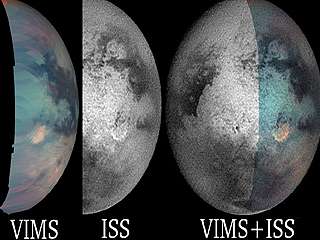
October 6th, 2005 ombined VIMS and ISS images of Titan's mysterious bright red spot gives researchers more information about the feature than eith

A 300-mile-wide patch that outshines everything else on Titan at long infrared wavelengths appears not to be a mountain, a cloud or a geologically active hot spot, University of Arizona scientists and Cassini team members say.

Image: Combined VIMS and ISS images of Titan's mysterious bright red spot gives researchers more information about the feature than either single view. (Credit: NASA/JPL/University of Arizona/Space Science Institute)

"We must be looking at a difference in surface composition," said Jason W. Barnes, a postdoctoral researcher at UA's Lunar and Planetary Lab. "That's exciting because this is the first evidence that says not all of the bright areas on Titan are the same. Now we have to figure out what those differences are, what might have caused them."

When NASA's Cassini spacecraft flew by Titan on March 31 and again on April 16, its visual and infrared mapping spectrometer saw a feature that was spectacularly bright at 5-micron wavelengths just southeast of the continent-sized region called Xanadu.

The bright spot occurs where Cassini's visible-wavelength imaging cameras photographed a bright arc-shaped feature approximately the same size in December 2004 and February 2005.

Cassini's radar instrument, operating in the "passive" mode that is sensitive to microwaves emitted from a planetary surface, saw no temperature difference between the bright spot and surrounding region. That rules out the possibility that the 5-micron bright spot is a hot spot, such as a geologically active ice volcano, Barnes said.

Cassini microwave radiometry also failed to detect a temperature drop that would show up if some two-mile high mountain rose from Titan's surface, he said.

And if the 5-micron bright spot is a cloud, it's a cloud that hasn't moved or changed shape for three years, according to ground-based observations made at the Keck Telescope and with Cassini's visual and infrared mapping spectrometer during five different flybys. "If this is a cloud," Barnes said, "it would have to be a persistent ground fog, like San Francisco on steroids, always foggy, all the time."

"The bright spot must be a patch of surface with a composition different from anything we've seen yet. Titan's surface is primarily composed of ice. It could be that something is contaminating the ice here, but what this might be is not clear," Barnes said.

"There's a lot left to explore about Titan. It's a very complex, exciting place. It's not obvious how it works. It's going to be a lot of fun over the next couple of years figuring out how Titan works," he said.

Barnes and 34 other scientists report the research in the Oct. 7 issue of Science. Authors include UA Lunar and Planetary Laboratory scientists and Cassini team members Robert H. Brown, head of Cassini's visual and infrared mapping spectrometer team; Elizabeth P. Turtle and Alfred S. McEwen of the Cassini imaging team; Ralph D. Lorenz of the Cassini radar team; Caitlin Griffith of the Cassini visual and infrared mapping team; and Jason Perry and Stephanie Fussner, who work with McEwen and Turtle on Cassini imaging.

Source: University of Arizona


print this article email this article download pdf blog this article bookmark this article     Digg this Stumble it share on Facebook share on Reddit add to delicious save to Yahoo! bookmarks
5/5 after 2 votes


October 6th, 2005 all stories
Space & Earth /

Comments: 0
Rank: 5/5 after 2 votes

  • Stumble this up

  • Digg this

  • Share it:
  • share on Facebook
  • share on MySpace
  • share on Slashdot
  • rss-newsfeed
  • share on Google
  • share on Reddit
  • add to delicious
  • save to Yahoo! bookmarks
  • share on Windows Live
  • Add to Mixx!
Rating: 5/5 after 2 votes

  • Related Stories

  • Hot Cyclones Churn at Both Ends of Saturn
    created Jan 04, 2008 | popularity not rated yet | comments 0
  • Cassini is on the Trail of a Runaway Mystery
    created Oct 08, 2007 | popularity not rated yet | comments 0
  • Cassini Finds Possible Origin of One of Saturn's Rings
    created Aug 02, 2007 | popularity not rated yet | comments 0
  • Cassini Reveals Earth-like Land on Titan
    created Jul 20, 2006 | popularity not rated yet | comments 0
  • Blue ring discovered around Uranus; Second known blue ring in solar system
    created Apr 07, 2006 | popularity not rated yet | comments 0

Tags


  • Physicists Demonstrate Quantum Memory with Matter Qubits
    Physicists Demonstrate Quantum Memory with Matter Qubits
    Physics / General Physics
    created Jul 03, 2009 | popularity 4.4 / 5 (17) | comments 1
  • 'Holey' Nanosheets for Wastewater Dye Removal
    Nanotechnology / Nanomaterials
    created Jul 01, 2009 | popularity 5 / 5 (5) | comments 1
  • Jellyfish Robot Swims Like its Biological Counterpart
    Jellyfish Robot Swims Like its Biological Counterpart
    Electronics / Robotics
    created Jun 26, 2009 | popularity 4.4 / 5 (8) | comments 1
  • Could Maxwell's Demon Exist in Nanoscale Systems?
    Could Maxwell's Demon Exist in Nanoscale Systems?
    Physics / General Physics
    created Jun 24, 2009 | popularity 4.4 / 5 (18) | comments 29
  • Living Safely with Robots, Beyond Asimov's Laws
    Living Safely with Robots, Beyond Asimov's Laws
    Electronics / Robotics
    created Jun 22, 2009 | popularity 4.6 / 5 (52) | comments 40
  • Other News

    Forty years ago man first walked on the moon

    Space & Earth / Space Exploration

    created 17 hours ago | popularity 4.3 / 5 (4) | comments 2

    Forty years ago on July 20, 1969, American astronaut Neil Armstrong realized the oldest dream of human civilizations when he became the first man to walk on the moon.


    The least sea ice in 800 years

    The least sea ice in 800 years

    Space & Earth / Earth Sciences

    created Jul 01, 2009 | popularity 4.2 / 5 (62) | comments 59

    New research, which reconstructs the extent of ice in the sea between Greenland and Svalbard from the 13th century to the present indicates that there has never been so little sea ice as there is now. The ...


    Gas around young galaxy

    Intense heat killed the Universe's would-be galaxies, researchers say

    Space & Earth / Astronomy

    created Jul 01, 2009 | popularity 3.4 / 5 (21) | comments 27

    (PhysOrg.com) -- Our Milky Way galaxy only survived because it was already immersed in a large clump of dark matter which trapped gases inside it, scientists led by Durham University's Institute for Computational ...


    Scientists' Drill Hits Magma: Only Third Time on Record

    Scientists' Drill Hits Magma: Only Third Time on Record

    Space & Earth / Earth Sciences

    created Jun 29, 2009 | popularity 4.7 / 5 (22) | comments 19

    (PhysOrg.com) -- Scientists drilling a borehole deep into Iceland’s rocky crust to explore new methods of using geothermal energy hit a major roadblock on Thursday: Their drill ran into molten rock at a depth ...


    NASA manager pitches a cheaper return-to-moon plan

    Space & Earth / Space Exploration

    created Jun 30, 2009 | popularity 4 / 5 (7) | comments 18

    (AP) -- Like a car salesman pushing a luxury vehicle that the customer no longer can afford, NASA has pulled out of its back pocket a deal for a cheaper ride to the moon.