Tracking Earth's wobbles down to the size of a cell phone
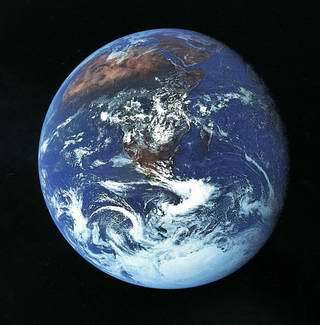
June 26th, 2006 Earth from space

New technologies are enabling scientists to determine precisely the extent and causes of Earth's short-term wobbling. Like a spinning top, Earth wobbles as it rotates on its axis. In fact, it displays many different wobbling motions, ranging in period from a few minutes to billions of years. Some of these are well studied, like the Chandler wobble of 433 days and the annual wobble, which together can tilt Earth's axis up to 10 meters [30 feet] from its nominal center.

Earth's irregular, shorter term wobbles, lasting a week or so, have been more difficult to study, partly because these motions are usually masked by those of more prominent wobbles. Now, scientists in Belgium and France have taken advantage of a quirk in the pattern of large-scale motions and the advent of the Global Positioning System (GPS) to pin down short-term wobbles that occurred from November 2005 through February 2006.

During this period, the Chandler wobble and the annual wobble essentially cancelled each other out, an event that occurs every 6.4 years, allowing the researchers to focus on the short-period wobbles. Over these three and a half months, the pole position traced small loops, ranging in size from that of a sheet of A4 [8-1/2x11 inch] paper down to that of a cell phone, and it remained within a one meter [yard] square during these four months.

Sebastien Lambert of the Royal Observatory of Belgium and colleagues there and at the Paris Observatory took advantage of the opportunity to track short-term wobbles, using newly available GPS data that establish the location of the poles precisely. They then sought to determine why these motions occurred when they did.

In a paper scheduled to be published 1 July in Geophysical Research Letters, they conclude that weather patterns in the northern hemisphere played a significant role. Both the location of high- or low-pressure centers--for example, over Asia or northern Europe--and the relationship of these weather systems to each other played a measurable role in creating, or "exciting," small, short-term wobbles, they report.

The ocean also affects short-term wobbles, according to Lambert and his colleagues. They were able to correlate oceanic and atmospheric pressure variations with the small observed wobbles during the study period. Although these forces had been credited by previous researchers with maintaining the large Chandler wobble, this was the first time that scientists have been able to demonstrate that day-to-day changes in atmospheric pressure produce a measurable effect on Earth's rotation.

Source: American Geophysical Union


print this article email this article download pdf blog this article bookmark this article     Digg this Stumble it share on Facebook share on Reddit add to delicious save to Yahoo! bookmarks
3.7/5 after 24 votes


June 26th, 2006 all stories
Space & Earth / Earth Sciences

Comments: 0
Rank: 3.7/5 after 24 votes

  • Stumble this up

  • Digg this

  • Share it:
  • share on Facebook
  • share on MySpace
  • share on Slashdot
  • rss-newsfeed
  • share on Google
  • share on Reddit
  • add to delicious
  • save to Yahoo! bookmarks
  • share on Windows Live
  • Add to Mixx!
Rating: 3.7/5 after 24 votes

  • Related Stories

  • A serious search for extraterrestrial life
    created May 26, 2009 | popularity not rated yet | comments 0
  • Record-setting Laser May Aid Searches for Earthlike Planets
    created May 05, 2008 | popularity not rated yet | comments 0
  • Record 5th planet found around nearby star
    created Nov 06, 2007 | popularity not rated yet | comments 0
  • Hubble observations confirm that planets form from disks around stars
    created Oct 09, 2006 | popularity not rated yet | comments 0
  • Big Magnets, Big Molecules
    created Sep 06, 2006 | popularity not rated yet | comments 0

Tags


  • Physicists Demonstrate Quantum Memory with Matter Qubits
    Physicists Demonstrate Quantum Memory with Matter Qubits
    Physics / General Physics
    created Jul 03, 2009 | popularity 4.4 / 5 (17) | comments 1
  • 'Holey' Nanosheets for Wastewater Dye Removal
    Nanotechnology / Nanomaterials
    created Jul 01, 2009 | popularity 5 / 5 (5) | comments 1
  • Jellyfish Robot Swims Like its Biological Counterpart
    Jellyfish Robot Swims Like its Biological Counterpart
    Electronics / Robotics
    created Jun 26, 2009 | popularity 4.4 / 5 (8) | comments 1
  • Could Maxwell's Demon Exist in Nanoscale Systems?
    Could Maxwell's Demon Exist in Nanoscale Systems?
    Physics / General Physics
    created Jun 24, 2009 | popularity 4.4 / 5 (18) | comments 29
  • Living Safely with Robots, Beyond Asimov's Laws
    Living Safely with Robots, Beyond Asimov's Laws
    Electronics / Robotics
    created Jun 22, 2009 | popularity 4.6 / 5 (52) | comments 40
  • Other News

    Forty years ago man first walked on the moon

    Space & Earth / Space Exploration

    created 15 hours ago | popularity 5 / 5 (2) | comments 1

    Forty years ago on July 20, 1969, American astronaut Neil Armstrong realized the oldest dream of human civilizations when he became the first man to walk on the moon.


    The least sea ice in 800 years

    The least sea ice in 800 years

    Space & Earth / Earth Sciences

    created Jul 01, 2009 | popularity 4.2 / 5 (62) | comments 57

    New research, which reconstructs the extent of ice in the sea between Greenland and Svalbard from the 13th century to the present indicates that there has never been so little sea ice as there is now. The ...


    Gas around young galaxy

    Intense heat killed the Universe's would-be galaxies, researchers say

    Space & Earth / Astronomy

    created Jul 01, 2009 | popularity 3.4 / 5 (21) | comments 27

    (PhysOrg.com) -- Our Milky Way galaxy only survived because it was already immersed in a large clump of dark matter which trapped gases inside it, scientists led by Durham University's Institute for Computational ...


    Scientists' Drill Hits Magma: Only Third Time on Record

    Scientists' Drill Hits Magma: Only Third Time on Record

    Space & Earth / Earth Sciences

    created Jun 29, 2009 | popularity 4.7 / 5 (22) | comments 19

    (PhysOrg.com) -- Scientists drilling a borehole deep into Iceland’s rocky crust to explore new methods of using geothermal energy hit a major roadblock on Thursday: Their drill ran into molten rock at a depth ...


    NASA manager pitches a cheaper return-to-moon plan

    Space & Earth / Space Exploration

    created Jun 30, 2009 | popularity 4 / 5 (7) | comments 18

    (AP) -- Like a car salesman pushing a luxury vehicle that the customer no longer can afford, NASA has pulled out of its back pocket a deal for a cheaper ride to the moon.