Scientists accurately simulate appearance of sun's corona during eclipse
June 26, 2006 Scientists accurately simulate appearance of sun's corona during eclipse

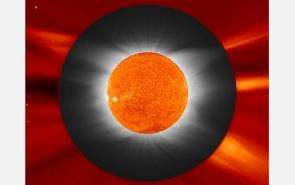
Scientists simulated the appearance of the Sun's corona during a March, 2006, solar eclipse. Credit: Science Applications International Corporation and NASA

The most true-to-life computer simulation ever made of our sun's multimillion-degree outer atmosphere, the corona, successfully predicted its actual appearance during the March 29, 2006, solar eclipse, scientists have announced.

The research, funded by NASA and the National Science Foundation (NSF), marks the beginning of a new era in space weather prediction. The results are presented today at the American Astronomical Society (AAS)'s Solar Physics Division meeting in Durham, N.H.

"This confirms that computer models can describe the physics of the solar corona," said Zoran Mikic of Science Applications International Corporation (SAIC), San Diego, Calif.

The turbulent corona is threaded with magnetic fields generated beneath the visible solar surface. The evolution of these magnetic fields causes violent eruptions and solar storms originating in the corona.

Like a rubber band that's been twisted too tightly, solar magnetic fields suddenly snap to a new shape while blasting billions of tons of plasma into space, at millions of miles per hour, in what scientists call a coronal mass ejection (CME). Or the magnetic field explodes as a solar flare with the force of up to a billion 1-megaton nuclear bombs.

When directed at Earth, solar flares and CMEs can disrupt satellites, communications and power systems.

"Finding out that a hurricane is bearing down on you isn't much good if the warning only gives you an hour to prepare," said Paul Bellaire, program director in NSF's Division of Atmospheric Sciences, which funded the research. "That's the situation we're in now with space weather. Being able to determine the structure of the solar wind at its source -- the sun -- will give us the lead time we need to make space weather predictions truly useful."

By accurately simulating the behavior of the corona, scientists hope to predict when it will produce flares and CMEs, the same way the National Weather Service uses computer simulations of Earth's atmosphere to predict when it will produce thunderstorms or hurricanes.

The computer model was based on spacecraft observations of magnetic activity on the sun's surface, which affects and shapes the corona above it. The SAIC team released simulated "photographs" of the March 29 eclipse 13 days and again 5 days before the eclipse.

During a total solar eclipse, the moon blocks direct light coming from the sun, so the much fainter corona is visible, resembling a white, lacy veil surrounding the black disk of the moon. That is the only time the corona is visible from Earth without special instruments.

Because the corona is always changing, each eclipse looks different. The simulated photographs closely resembled actual photos of the eclipse, "providing reassurance that the model may be able to predict space weather events," said Mikic.

Previous simulations were based on simplified models, so the calculations could be completed in a reasonable time by computers available then. The new simulation is the first to base its calculations on the physics of how energy is transferred in the corona.

Even with today's powerful computers, the calculations required four days to complete on about 700 computer processors.

Source: National Science Foundation


print this article email this article download pdf blog this article bookmark this article     Stumble it Digg this share on Facebook retweet share on Reddit add to delicious
Rate this story - 4 /5 (8 votes)


June 26, 2006 all stories

Comments: 0

4 /5 (8 votes)
  • Stumble this up

  • Digg this

  • share this

  • hide
  • Related Stories

  • Solar winds triggered by magnetic fields
    created Nov 02, 2009 | popularity not rated yet | comments 0
  • Tiny Flares Responsible for Outsized Heat of Sun's Atmosphere
    created Aug 14, 2009 | popularity not rated yet | comments 0
  • The violent youth of solar proxies steer course of genesis of life
    created Aug 10, 2009 | popularity not rated yet | comments 0
  • 'Monster' solar eclipse takes on Asian giants
    created Jul 20, 2009 | popularity not rated yet | comments 0
  • Proba-2's journey to Russia marks its first step towards space
    created Jul 06, 2009 | popularity not rated yet | comments 0


  • hide
  • Relevant PhysicsForums posts

  • Question about 2-body gravity
    created 14 hours ago
  • life on Mars
    created 17 hours ago
  • Semi-major axis from cartesian co-ordinates
    created Nov 23, 2009
  • Primary Mirror grinding
    created Nov 23, 2009
  • More from Physics Forums - General Astronomy

Other News

Cassini Captures Ghostly Dance of Saturn's Northern Lights

Cassini Captures Ghostly Dance of Saturn's Northern Lights (w/ Video)

Space & Earth / Space Exploration

created 7 hours ago | popularity 5 / 5 (3) | comments 0

(PhysOrg.com) -- In the first video showing the auroras above the northern latitudes of Saturn, Cassini has spotted the tallest known "northern lights" in the solar system, flickering in shape and brightness ...


First black holes may have incubated in giant, starlike cocoons, says CU-Boulder study

First black holes may have incubated in giant, starlike cocoons

Space & Earth / Astronomy

created 10 hours ago | popularity 4.7 / 5 (9) | comments 7

(PhysOrg.com) -- The first large black holes in the universe likely formed and grew deep inside gigantic, starlike cocoons that smothered their powerful x-ray radiation and prevented surrounding gases from ...


Infrared Image of Circumstellar Disk Illuminates Massive Star Formation Process

Infrared Image of Circumstellar Disk Illuminates Massive Star Formation Process

Space & Earth / Astronomy

created 5 hours ago | popularity 4.5 / 5 (2) | comments 0

(PhysOrg.com) -- A team of astronomers from Ibaraki University, Japan Aerospace Exploration Agency, Kanagawa University, University of Tokyo, Academica Sinica, and National Astronomical Observatory of Japan ...


ET: Check your voicemail

ET: Check your voicemail

Space & Earth / Space Exploration

created 7 hours ago | popularity 3.4 / 5 (5) | comments 4

(PhysOrg.com) -- Alien beings on faraway planets may not have noticed, but it’s been 35 years since human beings made the first deliberate effort to send them a message.


U.S. losing its lead in space, experts warn Congress

Space & Earth / Space Exploration

created 4 hours ago | popularity 2.5 / 5 (2) | comments 1

America's once clear dominance in space is eroding as other nations, including China, Iran and North Korea, step up their activities, a panel of experts told the House subcommittee on Space and Aeronautics Thursday.