New Deep-Sea Hybrid Vehicle Gets a Mythical Name
June 27, 2006 New Deep-Sea Hybrid Vehicle Gets a Mythical Name

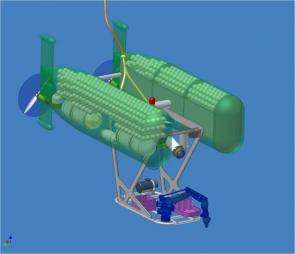
Internal components of HROV, now Nereus, in its remotely opeprated vehicle mode. (Illustration by Jack Cook, Woods Hole Oceanographic Institution)

Nereus, a mythical god with the torso of a man and the tail of a fish, was chosen June 25 as the name of a new deep-sea vehicle under construction at the Woods Hole Oceanographic Institution (WHOI).

The vehicle, known until now as the Hybrid Remotely Operated Vehicle, or HROV, will be able to work in the deepest parts of the ocean, from 6,500 meters to 11,000 meters (21,500 feet to 36,000 feet), a depth currently unreachable for routine ocean research. Scientists also plan to use it to explore remote, difficult-to-reach areas, including under the Arctic ice cap.

Engineers and ship's crew will transform Nereus from a free-swimming vehicle for wide-area ocean surveys to a vehicle tethered by a cable to a surface ship for close-up investigation and sampling of seafloor rocks and organisms. The transformation will take 6 to 8 hours and happen on the ship's deck.

The $5-million, battery-operated vehicle will be the first ever designed to transform from a guided, tethered robot to a free-swimming vehicle. Nereus (rhymes with “serious”) keeps with a tradition in the WHOI Deep Submergence Laboratory of naming vehicles for mythical Greek figures. Among others in the WHOI-operated fleet of vehicles are Jason (a fabled adventurer and ocean explorer), Argo (a ship used by Jason), and Medea (the mythical wife of Jason).

“Nereus best fits the image of our vehicle, which engineers can change shape at sea for various science needs,” said Andy Bowen, the WHOI engineer overseeing the vehicle’s design and development. The vehicle is scheduled for sea trials in early 2007, and scientists plan to use it for research later that year at Challenger Deep near Guam, the deepest spot in the world’s oceans.

The Challenger Deep was first visited in 1960 by the U.S. Navy bathyscaphe Trieste, and again in 1995 by the Japanese remotely operated vehicle Kaiko, which has later lost on an unrelated expedition.

Bowen was among a panel of judges from WHOI and engineering consulting groups that selected Nereus from 22 entries in a naming contest open to junior high, high school, and college students who participate in the California-based Marine Advanced Technology (MATE) Center.

Nereus was announced the winner during a June 25 awards banquet at the NASA Johnson Space Center in Houston. The prize for the winning team is a trip this September to see the HROV in Woods Hole, where Bowen said engineers expect to be concluding tests on the vehicle’s manipulator arm, thruster, pressure housings, and electronic components.

Source: Woods Hole Oceanographic Institution


print this article email this article download pdf blog this article bookmark this article     Stumble it Digg this share on Facebook retweet share on Reddit add to delicious
Rate this story - 4.3 /5 (4 votes)


June 27, 2006 all stories

Comments: 0

4.3 /5 (4 votes)
  • Stumble this up

  • Digg this

  • share this

  • hide
  • Related Stories

  • The Abyss: Deepest Part of the Oceans No Longer Hidden
    created Jun 03, 2009 | popularity not rated yet | comments 0
  • Beyond sunlight: Explorers census 17,650 ocean species between edge of darkness and black abyss (w/ Video)
    created Nov 22, 2009 | popularity not rated yet | comments 0
  • NASA Supercomputer Ranks Among World's Fastest
    created Nov 19, 2009 | popularity not rated yet | comments 0
  • A glimpse at the Earth's crust deep below the Atlantic
    created Nov 12, 2009 | popularity not rated yet | comments 0
  • Planetary Society plans new 'solar sail'
    created Nov 09, 2009 | popularity not rated yet | comments 0


  • hide
  • Relevant PhysicsForums posts

  • The IPCC and the term "most"
    created 18 hours ago
  • Is global warming a fact?
    created 19 hours ago
  • Random variability of wind patterns
    created Nov 23, 2009
  • Record precipitation in the UK
    created Nov 22, 2009
  • More from Physics Forums - Earth

Other News

From Greenhouse to Icehouse

From Greenhouse to Icehouse

Space & Earth / Earth Sciences

created 2 hours ago | popularity 4 / 5 (2) | comments 5

A new study that reconstructed ocean temperatures from millions of years ago could provide new insight into how the Earth responds to climate change.


'Cosmic fruit machine' matches collisions

'Cosmic fruit machine' matches collisions

Space & Earth / Astronomy

created 5 hours ago | popularity 5 / 5 (1) | comments 1

(PhysOrg.com) -- A new website will give everyone the chance to contribute to science by playing a 'cosmic fruit machine' and compare images of colliding galaxies with millions of simulated images of galactic ...


Humanity would need five Earths to create the resources needed if everyone lived as like Americans, a report has stated

Mankind using Earth's resources at alarming rate

Space & Earth / Environment

created 2 hours ago | popularity 3 / 5 (4) | comments 6

Humanity would need five Earths to produce the resources needed if everyone lived as profligately as Americans, according to a report issued Tuesday.


Supervolcano eruption -- in Sumatra -- deforested India 73,000 years ago

Supervolcano eruption -- in Sumatra -- deforested India 73,000 years ago

Space & Earth / Earth Sciences

created 20 hours ago | popularity 4.4 / 5 (12) | comments 2

A new study provides "incontrovertible evidence" that the volcanic super-eruption of Toba on the island of Sumatra about 73,000 years ago deforested much of central India, some 3,000 miles from the epicenter, ...


New computer-developed map shows more extensive valley network on Mars

New computer-developed map shows more extensive valley network on Mars

Space & Earth / Space Exploration

created 18 hours ago | popularity 4.5 / 5 (8) | comments 0

New research adds to the growing body of evidence suggesting the Red Planet once had an ocean.