Underwater Microscope Finds Biological Treasures in the Subtropical Ocean
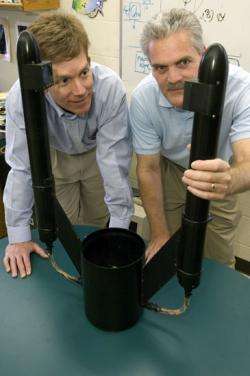
Scientists towing an underwater digital microscope across the Atlantic have found possible missing links to the global nitrogen cycle, which in turn is linked to ocean productivity.
In a recent report in the journal Science, researchers from the Woods Hole Oceanographic Institution (WHOI) found abundant colonies of Trichodesmium. The multi-celled, filamentous organism is thought to play a significant role in the input of nitrogen to the upper layers of the tropical and subtropical ocean, nearly half of the Earth’s surface.
Lead author Cabell Davis, a senior scientist in the WHOI Biology Department, and co-author Dennis McGillicuddy, an associate scientist in the WHOI Applied Ocean Physics and Engineering Department, suggest that nitrogen fixation rates for Trichodesmium may be 2.7 to 5 times higher than previously estimated from traditional sampling.
Trichodesmium is one of many tiny photosynthetic organisms that use the sun’s energy, carbon dioxide and other nutrients to make organic material that constitutes the basis of the marine food web. Production of biomass in surface waters is typically limited by nitrogen, but Trichodesmium is able to escape that constraint by virtue of its ability to utilize nitrogen gas, which is plentiful in the atmosphere and upper ocean.
Trichodesmium abundance has been difficult to measure using traditional net sampling because the colonies are easily damaged or destroyed during collection. Sampling with bottles has provided estimates of abundance of the organism, but it is a snapshot view.
The Video Plankton Recorder (VPR) is a noninvasive instrument, consisting of a digital video-microscope on a towed vehicle that samples at 30 frames per second and automatically sorts the Trichodesmium images from other organisms.
“If traditional sampling has underestimated colonies in other regions of the world, our estimates of global Trichodesmium abundance will increase dramatically,” Davis said. “That increase could potentially account for a significant portion of the global nitrogen cycle, thus changing our perception of the importance of this organism to the productivity of the world ocean.”
Davis and McGillicuddy towed the VPR across the North Atlantic between the Azores and the Slope Water south of Woods Hole in 2003, skirting category 3 hurricane Fabian. The vehicle was towed at six meters per second, about 12 nautical miles an hour, surveying continually and automatically between the surface and about 130 meters (400 feet) deep like a yo-yo. Nearly 7,000 vertical profiles were taken during the 5,517 kilometer (about 3,443 miles) transit across the North Atlantic.
While the colonies of Trichodesmium are fragile and thought to be destroyed when mixed by strong winds, the team found no evidence that hurricane Fabian, with winds up to 200 kilometers an hour (about 125 miles per hour), had caused them any damage. The team sampled the upper layers of the ocean across the wake of the storm.
The researchers also found a strong correlation between temperature, salinity and abundance of Trichodesmium colonies in the various eddies and the Gulf Stream the VPR crossed during its survey.
Two forms of Trichodesmium, called puffs and tufts because of their shapes, were found in higher concentrations in warm salty water. Higher concentrations of the organism were also found in warm anticyclonic eddies than in cold cyclonic ones, but the reasons are unclear.
Davis and McGillicuddy are doing a similar survey aboard WHOI’s research vessel Knorr. The researchers will deploy the VPR and survey across the Caribbean Sea, a region known to have very high concentrations of Trichodesmium. The ship will arrive back at Woods Hole on June 29.
Davis says the new Caribbean VPR survey will provide much needed information about Trichodesmium population estimates in its tropical home, information that has been difficult to obtain due to the patchy nature of the species in ocean waters.
Source: Woods Hole Oceanographic Institution


