Curtain may be closing on scientific water controversy
The curtain may be ringing down on a scientific controversy regarding the structure of water which arose two years ago. A new study by scientists with the U.S. Department of Energy's Lawrence Berkeley National Laboratory has provided further evidence that the traditional structure of liquid water, in which the average water molecule is hydrogen-bonded to approximately four other water molecules in a tetrahedral arrangement, is correct.
Teresa Head-Gordon and Margaret Johnson, bioengineers with Berkeley Lab's Physical Biosciences Division, and the University of California Berkeley/San Francisco Joint Graduate Group in Bioengineering, characterized the static structural organization of liquid water by analyzing data which was collected by Head-Gordon's research group in 2002 using the ultrabright x-ray beams at Berkeley Lab's Advanced Light Source (ALS). They found that while the "rings and chains" alternative model of liquid water may exist for the briefest of instants, the average structure is that of the familiar tetrahedral network.
"I think that most scientists who work in water, liquids or disordered systems will find our paper very convincing," said Head-Gordon. "For some, it will be convincing enough so that it should end the controversy."
Water covers 70 percent of the Earth's surface and makes up 60 percent of the human body. Despite water's ubiquitous presence in our lives, it remains a mystery. Whereas most substances contract when they solidify, water expands, making it less dense as a solid than as a liquid. Our lives depend upon liquid water but, given its light molecular weight, water at room temperature should be a gas. The key to understanding the strange but vital properties of liquid water is to fully understand its structure.
A single water molecule is V-shaped, but because the oxygen atom is more electronegative than the hydrogen atoms, the electrons in the molecule tend to gather towards the oxygen end, creating a slightly negative pole there and a slightly positive pole on the hydrogen side. The polarity of each water molecule results in a weak attraction between it and other water molecules, called a hydrogen bond.
In the traditional scientific picture of water in the solid ice state, every individual water molecule forms four hydrogen bonds -- two that are electron acceptors and two that are electron donors – through which it connects to its nearest neighbors. The result is a network of tetrahedrons. When ice melts, these bonds may become distorted and up to 20-percent of them broken. Despite these thermal distortions, liquid water still retains its tetrahedral network. This tetrahedral structure, coupled with strong hydrogen bonding, has long been thought to be the source of liquid water's unusual properties.
Two years ago, however, scientists at Stanford University reported a series of experiments, using x-ray absorption spectroscopy and x-ray Raman scattering techniques, that indicated a radically different molecular arrangement for water. They reported that in the liquid state, more than 80 percent of the hydrogen bonds between water molecules were broken. On the average, they found each liquid water molecule formed only two hydrogen bonds -- one electron donor and one electron acceptor. From this they concluded that in the liquid state, water molecules form a network of large rings or chains, rather than tetrahedrons.
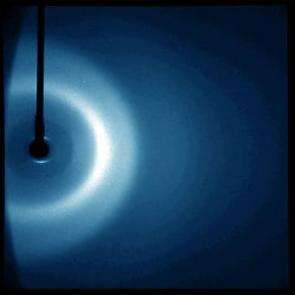
The data analyzed by Head-Gordon and Johnson was collected through a technique called x-ray scattering, in which a beam of x-rays is sent through a sample and the photons are scattered by the electron density of the sample's constituent atoms or molecules. The scattering cross-section or intensity of x-rays increases in direct proportion to the number of electrons.
"We used x-ray scattering because the technique enables you to characterize the time-averaged structural organization of atoms or molecules in a liquid or solid," said Head-Gordon. "In our study, it provided us with information on both the long-range and local order."
The x-ray scattering experiments analyzed by Head-Gordon and Johnson were conducted Head-Gordon in a collaboration with Greg Hura and Daniela Russo. These experiments were carried out at ALS beamline 7.3.3, an experimental station which provides exceptionally rapid collection of x-ray scattering data with extremely high spatial resolution. Berkeley Lab's ALS is an electron synchrotron designed to accelerate electrons to energies of nearly 2 billion electron volts (GeV) and extract from them beams of x-ray light that are a hundred million times brighter than those from the best x-ray tubes.
In a paper which is now available on-line in the Proceedings of the National Academy of Sciences (PNAS), Head-Gordon and Johnson describe a model of liquid water they created in which a water molecule's two hydrogen atoms formed hydrogen-bonded chains. This anti-tetrahedral model was then shown to be inconsistent with the long-range order exhibited in the x-ray scattering data taken at the ALS.
On the other hand, a model of liquid water that formed a tetrahedral structure was shown to agree with the long-range orders in the ALS x-ray scattering data.
"Our best understanding of liquid water at present is that charge asymmetry in water's electron density arises from symmetry-breaking environments that fluctuate rapidly on the femtosecond timescale," the authors stated in their PNAS paper.
"Although these instantaneous asymmetries may be seen in an x-ray absorption spectroscopy (XAS) experiment, the long timescale (or ensemble) averages inherent in bulk structural experiments such as x-ray scattering tell us that they do not persist. It is important to reconcile the XAS data with the view of water as a tetrahedral hydrogen-bonded liquid."
Source: Lawrence Berkeley National Laboratory


