Movies show nanotubes bend like sluggish guitar strings
June 27th, 2006 Movies show nanotubes bend like sluggish guitar strings

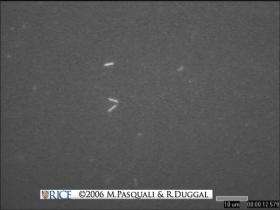
In an exciting advance in nanotechnology imaging, Rice University scientists have discovered a way to use standard optical microscopes and video cameras to film individual carbon nanotubes – tiny cylinders of carbon no wider than a strand of DNA. The movies show that nanotubes can be "plucked" by individual molecules of water and made to bend like guitar strings.

"Nanotubes are fairly stiff, and when they are long enough, the bombardment by the surrounding water molecules makes them bend in harmonic shapes, just like the string of a guitar or a piano," said lead researcher Matteo Pasquali, associate professor of chemical and biomolecular engineering and chemistry, and co-director of Rice's Carbon Nanotechnology Laboratory.

The results, which are due to appear in an upcoming issue of Physical Review Letters, were published online June 23.

Pasquali said the analogy with stringed instruments doesn't completely fit with the nanoscale world. Unlike the guitar string, for example, the carbon nanotube is plucked randomly in many places at the same time. Also, it cannot resonate like the guitar string because the nanotube has too little mass, and its vibrations die quickly because it's surrounded by viscous liquid.

Carbon nanotubes are hollow, hair-like strands of pure carbon that are 100 times stronger than steel but weigh only one sixth as much. Nanotubes are one nanometer, or one billionth of a meter, wide. Human hair, by comparison, is about 80,000 nanometers wide.

Nanotubes tend to clump together. To isolate individual tubes, Pasquali and doctoral student Rajat Duggal, now a research engineer at General Electric Co., put clumps of tubes into a mixture of water and a soap-like surfactant called sodium dodecyl sulphate, or SDS. When the nanotube clumps were broken apart with ultrasonic sound waves, the SDS surrounded the individual nanotubes and held them apart, in the same way laundry detergent surrounds and separates dirt particles in the wash.

In order to see individual nanotubes with a standard optical microscope, like those found in most biological laboratories, Pasquali and Duggal added a common red fluorescent dye that's often used to stain cells. The dye, which attached itself to the SDS surrounding each nanotube, glows brightly enough to be seen with the naked eye under a microscope.

"I had been working on fluorescence visualization of DNA, and other students in the lab were working on nanotubes," Duggal recalled. "A colleague was disposing of nanotube suspensions after an experiment, and I asked them to spare me a vial so I could try them with an optical microscope. I thought of decorating the nanotubes with a fluorescent dye that would prefer to be with the SDS rather than the water, and when I looked under the microscope – to my delight – I found bright dancing nanotubes."

Duggal said scientists have used electron microscopes to observe the underdamped vibrations of nanotubes in vacuum, but his and Pasquali's technique gives scientists the ability to see how nanotubes behave in liquids in real time.

Pasquali and Duggal videotaped dozens of nanotubes at 30 frames per second. A frame-by-frame analysis of the tapes revealed harmonic bending in several nanotubes that were 3-5 microns long and showed that the measured amplitude of the bending motion is consistent with earlier predictions of Rice materials scientist Boris Yakobson, professor of mechanical engineering and materials science and of chemistry.

Pasquali said the method works with other surfactants and it may be useful for life scientists who want to find out how nanotubes interact with cells, biomolecules and other biological entities.

"Our method doesn't provide the sensitivity or precision you get with the infrared, single-nanotube imaging methods developed last year by Rice chemist Bruce Weisman and doctoral student Dmitri Tsyboulski, but the equipment we need is less expensive," Pasquali said. "It's akin to the difference between playing a Stadivarius and playing a common violin."

Source: Rice University


print this article email this article download pdf blog this article bookmark this article     Digg this Stumble it share on Facebook share on Reddit add to delicious save to Yahoo! bookmarks
4/5 after 17 votes


June 27th, 2006 all stories
Nanotechnology / Nanomaterials

Comments: 0
Rank: 4/5 after 17 votes

  • Stumble this up

  • Digg this

  • Share it:
  • share on Facebook
  • share on MySpace
  • share on Slashdot
  • rss-newsfeed
  • share on Google
  • share on Reddit
  • add to delicious
  • save to Yahoo! bookmarks
  • share on Windows Live
  • Add to Mixx!
Rating: 4/5 after 17 votes

  • Related Stories

  • Carbon Nanotubes Continue To Show Promise in Battle Against Cancer
    created Jun 30, 2009 | popularity not rated yet | comments 0
  • Nanotubes weigh the atom
    created Jun 29, 2009 | popularity not rated yet | comments 0
  • Scientists fight cancer with nanotechnology
    created May 21, 2009 | popularity not rated yet | comments 0
  • 'Writing' Patterns on Carbon Nanotubes With Polymer Chains
    created May 19, 2009 | popularity not rated yet | comments 0
  • Highly conductive nanocomposites: Inexpensive plastic used in CDs could improve electronics
    created May 15, 2009 | popularity not rated yet | comments 0

Tags


  • Physicists Demonstrate Quantum Memory with Matter Qubits
    Physicists Demonstrate Quantum Memory with Matter Qubits
    Physics / General Physics
    created Jul 03, 2009 | popularity 4.4 / 5 (16) | comments 1
  • 'Holey' Nanosheets for Wastewater Dye Removal
    Nanotechnology / Nanomaterials
    created Jul 01, 2009 | popularity 5 / 5 (5) | comments 1
  • Jellyfish Robot Swims Like its Biological Counterpart
    Jellyfish Robot Swims Like its Biological Counterpart
    Electronics / Robotics
    created Jun 26, 2009 | popularity 4.4 / 5 (7) | comments 1
  • Could Maxwell's Demon Exist in Nanoscale Systems?
    Could Maxwell's Demon Exist in Nanoscale Systems?
    Physics / General Physics
    created Jun 24, 2009 | popularity 4.4 / 5 (18) | comments 29
  • Living Safely with Robots, Beyond Asimov's Laws
    Living Safely with Robots, Beyond Asimov's Laws
    Electronics / Robotics
    created Jun 22, 2009 | popularity 4.6 / 5 (52) | comments 40
  • Other News

    A 'quantum of sol' -- how nanotechnology could hold the key to a solar-powered future

    A 'quantum of sol' -- how nanotechnology could hold the key to a solar-powered future

    Nanotechnology / Nanomaterials

    created Jun 30, 2009 | popularity 3.7 / 5 (12) | comments 16

    (PhysOrg.com) -- A new generation of 'nano-structured' millimetre-sized solar cells that could convert the sun's energy to electricity more than twice as efficiently as current technology, is the subject of ...


    Australian researchers are set to begin human trials of a tiny nano-cell that acts as a "Trojan horse" against cancer

    Hi-tech 'Trojan horse' can kill cancer cells: researchers

    Nanotechnology / Bio & Medicine

    created Jun 29, 2009 | popularity 4.6 / 5 (11) | comments 7

    Australian researchers are set to begin human trials of a tiny nano-cell that acts as a "Trojan horse" against cancer cells, a breakthrough they say may curb the need for debilitating chemotherapy.


    Harnessing Nanoparticles To Track Cancer Cell Changes

    Nanotechnology / Bio & Medicine

    created Jul 03, 2009 | popularity not rated yet | comments 1

    The more dots there are, the more accurate a picture you get when you connect them. Cancer researchers adopting that philosophy have developed a new imaging technology that could give scientists the ability to simultaneously ...


    'Holey' Nanosheets for Wastewater Dye Removal

    Nanotechnology / Nanomaterials

    created Jul 01, 2009 | popularity 5 / 5 (5) | comments 1

    (PhysOrg.com) -- Researchers have discovered that extremely thin sheets of nickel oxide with hexagonally shaped holes can absorb hazardous dyes from wastewater nearly as well as the best traditional methods, but are recyclable. ...


    New statistical technique improves precision of nanotechnology data

    New statistical technique improves precision of nanotechnology data

    Nanotechnology / Nanophysics

    created Jul 01, 2009 | popularity 3 / 5 (2) | comments 0

    A new statistical analysis technique that identifies and removes systematic bias, noise and equipment-based artifacts from experimental data could lead to more precise and reliable measurement of nanomaterials ...