Pirates pursued democracy, helped American colonies survive
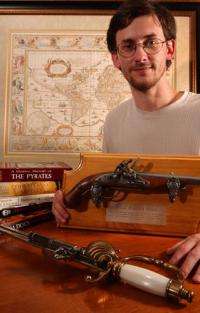
Blackbeard and Ben Franklin deserve equal billing for founding democracy in the United States and New World, a new University of Florida study finds.
Pirates practiced the same egalitarian principles as the Founding Fathers and displayed pioneering spirit in exploring new territory and meeting the native peoples, said Jason Acosta, who did the research for his thesis in history at the University of Florida.
“Hollywood really has given pirates a bum rap with its image of bloodthirsty, one-eyed, peg-legged men who bury treasure and force people to walk the plank,” he said. “We owe them a little more respect.”
Acosta, a descendant of a pirate who fought for the United States in the Battle of New Orleans, studied travel narratives, court hearings, sermons delivered at pirate hangings and firsthand accounts of passengers held captive by pirates. Comparing pirate charters with the Declaration of Independence and the U.S. Constitution, he said he was amazed by the similarities.
Like the American revolutionaries, pirates developed three branches of government with checks and balances. The ship captain was elected, just as the U.S. president; the pirate assembly was comparable to Congress; and the quartermaster resembled a judge in settling shipmate disputes and preventing the captain from overstepping his authority, he said.
Colonists and pirates also were alike in emphasizing written laws, democratic representation and due process, Acosta said. All crew members were allowed to vote, ship charters had to be signed by every man on board, and anyone who lost an eye or a leg was compensated financially, he said.
These ideals grew out of both groups’ frustration at being mistreated by their leaders; the British forced the colonists to quarter troops and pay taxes, and captains on merchant ships beat their shipmen, starved them and paid less than promised, Acosta said.
“It’s no wonder that many sailors seized the opportunity to jump ship and search for a better way of life, namely piracy, which offered better food, shorter work shifts and the power of the crew in decision-making,” he said.
A golden age of pirating emerged in the 17th and 18th centuries as these Brethren of the Sea sailed the world’s waterways, plundering hundreds of millions of dollars worth of gold, silver and other merchandise, shaping the modern world in the process, Acosta said.
Pirates mapped new territory, expanded trade routes, discovered good ports and opened doors with the native peoples, Acosta said. “They really helped European nations explore the Americas before Europeans could afford to explore them on their own,” he said.
By selling stolen silks, satins, spices and other merchandise in ports and spending their booty in the colonies, pirates created an economic boom, helping struggling settlements and making Port Royale in Jamaica and Charleston, S.C., huge mercantile centers, Acosta said. “They didn’t bury their treasure, they spent it, helping colonies survive that couldn’t get the money and supplies they needed from Europe,” he said.
Without the infusion of money into the New World from piracy, it is possible that Britain and France may not have been able to catch up with Spain, Acosta said.
“Had it not been for pirates, Britain might have had trouble holding onto the American colonies,” he said. “Pirates decimated the Spanish so badly that Spain finally had to give up some of its American empire just to get pirating to stop.”
Native Americans and black slaves oppressed by the Spanish in the Caribbean gave pirates inside information on where to dock ships and find supplies, Acosta said. Slaves fleeing plantations were welcomed on pirate ships, where they shared an equal voice with white sailors, he said.
Acosta said he believes pirates would be given a place in the history books if they had been able to write their stories and leave diaries like the more literate American colonists.
A Gainesville middle school teacher, Acosta occasionally brings up pirates in his classroom, where he has a captive audience, thanks to the popularity of the movie “Pirates of the Caribbean,” which has a sequel opening July 7. “I had one group of students in my class who just went around the playground all the time saying, ‘Aaar, we’re the pirates,’” he said.
Richard Burg, an Arizona State University professor and expert on pirates, said Acosta is performing a great service by emphasizing pirates’ democratic and egalitarian ways. “The men who sailed under the skull and crossbones were ordinary folk, like America’s revolutionaries, standing firm against oppressive governments and economic systems,” he said. “Mr. Acosta is one of the few scholars who understand this.”
Source: by Cathy Keen, University of Florida


