Founding document of mathematics published in digital form for the first time
October 7th, 2005 Founding document of mathematics published in digital form for the first time

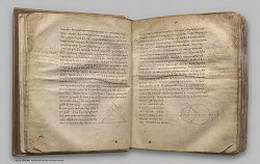
The oldest surviving manuscript of Euclid’s Elements, probably the most influential work in the history of mathematics, has been published in digital form for the first time thanks to a collaboration between the Bodleian Library, the Clay Mathematics Institute and Octavo Corporation.

Picture: The oldest surviving manuscript of Euclid’s Elements. Credit: Octavo Corporation.

To mark the occasion a conference at St Catherine's College on 7-8 October will bring together leading mathematicians, historians, classicists and philosophers from around the world to take a fresh look at Euclid and his work.

Around 300BC the Greek mathematician Euclid wrote the Elements, in which he summarized the preceding two centuries of mathematical research. Now known as the founding document of mathematics, the Elements was the standard textbook for mathematical education in ancient times, in the Islamic world, and in Europe through the Middle Ages, the Renaissance, and until almost the present day. The system of thought presented by the Elements, in which knowledge was distilled in the form of theorems and then given a written proof, inspired fields as diverse as law and physics. Indeed, Newton’s Principia, which marked the beginning of modern physics, took Euclid’s work as its intellectual and stylistic model.

The oldest surviving copy of Euclid’s Elements, handwritten in 888AD on parchment, has been housed in the Bodleian Library since 1804. Few people have ever seen the manuscript, but this is about to change now that it has been published for the first time in digital form online. In 2004 the Clay Mathematics Institute discussed with the Bodleian Library and Octavo Corporation, one of the leading firms in highest-quality rare book digitisation, a proposal to produce a digital edition of this earliest of Euclid manuscripts. The result, just over a year later, is a complete digital edition of the manuscript which students, scholars, mathematicians, and members of the public can consult online at Octavo’s website.

Richard Ovenden, Keeper of Special Collections and Western Manuscripts at the Bodleian Library, said: ‘We were delighted to work with Octavo and the Clay Mathematics Institute to make the oldest surviving manuscript of Euclid’s Elements available to all in digital form. The result is access to this most important document unequalled at any time in history. Those who examine the manuscript may find that its physical beauty is as great as its historical value.’

Source: University of Oxford


print this article email this article download pdf blog this article bookmark this article     Digg this Stumble it share on Facebook share on Reddit add to delicious save to Yahoo! bookmarks
4/5 after 1 votes


October 7th, 2005 all stories
Other Sciences /

Comments: 0
Rank: 4/5 after 1 votes

  • Stumble this up

  • Digg this

  • Share it:
  • share on Facebook
  • share on MySpace
  • share on Slashdot
  • rss-newsfeed
  • share on Google
  • share on Reddit
  • add to delicious
  • save to Yahoo! bookmarks
  • share on Windows Live
  • Add to Mixx!
Rating: 4/5 after 1 votes

  • Related Stories

  • The not-so-digital future of digital signal processing
    created Apr 07, 2008 | popularity not rated yet | comments 0
  • Visual technology enables brain to learn in new ways
    created Mar 21, 2008 | popularity not rated yet | comments 0
  • USC engineering class creates tools to analyze musical expression
    created May 11, 2006 | popularity not rated yet | comments 0
  • Tablet-Size Seismometer
    created Sep 03, 2004 | popularity not rated yet | comments 0
  • New tracking approach will help protect polar bears
    created Jun 18, 2009 | popularity not rated yet | comments 0

Tags


  • Physicists Demonstrate Quantum Memory with Matter Qubits
    Physicists Demonstrate Quantum Memory with Matter Qubits
    Physics / General Physics
    created 19 hours ago | popularity 4.5 / 5 (11) | comments 1
  • 'Holey' Nanosheets for Wastewater Dye Removal
    Nanotechnology / Nanomaterials
    created Jul 01, 2009 | popularity 5 / 5 (5) | comments 1
  • Jellyfish Robot Swims Like its Biological Counterpart
    Jellyfish Robot Swims Like its Biological Counterpart
    Electronics / Robotics
    created Jun 26, 2009 | popularity 4.4 / 5 (7) | comments 1
  • Could Maxwell's Demon Exist in Nanoscale Systems?
    Could Maxwell's Demon Exist in Nanoscale Systems?
    Physics / General Physics
    created Jun 24, 2009 | popularity 4.4 / 5 (18) | comments 29
  • Living Safely with Robots, Beyond Asimov's Laws
    Living Safely with Robots, Beyond Asimov's Laws
    Electronics / Robotics
    created Jun 22, 2009 | popularity 4.6 / 5 (51) | comments 39
  • Other News

    Creation Museum president Ken A. Ham

    Paleontologists brought to tears, laughter by Creation Museum

    Other Sciences / Other

    created Jun 30, 2009 | popularity 4.4 / 5 (35) | comments 54

    For a group of paleontologists, a tour of the Creation Museum seemed like a great tongue-in-cheek way to cap off a serious conference.


    Mummified dinosaur skin yields up new secrets

    Mummified dinosaur skin yields up new secrets

    Other Sciences / Archaeology & Fossils

    created Jul 01, 2009 | popularity 4.8 / 5 (13) | comments 9

    (PhysOrg.com) -- Scientists from The University of Manchester have identified preserved organic molecules in the skin of a dinosaur that died around 66-million years ago.


    Bush's court appointments emphasized ideology over diversity

    Other Sciences / Other

    created Jun 26, 2009 | popularity 2 / 5 (8) | comments 11

    The judicial appointments of former president George W. Bush suggests that his motivation for appointing nontraditional judges was driven more by ideology and strategy than concerns for diversity, a new analysis shows.


    Liberal? Conservative? Stanford study says mental nudge can make voters flip-flop

    Liberal? Conservative? Stanford study says mental nudge can make voters flip-flop

    Other Sciences / Social Sciences

    created Jul 02, 2009 | popularity 3.5 / 5 (4) | comments 3

    (PhysOrg.com) -- No doubt you’ve worked hard for your success. But chances are you’ve also had some help and lucky breaks along the way.


    Probing Question: How do Ponzi Schemes work?

    Other Sciences / Economics

    created Jul 02, 2009 | popularity not rated yet | comments 2

    Imagine the shock, the horror, and the sheer panic that would come with learning that the financial plan you’d sunk your life savings into was a sham, the financial experts you trusted were crooks, and all your money was ...