How to stop SARS viruses from reproducing
June 29th, 2006 How to stop SARS viruses from reproducing

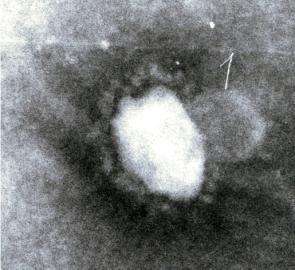
The bright spot surrounded by a corona looks harmless, but it is a deadly pathogen: A corona virus causing SARS. The virus was first identified by the Bernhard Nocht Institute for Tropical Medicine in Hamburg. Picture by Bernhard Nocht Institute for Tropical Medicine.

In times of the “bird flu” SARS seems to be no threat anymore. This notion is deceptive. Experts assume that viruses causing the severe acute respiratory syndrome SARS, or other related corona viruses, could re-emerge at any time and might pose a global public-health threat.

From November 2002 to June 2003, 8,500 patients were infected with an at that time unknown pathogen originating in southern China; 800 humans died. Then, the epidemic was controlled and it’s cause detected. The pathogen was a novel corona virus. Such viruses are extremely alterable.

Now, researchers of the “Leibniz-Institut für Molekulare Pharmakologie” (FMP) in Berlin have synthesized substances that target a vital enzyme of the SARS virus, namely it’s main protease. “We were systematically looking for molecules to prevent the corona virus from reproducing itself”, says Prof. Jörg Rademann. He heads the group “Medical Chemistry” at the FMP. Rademann adds: “We hope that our research can help to produce suitable drugs against such viruses in a short time, especially in the case of a new epidemic.”

The main protease proved to be a good starting-point for the researchers: The group of Prof. Rolf Hilgenfeld at the University of Lübeck provided the protein and solved its structure. The viral enzyme cuts long protein molecules manufactured by the virus in the host cell into small pieces. The main protease is essential for the reproduction of all corona viruses and it has an almost identical structure in all of these pathogens. Thus, once a substance that attacks the main protease is found, scientists would have a wide range of possibilities to fight different corona viruses.

Rademann and his team, together with colleagues, have synthesized for the first time molecules that attach themselves to the main protease without being chemically reactive. Most importantly, this process is reversible, thus minimizing side-effects of potential drugs. The researchers presented a collection of substances that resemble the natural substrate of the main protease.

Even if it is still a long way from such a collection to suitable drugs, the newly synthesized peptide aldehydes mark an important step towards a therapy for SARS. The next goal is to identify the most effective peptide aldehydes out of the collection and then to further optimize the substance. “If we are successful, the next outbreak of SARS will pose a much smaller threat to public-health and we will not be helpless”, says Rademann.

Source: Forschungsverbund Berlin e.V. (FVB)


print this article email this article download pdf blog this article bookmark this article     Digg this Stumble it share on Facebook share on Reddit add to delicious save to Yahoo! bookmarks
3.6/5 after 7 votes


June 29th, 2006 all stories
Medicine & Health /

Comments: 0
Rank: 3.6/5 after 7 votes

  • Stumble this up

  • Digg this

  • Share it:
  • share on Facebook
  • share on MySpace
  • share on Slashdot
  • rss-newsfeed
  • share on Google
  • share on Reddit
  • add to delicious
  • save to Yahoo! bookmarks
  • share on Windows Live
  • Add to Mixx!
Rating: 3.6/5 after 7 votes

  • Related Stories

  • Gene's novel role may provide key to treating liver and neurodegenerative diseases
    created Jul 03, 2009 | popularity not rated yet | comments 0
  • Scientists find key culprits in lupus
    created Jun 29, 2009 | popularity not rated yet | comments 0
  • Safer stem cells for therapy
    created Jun 29, 2009 | popularity not rated yet | comments 0
  • Chronic Infection Now Clearly Tied to Immune-System Protein
    created Jun 13, 2009 | popularity not rated yet | comments 0
  • Viruses are sneakier than we thought
    created May 27, 2009 | popularity not rated yet | comments 0

Tags


  • Physicists Demonstrate Quantum Memory with Matter Qubits
    Physicists Demonstrate Quantum Memory with Matter Qubits
    Physics / General Physics
    created Jul 03, 2009 | popularity 4.4 / 5 (17) | comments 1
  • 'Holey' Nanosheets for Wastewater Dye Removal
    Nanotechnology / Nanomaterials
    created Jul 01, 2009 | popularity 5 / 5 (5) | comments 1
  • Jellyfish Robot Swims Like its Biological Counterpart
    Jellyfish Robot Swims Like its Biological Counterpart
    Electronics / Robotics
    created Jun 26, 2009 | popularity 4.4 / 5 (8) | comments 1
  • Could Maxwell's Demon Exist in Nanoscale Systems?
    Could Maxwell's Demon Exist in Nanoscale Systems?
    Physics / General Physics
    created Jun 24, 2009 | popularity 4.4 / 5 (18) | comments 29
  • Living Safely with Robots, Beyond Asimov's Laws
    Living Safely with Robots, Beyond Asimov's Laws
    Electronics / Robotics
    created Jun 22, 2009 | popularity 4.6 / 5 (53) | comments 40
  • Other News

    Overweight individuals have greater risk of reduced memory and thinking skills in late life

    Medicine & Health / Health

    created 1hour ago | popularity not rated yet | comments 0

    Individuals with higher mid-life Body Mass Index (BMI) in the 1960s have been found to have lower memory and thinking skills and a sharper decline in these abilities in old age, compared to those with lower BMI in mid-life.


    Caffeine reverses memory impairment in Alzheimer's mice

    Caffeine reverses memory impairment in Alzheimer's mice

    Medicine & Health / Research

    created 4 hours ago | popularity not rated yet | comments 0

    Coffee drinkers may have another reason to pour that extra cup. When aged mice bred to develop symptoms of Alzheimer's disease were given caffeine - the equivalent of five cups of coffee a day - their memory ...


    Takeo Doi, scholar on Japanese psyche, dies (AP)

    Takeo Doi, scholar on Japanese psyche, dies

    Medicine & Health / Other

    created 1hour ago | popularity not rated yet | comments 0

    (AP) -- Takeo Doi, a scholar who wrote that the Japanese psyche thrived on a love-hungry dependence on authority figures, has died, his family said Monday. He was 89.


    Researchers find possible environmental causes for Alzheimer's, diabetes

    Medicine & Health / Diseases

    created 4 hours ago | popularity 5 / 5 (1) | comments 0

    A new study by researchers at Rhode Island Hospital have found a substantial link between increased levels of nitrates in our environment and food with increased deaths from diseases, including Alzheimer's, diabetes mellitus ...


    Variations in 5 genes raise risk for most common brain tumors

    Medicine & Health / Genetics

    created 20 hours ago | popularity not rated yet | comments 1

    Common genetic variations spread across five genes raise a person's risk of developing the most frequent type of brain tumor, an international research team reports online in Nature Genetics.