Was there life on Mars? Shiny rock coating may hold the answer
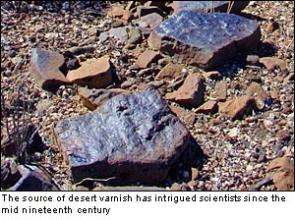
A mysterious shiny coating found on rocks in many of Earth's arid environments could reveal whether there was once life on Mars, according to new research.
The research, published in the July edition of the journal Geology, reveals that the dark coating known as desert varnish creates a record of life around it, by binding traces of DNA, amino acids and other organic compounds to desert rocks. Samples of Martian desert varnish could therefore show whether there has been life on Mars at any stage over the last 4.5 billion years.
The researchers hope that these results will encourage any future Mars Sample Return mission to add desert varnish to its Martian shopping list.
The source of the varnish, which looks like it has been painted onto the rocks, has intrigued scientists since the mid nineteenth century, including Darwin, who was so fascinated that he asked the geochemist Berzelius to investigate it. It was previously suggested that its dark colour was the result of the presence of the mineral manganese oxide, and that any traces of life found within the varnish came from biological processes caused by microbes in this mineral.
However, the new research used a battery of techniques, including high resolution electron microscopy, to show that any traces of life in the varnish do not come from microbes in manganese oxide. The research reveals that the most important mineral in the varnish is silica, which means that biological processes are not significant in the varnish's formation. On desert rock surfaces, silica is dissolved from other minerals and then gels together to form a glaze, trapping organic traces from its surroundings.
Dr Randall Perry, lead author of the research from the Department of Earth Science and Engineering at Imperial College London, explained that as life is not involved in desert varnish formation, the varnish can act as an indicator of whether life was present or absent in the local environment.
Dr Perry said: "If silica exists in varnish-like coatings in Martian deserts or caves, then it may entomb ancient microbes or chemical signatures of previous life there, too. Desert varnish forms over tens of thousands of years and the deepest, oldest layers in the varnish may have formed in very different conditions to the shallowest, youngest layer.
"These lustrous chroniclers of the local surroundings can provide a window back in time. Martian desert varnish would contain a fascinating chronology of the Martian setting," he added.
Source: Imperial College London


