Oscillating Pattern in Nanoparticle Crystallisation
June 30, 2006
Oscillating Pattern in Nanoparticle Crystallisation

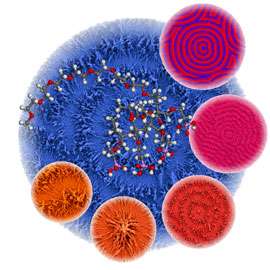
A typical Belousov-Zhabotinsky pattern of concentric circles, observed in this case in polymer-controlled crystallisation and self-organisation from barium carbonate. The structures are similar to a computer-simulated pattern (smaller circle, upper right). The block copolymer used appears in the picture as a shortened molecule structure. Image: Max Planck Institute of Colloids and Interfaces

In order to survive, biological systems need to form patterns and organise themselves. Scientists at the Max Planck Institute for Colloids and Interfaces in Potsdam, Germany, have now combined self-organisation with chemical pattern formation. They coupled an oscillating chemical reaction with polymer-controlled crystallisation and self-organisation in barium carbonate.

In this way, they proved that oscillating reactions - like the renowned Belousov-Zhabotinsky reaction - can also take place in multi-phase systems. On basis of these results, scientists can better explain chemical reactions which are out of thermodynamic balance, as well as biological pattern formation in nature. Furthermore, these results could lead to the creation of surfaces with new kinds of structures.

Scientists are especially interested in oscillating chemical reactions. These occur when reaction products periodically and repeatedly change. Their behaviour is of importance to many fields of study - including chaos research. That is because these reaction systems are always complex and far away from thermodynamic equilibrium. One particularly well-known example is the "Belousov-Zhabotinsky" reaction. In it, a coloured indicator is used to make the reaction products of a coupled redox reaction visible. They typically take on the pattern of concentric circles, spreading out, for example, across a petri dish.

Mathematically, spatially oscillating reactions can be described as "reaction-diffusion systems". This means that it is not just chemical reactions which influence the amount of material at a certain point in space. Diffusion also plays a role - the exchange of material with the surrounding area. In such simulations, we get the typical concentric circle pattern of a Belousov-Zhabotinsky reaction. In the picture above, it is indicated in red-violet.

Researchers from Potsdam have now proven that these oscillating reactions can also apply to multi-phase systems, and even to the self-organisation processes of nanoparticles. What is central is that in a multi-phase reaction system, it is possible to formulate either an autocatalyic or autoinhibiting reaction step. This leads an oscillating system to be constructed, and ultimately a pattern to be formed.

The researchers used a newly synthesized polymer to create the typical concentric circle pattern, via controlled barium carbonate crystallisation (see image). Such patterns correspond quite well to the calculations in a simulation. The researchers also were able to formulate a complex coupled reaction system including crystallisation, complexation, and precipitation reactions and identify the autocatalytic formation of a complex between barium and the polymer.

Notably, the elongated crystalline structures which made up the circular pattern are themselves created by superstructures of nanoparticles, which are themselves created by self-organisation (see image). In this way, Max Planck researchers have shown for the first time that the Belousov-Zhabotinsky reaction does not just take place in a solution, but also in multi-phase systems, and in nanoparticle self-organisation. This discovery is not only important to research into reactions far away from thermodynamic equilibrium. It can also help explain biological pattern formation. One example of biological self-organisation is mussel shell patterns. They are created via controlled crystallisation, just like the model systems of the researchers in Potsdam used. Interestingly, these patterns also mathematically duplicate reaction-diffusion systems exactly.

Citation: Tongxin Wang, An-Wu Xu, Helmut Cölfen, Formation of self-organized, dynamic structure patterns of barium carbonate crystals in polymer controlled crystallization, Angewandte Chemie (Online-Edition), June 21, 2006

Source: Max Planck Institute of Colloids and Interfaces

4.4 /5 (9 votes)  

Rank 4.4 /5 (9 votes)
Tags

Relevant PhysicsForums posts
  • polymer nanocomposites
    createdFeb 10, 2012
  • Corrosion Tests on Magnesium
    createdFeb 09, 2012
  • polyethylene copper nanocomposite
    createdFeb 09, 2012
  • Output of xrd analysis
    createdFeb 08, 2012
  • Transport phenomena problem based on problems 18.B11 and 19B.6 from Bird, stewart, lw
    createdFeb 06, 2012
  • Help with material selection - Car Piston
    createdFeb 05, 2012
  • More from Physics Forums - Materials & Chemical Engineering

More news stories

New kind of solar cell could capture significantly more energy than current cells

New solar cells could increase the maximum efficiency of solar panels by over 25%, according to scientists from the University of Cambridge.

Nanotechnology / Nanophysics

created Feb 08, 2012 | popularity 4.5 / 5 (12) | comments 14 | with audio podcast

Nanoshell whispering galleries improve thin solar panels

Visitors to Statuary Hall in the U.S. Capitol Building may have experienced a curious acoustic feature that allows a person to whisper softly at one side of the cavernous, half-domed room and for another on ...

Nanotechnology / Nanomaterials

created Feb 07, 2012 | popularity 4.3 / 5 (6) | comments 6 | with audio podcast

'Dark plasmons' transmit energy

Microscopic channels of gold nanoparticles have the ability to transmit electromagnetic energy that starts as light and propagates via "dark plasmons," according to researchers at Rice University.

Nanotechnology / Nanophysics

created Feb 09, 2012 | popularity 4.8 / 5 (9) | comments 1 | with audio podcast

Revealing how a battery material works

Since its discovery 15 years ago, lithium iron phosphate (LiFePO4) has become one of the most promising materials for rechargeable batteries because of its stability, durability, safety and ability to deliver ...

Nanotechnology / Nanomaterials

created Feb 08, 2012 | popularity 5 / 5 (5) | comments 0 | with audio podcast

Nanotube therapy takes aim at breast cancer stem cells

Wake Forest Baptist Medical Center researchers have again proven that injecting multiwalled carbon nanotubes (MWCNTs) into tumors and heating them with a quick, 30-second laser treatment can kill them.

Nanotechnology / Bio & Medicine

created Feb 09, 2012 | popularity 5 / 5 (1) | comments 0 | with audio podcast


Walney offshore wind farm is world's biggest (for now)

(PhysOrg.com) -- The Walney wind farm on the Irish Sea--characterized by high tides, waves and windy weather--officially opened this week. The farm is treated in the press as a very big deal as the Walney ...

GPS court ruling leaves US phone tracking unclear

A US Supreme Court decision requiring a warrant to place a GPS device on the car of a criminal suspect leaves unresolved the bigger issue of police tracking using mobile phones, legal experts say.

Study finds that anti-diabetic medication can prevent the long-term effects of maternal obesity

In a study to be presented today at the Society for Maternal-Fetal Medicine's annual meeting, The Pregnancy Meeting, in Dallas, Texas, researchers will report findings that show that short therapy with the anti-diabetic medication ...

Europe stakes billion-dollar bet on new rocket

A pencil-slim rocket is scheduled to lift into space from South America on Monday, carrying a billion-dollar bet that Europe can grab a juicy slice of the market to place satellites in low orbit.

Netflix settlement trims 14 pct off 4Q earnings

(AP) -- Netflix pressed the rewind button on its fourth-quarter earnings after settling allegations that the video subscription service violated a consumer-privacy law.

Europeans protest controversial Internet pact

Tens of thousands of people marched in protests in more than a dozen European cities Saturday against a controversial anti-online piracy pact that critics say could curtail Internet freedom.