Jellyfish-Like Creatures May Play Major Role in Fate of CO2 in the Ocean
July 3rd, 2006 Jellyfish-Like Creatures May Play Major Role in Fate of Carbon Dioxide in the Ocean

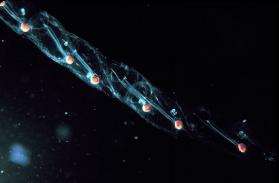
A chain of salpa aspera (Photo by Larry Madin, Woods Hole Oceanographic Institution)

Transparent jellyfish-like creatures known as a salps, considered by many a low member in the ocean food web, may be more important to the fate of the greenhouse gas carbon dioxide in the ocean than previously thought.

In the May issue of Deep Sea Research, scientists report that salps, about the size of a human thumb, swarming by the billions in “hot spots” may be transporting tons of carbon per day from the ocean surface to the deep sea and keep it from re-entering the atmosphere.

Salps are semi-transparent, barrel-shaped marine animals that move through the water by drawing water in the front end and propelling it out the rear in a sort of jet propulsion. The water passes over a mucus membrane that vacuums it clean of all edible material.

The oceans absorb excess carbon dioxide from the atmosphere, including some from the burning of fossil fuels. In sunlit surface waters, tiny marine plants called phytoplankton use the carbon dioxide, CO2, to grow. Animals then consume the phytoplankton and incorporate the carbon, but most of it dissolves back into the oceans when the animals defecate or die. The carbon can be used again by bacteria and plants, or can return to the atmosphere as heat-trapping carbon dioxide when it is consumed and respired by animals.

Biologists Laurence Madin of Woods Hole Oceanographic Institution (WHOI) and Patricia Kremer of the University of Connecticut and colleagues have conducted four summer expeditions to the Mid-Atlantic Bight region, between Cape Hatteras and Georges Bank, in the North Atlantic, since 1975. Each time the researchers found that one particular salp species, Salpa aspera, multiplied into dense swarms that lasted for months.

One swarm covered 100,000 square kilometers (38,600 square miles) of the sea surface. The scientists estimated that the swarm consumed up to 74 percent of microscopic carbon-containing plants from the surface water per day, and their sinking fecal pellets transported up to 4,000 tons of carbon a day to deep water.

“Salps swim, feed, and produce waste continuously,” Madin said. “They take in small packages of carbon and make them into big packages that sink fast.”

In previous work, Madin and WHOI biologist Richard Harbison found that salp fecal pellets sink as much as 1,000 meters (3,280 feet) a day. The scientists also showed that when salps die, their bodies also sink fast—up to 475 meters (1,575 feet) a day, far faster than most pellets.. If salps are really a dead-end in the food web and remain uneaten on the way down, they could send even more carbon to the deep.

Salpa aspera swims long distances down in daylight and back up at night in what is known as vertical migration. Madin, Kremer and colleagues Peter Wiebe and Erich Horgan of WHOI and Jennifer Purcell and David Nemazie of the University of Maryland found that the salps stay at depths of 600 to 800 meters (1,970 to 2,625 feet) during the day, coming to the surface only at night.

“At the surface,” Madin said, “salps can feed on phytoplankton. They may swim down in the day to avoid predators or damaging sunlight. And swimming up at night allows them to aggregate to reproduce and multiply quickly when food is abundant.”

Because of this behavior, salps release fecal pellets in deep water, where few animals eat them. This enhances the transport of carbon away from the atmosphere.

In 2004 and 2006, Madin and Kremer studied salp swarms in a different ecosystem, the Southern Ocean near Antarctica. Some scientists have reported larger salp populations there in warmer years with less sea ice. If this proves true, and if Antarctica’s climate warms, salp swarms could have a greater effect on phytoplankton and carbon in the Southern Ocean ecosystem.

Funding for this study was provided by the National Science Foundation, National Oceanic and Atmospheric Administration, and the Access to the Sea program at Woods Hole Oceanographic Institution.

Source: Woods Hole Oceanographic Institution


print this article email this article download pdf blog this article bookmark this article     Digg this Stumble it share on Facebook share on Reddit add to delicious save to Yahoo! bookmarks
4.6/5 after 14 votes


July 3rd, 2006 all stories
Biology /

Comments: 0
Rank: 4.6/5 after 14 votes

  • Stumble this up

  • Digg this

  • Share it:
  • share on Facebook
  • share on MySpace
  • share on Slashdot
  • rss-newsfeed
  • share on Google
  • share on Reddit
  • add to delicious
  • save to Yahoo! bookmarks
  • share on Windows Live
  • Add to Mixx!
Rating: 4.6/5 after 14 votes

  • Related Stories

  • Energy-Efficient Intelligent House that Can Learn our Routines
    created Jul 03, 2009 | popularity not rated yet | comments 0
  • Sulfate lens enhances climate warming properties of atmospheric soot
    created Jun 29, 2009 | popularity not rated yet | comments 0
  • Swiss team unveil pioneering solar plane
    created Jun 26, 2009 | popularity not rated yet | comments 0
  • Ozone hole reduces atmospheric CO2 uptake in the Southern Ocean
    created Jun 24, 2009 | popularity not rated yet | comments 0
  • Going, going green
    created Jun 22, 2009 | popularity not rated yet | comments 0

Tags


  • Physicists Demonstrate Quantum Memory with Matter Qubits
    Physicists Demonstrate Quantum Memory with Matter Qubits
    Physics / General Physics
    created Jul 03, 2009 | popularity 4.4 / 5 (17) | comments 1
  • 'Holey' Nanosheets for Wastewater Dye Removal
    Nanotechnology / Nanomaterials
    created Jul 01, 2009 | popularity 5 / 5 (5) | comments 1
  • Jellyfish Robot Swims Like its Biological Counterpart
    Jellyfish Robot Swims Like its Biological Counterpart
    Electronics / Robotics
    created Jun 26, 2009 | popularity 4.4 / 5 (8) | comments 1
  • Could Maxwell's Demon Exist in Nanoscale Systems?
    Could Maxwell's Demon Exist in Nanoscale Systems?
    Physics / General Physics
    created Jun 24, 2009 | popularity 4.4 / 5 (18) | comments 29
  • Living Safely with Robots, Beyond Asimov's Laws
    Living Safely with Robots, Beyond Asimov's Laws
    Electronics / Robotics
    created Jun 22, 2009 | popularity 4.6 / 5 (52) | comments 40
  • Other News

    California water plan aims to save Puget Sound orcas

    Biology / Ecology

    created 7 hours ago | popularity not rated yet | comments 0

    A plan to restore salmon runs on California's Sacramento River also could help revive killer whale populations 700 miles to the north in Puget Sound, as federal scientists struggle to protect endangered species in a complex ...


    Scientists 'rebuild' giant moa using ancient DNA

    Biology / Plants & Animals

    created Jul 01, 2009 | popularity 5 / 5 (10) | comments 12

    (PhysOrg.com) -- Scientists have performed the first DNA-based reconstruction of the giant extinct moa bird, using prehistoric feathers recovered from caves and rock shelters in New Zealand.


    Pacific Giant Salamander (Dicamptodon tenebrosus)

    Salamanders, regenerative wonders, heal like mammals, people

    Biology / Microbiology

    created Jul 01, 2009 | popularity 5 / 5 (20) | comments 11

    The salamander is a superhero of regeneration, able to replace lost limbs, damaged lungs, sliced spinal cord -- even bits of lopped-off brain. But it turns out that remarkable ability isn't so mysterious after ...


    Genetically modified trees

    Anti-biotech groups obstruct forest biotechnology

    Biology / Biotechnology

    created Jun 30, 2009 | popularity 3.7 / 5 (7) | comments 5

    The potential of forest biotechnology to help address significant social and environmental issues is being "strangled at birth" by the rigid opposition of some groups and regulations that effectively preclude ...


    Super-sleepers could help super-sizers!

    Super-sleepers could help super-sizers!

    Biology / Plants & Animals

    created Jun 29, 2009 | popularity 5 / 5 (2) | comments 4

    Burrowing frogs can survive buried for several years without food or water. Scientists have discovered that the metabolism of their cells changes radically during the dormancy period allowing the frogs to ...