'Rough Guide to Mars' – scientists offer virtual reality tours of the surface of Mars
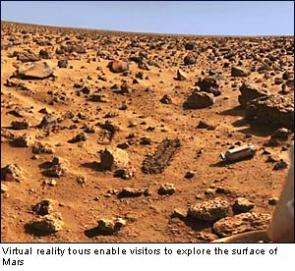
The dramatic landscapes of Mars will be brought to life at this week's Royal Society Summer Science Exhibition, thanks to work carried out by a team of geologists and engineers at Imperial, University College London and the Open University.
Using new images generated by the European Space Agency's Mars Express High Resolution Stereo Camera, the team has created 3D visualisations of the canyons, volcanoes and craters of the Red Planet.
This 'Rough Guide to Mars' will allow visitors to take the controls and explore canyons carved by gigantic floods, peer down into volcanoes and plunge into a frozen sea, recently discovered by the Mars Express spacecraft. Dr Sanjeev Gupta, of Imperial's Department of Earth Science and Engineering, comments:
"It will be great fun,like having your very own jetpack and whizzing around the Martian landscape without leaving your chair."
As well as bringing Martian landscapes to life, the technology gives geologists new opportunities to examine geological features that provide important clues to the planet's evolution and history. Dr Gupta adds:
"The more we see of the surface of Mars, the more exciting it becomes. At Imperial we are investigating features created by huge catastrophic floods that form deep beneath the surface, where life may have developed. Theres every chance that future explorations could bring back proof that Earth is not the only planet in our Solar System supporting living organisms."
The team will also display a meteorite from Mars and a scale model of the ESA's Mars Express.
Source: University College London


