Space shield could help image Earth-like planets
July 5, 2006
The daisy-shaped starshade will allow light from distant planets to pass unimpeded into the orbiting space telescope. Credit: CU-Boulder
A gigantic, daisy-shaped space shield could be used to block out pesky starlight and allow astronomers using an orbiting telescope to zero in on Earth-like planets in other solar systems, according to a University of Colorado at Boulder study.
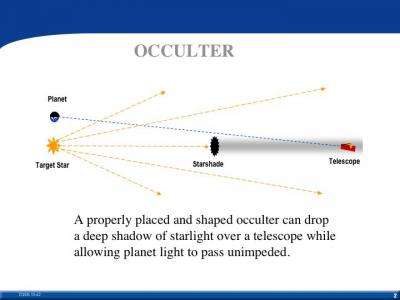
The thin plastic "starshade" would allow a telescope trailing thousands of miles behind it to image light from distant planets skimming by the giant petals without being swamped by light from the parent stars, said CU-Boulder Professor Webster Cash. Researchers could then identify planetary features like oceans, continents, polar caps and cloud banks and even detect biomarkers like methane, oxygen and water if they exist, he said.
"We think this is a compelling concept, particularly because it can be built today with existing technology," said Cash. "We will be able to study Earth-like planets tens of trillions of miles away and chemically analyze their atmospheres for signs of life."
A paper on the subject by Cash is featured on the cover of the July 6 issue of Nature. The paper includes mathematical solutions to optical challenges like the bending and scattering of light between the pliable, 50-yard-in-diameter starshade and the space telescope, which would orbit in tandem roughly 15,000 miles apart.
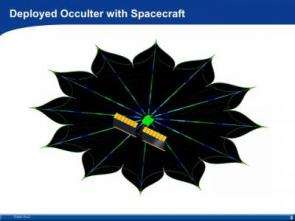
Roughly half the size of a football field, the starshade will be equipped with thrusters to move into the line of sight of distant stars. Credit: CU-Boulder
Scientists would launch the telescope and starshade together into an orbit roughly 1 million miles from Earth, then remotely unfurl the starshade and use small thrusters to move it into lines of sight of nearby stars thought to harbor planets, said Cash. The thrusters would be intermittently turned on to hold the starshade steady during the observations of the planets, which would appear as bright specks."Think of an outfielder holding up one hand to block out the sunlight as he tracks a fly ball," said Cash, director of CU-Boulder's Center for Astrophysics and Space Astronomy. "We would use the starshade as a giant hand to suppress the light emanating from a central star by a factor of about 10 billion."
The novel concept could be used to map planetary systems around distant stars and detect planets as small as Earth's moon, said Cash. In recent years, more than 175 planets have been discovered orbiting other stars.
Dubbed the New Worlds Observer, Cash's design was selected for a $400,000 funding boost last October by NASA's Institute for Advanced Concepts after being selected for initial study in 2004. The team includes researchers from Princeton University, NASA's Goddard Space Flight Center, Ball Aerospace of Boulder, Northrop Grumman Corp. of Los Angeles and the Carnegie Institution in Washington, D.C.
The team also has submitted a $400 million proposal with NASA's Discovery Program to launch a stand-alone starshade to work in concert with the powerful James Webb Space Telescope. The James Webb Space Telescope is an infrared observatory slated for launch in 2013 and considered the successor to the Hubble Space Telescope.
Alternative proposals for imaging distant planets involve suppressing parent starlight once it has entered the telescope -- a complicated, Rube Goldberg-like undertaking involving shifting mirrors and active electronics, said Marc Kuchner of NASA's Goddard Space Flight Center's Exoplanets and Stellar Astrophysics Laboratory. "In contrast, this is a very clean and simple optical concept, and may be the most promising idea yet on how to directly image our Earth-like neighbors," said Kuchner, also a member of the New Worlds Observer science team.
"For over a century, science fiction writers have speculated on the existence of Earth-like planets around nearby stars," Cash wrote in Nature. "If they actually exist, use of an occulter could find them within the next decade."
An even more advanced version of the New Worlds Imager might involve a ring of telescopes placed on the moon beneath a fleet of orbiting starshades that would allow scientists to actually photograph distant, Earth-like planets, Cash speculated. "There is a bit of Buck Rogers in the New Worlds Imager concept, but seeking and mapping new lands is something that seems to ring deep in the human psyche."
Source: University of Colorado at Boulder
-
Astronomers fret over Webb Telescope's future
Oct 10, 2011 |
5 / 5 (4) |
2
-
Proposed astronomy missions selected for further study by NASA
Feb 22, 2008 |
4.4 / 5 (7) |
0
-
Proposed 'starshade' observatory could image continents on exo-solar planets
Oct 12, 2005 |
4.2 / 5 (9) |
0
-
Novel Technique for Imaging Distant Planets
Sep 30, 2004 |
not rated yet |
0
-
When stars play planetary pinball
16 hours ago |
4 / 5 (1) |
0
-
Engineers build first sub-10-nm carbon nanotube transistor
Feb 01, 2012 |
4.9 / 5 (31) |
30
-
Something old, something new: Evolution and the structural divergence of duplicate genes
Jan 31, 2012 |
4.6 / 5 (7) |
1
-
The hidden nanoworld of ice crystals: Revealing the dynamic behavior of quasi-liquid layers
Jan 30, 2012 |
5 / 5 (3) |
1
-
Stock market network reveals investor clustering
Jan 27, 2012 |
3.9 / 5 (23) |
8
-
Of microchemistry and molecules: Electronic microfluidic device synthesizes biocompatible probes
Jan 26, 2012 |
5 / 5 (1) |
0
-
Understanding induced emfs
2 hours ago
-
What is the precise definition of a year?
3 hours ago
-
Universe as a cellular automaton
4 hours ago
-
Question about Newton's laws
5 hours ago
-
Gravity Question (I think) with mass and speed
7 hours ago
-
Can you manipulate any formula in Physics?
8 hours ago
- More from Physics Forums - General Physics
More news stories
Explained: Sigma
It's a question that arises with virtually every major new finding in science or medicine: What makes a result reliable enough to be taken seriously? The answer has to do with statistical significance -- but ...
Feb 09, 2012 |
5 / 5 (19) |
65
Quantum physicist explains $100K offer for proof scaled-up quantum computing is impossible
(PhysOrg.com) -- MIT researcher Scott Aaronson has certainly riled the physics community with his offer this past Friday, of $100,000 to anyone who can prove that scaled-up quantum computing is impossible. ...
Diamond light, brighter than the sun
Its the size of five football pitches and generates light 10 billion times brighter than the sun. As the Diamond Light Source celebrates its tenth anniversary this year, Penny Bailey visits one of the ...
Feb 07, 2012 |
4.3 / 5 (7) |
15
|
Physicists 'record' magnetic breakthrough
An international team of scientists has demonstrated a revolutionary new way of magnetic recording which will allow information to be processed hundreds of times faster than by current hard drive technology.
Feb 07, 2012 |
4.5 / 5 (41) |
14
|
Hints of the Higgs - papers are submitted
Back in December 2011, the ATLAS and CMS experiments at CERN presented some exciting results that provided tantalising hints of the Higgs boson.
Feb 08, 2012 |
4.1 / 5 (7) |
10
Walney offshore wind farm is world's biggest (for now)
(PhysOrg.com) -- The Walney wind farm on the Irish Sea--characterized by high tides, waves and windy weather--officially opened this week. The farm is treated in the press as a very big deal as the Walney ...
GPS court ruling leaves US phone tracking unclear
A US Supreme Court decision requiring a warrant to place a GPS device on the car of a criminal suspect leaves unresolved the bigger issue of police tracking using mobile phones, legal experts say.
Europeans protest controversial Internet pact
Tens of thousands of people marched in protests in more than a dozen European cities Saturday against a controversial anti-online piracy pact that critics say could curtail Internet freedom.
Europe stakes billion-dollar bet on new rocket
A pencil-slim rocket is scheduled to lift into space from South America on Monday, carrying a billion-dollar bet that Europe can grab a juicy slice of the market to place satellites in low orbit.
Study finds that anti-diabetic medication can prevent the long-term effects of maternal obesity
In a study to be presented today at the Society for Maternal-Fetal Medicine's annual meeting, The Pregnancy Meeting, in Dallas, Texas, researchers will report findings that show that short therapy with the anti-diabetic medication ...
Netflix settlement trims 14 pct off 4Q earnings
(AP) -- Netflix pressed the rewind button on its fourth-quarter earnings after settling allegations that the video subscription service violated a consumer-privacy law.