New instrument probes nanostructure growth for industry and research
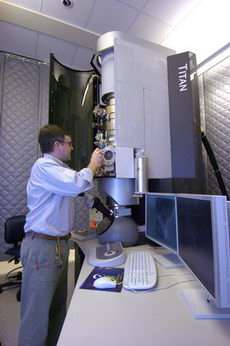
Researchers at Purdue University are using a rare type of electron microscope to see how structures like carbon nanotubes form at the atomic level, information that will be crucial for nanotechnology to find practical applications in computing, electronics and other areas.
The new transmission electron microscope has been modified so that researchers can watch how atoms come together to form nanostructures as gases flow into a chamber in the presence of a metal catalyst. This is the same method used to make nanotubes in research labs and electronic devices in the semiconductor industry.
"Before we can consistently manufacture nanostructures that have the same specifications and qualities, we have to learn precisely how atoms interact and come together to form these structures," said Eric Stach, an associate professor of materials engineering who operates the microscope at the Birck Nanotechnology Center.
The $4 million FEI Titan microscope is equipped with an "environmental cell," in which gases such as acetylene or butane, which contain carbon, are passed over nanoparticles of metal, such as iron or nickel. The metal particles act as a catalyst for breaking down the gases and releasing carbon atoms during the reaction, which takes place in the cell at temperatures sometimes reaching more than 1,000 degrees Celsius, or more than 1,800 degrees Fahrenheit.
"What's unusual about this instrument is the ability to take high-resolution pictures while you flow gases over a sample," said Stach, noting that fewer than five such microscopes exist in the world.
Electrons are accelerated under high voltage and manipulated with a series of "magnetic lenses" that focus electrons through thin sections of materials being studied. The electrons bounce off the atoms in the material, and this scattering process can be reconstructed to form an image.
"The transmission electron microscope allows you take pictures of the internal structure of a material," Stach said.
The instrument, which has 14 main lenses and another 50 smaller lenses, is housed in a specially shielded facility in the Discovery Park lab to block electromagnetic interference from sources such as powerlines and radio transmitters. The 10-foot-tall, 3 1/2-ton microscope sits on its own concrete slab, separated from the building's foundation to isolate it from vibration.
Pictures are formed with a resolution of 2 angstroms, which is fine enough to allow imaging of atomic arrangements in the sample.
"Researchers have done these sorts of experiments with other microscopes that have environmental cells but not with this level of resolution," Stach said.
Carbon nanotubes — hollow fibers that have promising future applications in computer chips and electronic devices — are "grown" using the metal catalyst to break down a gas. But Stach said the catalytic mechanism is not fully understood, and that is one area researchers will pursue using this microscope.
During the reaction, carbon forms into nanotubes having various lengths, diameters and twists, or "chiralities."
"These different nanotubes possess different performance characteristics," Stach said. "What we really need to understand is how to get the same performance and the same characteristics by growing the same tubes every time."
Carbon nanotubes, which were discovered in the early 1990s, might enable industry to create a new class of transistors and more powerful, energy-efficient computers, as well as ultra-thin "nanowires" for electronic circuits, but their practical application requires that they be manufactured to specific standards.
"In the lab, a whole bunch of nanotubes are grown, and then you see which one has good properties," Stach said. "You cannot yet control how to get the exact nanotube twice, but in order to move from the laboratory into creating something that can be engineered and made into devices, we have to have an understanding of the process. How do we get the same nanotube every time? Now we are going to be able to take pictures that show individual carbon atoms interacting with the metal catalyst and growing into nanotubes."
Chemical processes to grow materials using a gas require an environment that's close to normal atmospheric pressure, but electron microscopes operate in a vacuum to maintain the flow of electrons. The new instrument enables researchers to run experiments at close to normal pressure levels inside the environmental cell, while critical microscope components run in a vacuum.
"It's tricky because we are trying to recreate real growth conditions within the microscope, an instrument that normally operates in a vacuum environment," Stach said.
The environmental cell is a cube-shaped chamber, and each side measures about 5 millimeters, or about one-fifth of an inch.
"The idea is to keep it small so that you can have high pressure locally, while maintaining vacuum conditions everywhere else," Stach said.
Purdue researchers are using the microscope in a joint project with scientists at IBM Corp.'s Thomas J. Watson Research Center in Yorktown Heights, N.Y., to study how to make silicon nanowires for future computers.
"In addition to studying nanometer-scale structures made of unconventional materials, such as carbon, we are also trying to learn how to make smaller devices and structures from conventional silicon," Stach said.
"On this size scale, a material's properties change. For example, if you take a piece of gold and make it very small, it's not really quite gold anymore because the electronic structure changes and it has different properties. These nanomaterials transmit electricity and light differently than when they are in bulk form, and these differing properties could be harnessed to create superior computers and electronics, but only if we learn precisely how they form at the atomic level and how to fabricate them in a uniform way."
The researchers at Birck also are using the new instrument for work funded by the National Science Foundation to study the growth of semiconductor materials, such as silicon, germanium and gallium arsenide.
"It's the same idea as studying the growth process of carbon nanotubes," Stach said. "We need to know which atoms are going where. What is the effect of temperature, pressure, source gas and catalysts in creating uniform structures that are the same every time?"
Researchers also will use the instrument to help Purdue researchers study the workings of catalysts, which are critical for industry in making everything from gasoline to plastics. As part of that work, the microscope will be used in projects involving Purdue's Center for Catalyst Design.
"Ultimately, the goal is to create better catalysts to make products more efficiently and at lower cost," Stach said.
Researchers at the interdisciplinary center plan to use the instrument for a variety of other research, including studies to learn more about how metals rust and oxidize at the atomic level, information that has potentially major economic value for industry, he said.
"Now that the microscope is up and running, we expect greater interest for more joint research projects through Birck and Discovery Park with other industrial and corporate partners," Stach said. "This microscope is going to be very busy."
Source: by Emil Venere, Phillip Fiorini,


