New Ion Trap May Lead to Large Quantum Computers
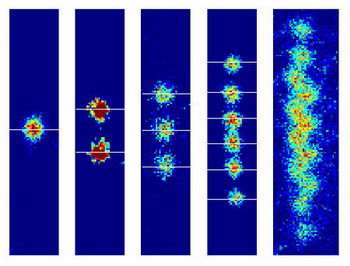
Physicists at the National Institute of Standards and Technology have designed and built a novel electromagnetic trap for ions that could be easily mass produced to potentially make quantum computers large enough for practical use. The new trap, described in the June 30 issue of Physical Review Letters, may help scientists surmount what is currently the most significant barrier to building a working quantum computer—scaling up components and processes that have been successfully demonstrated individually.
Quantum computers would exploit the unusual behavior of the smallest particles of matter and light. Their theoretical ability to perform vast numbers of operations simultaneously has the potential to solve certain problems, such as breaking data encryption codes or searching large databases, far faster than conventional computers.
Ions (electrically charged atoms) are promising candidates for use as quantum bits (qubits) in quantum computers. The NIST team, one of 18 research groups worldwide experimenting with ion qubits, previously has demonstrated at a rudimentary level all the basic building blocks for a quantum computer, including key processes such as error correction, and also has proposed a large-scale architecture.
The new NIST trap is the first functional ion trap in which all electrodes are arranged in one horizontal layer, a “chip-like” geometry that is much easier to manufacture than previous ion traps with two or three layers of electrodes. The new trap, which has gold electrodes that confine ions about 40 micrometers above the electrodes, was constructed using standard microfabrication techniques.
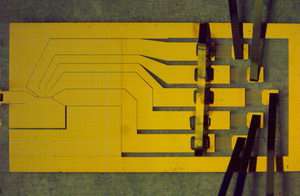
NIST scientists report that their single-layer device can trap a dozen magnesium ions without generating too much heat from electrode voltage fluctuations—also an important factor, because heating has limited the prospects for previous small traps. Microscale traps are desirable because the smaller the trap, the faster the future computer. Work is continuing at NIST and at collaborating industrial and federal labs to build single-layer traps with more complex structures in which perhaps 10 to 15 ions eventually could be manipulated with lasers to carry out logic operations.
Quantum Information Research at NIST: Goals and Vision
America’s future prosperity and security may rely in part on the exotic properties of some of the smallest articles in nature. Research on quantum information (QI) seeks to control and exploit these properties for scientific and societal benefits. This remarkable field combines physics, information science, and mathematics in an effort to design nanotechnologies that may accomplish feats considered impossible with today’s technology. QI researchers are already generating “unbreakable” codes for ultra-secure encryption. They may someday build quantum computers that can solve problems in seconds that today’s best supercomputers could not solve in years. QI has the potential to expand and strengthen the U.S. economy and security in the 21st century just as transistors and lasers did in the 20th century.
Nations around the world are investing heavily in QI research in recognition of the economic and security implications. A significant part of the U.S. effort is based at the National Institute of Standards and Technology (NIST), which has the largest internal QI research program of any federal agency.
NIST laboratories routinely develop the measurement and standards infrastructure needed to promote innovation in emerging fields that may transform the future. Few fields need this support as much as QI, which involves entirely new concepts of information processing as well as complex hardware for precision control of individual atoms, very small quantities of light, and electrical currents 1 billion times weaker than those in light bulbs. As the nation’s measurement experts, NIST researchers long have had world-class capabilities in precision measurement and control of atoms, light, and other quantum systems. NIST, therefore, has the world-class skills and facilities needed to advance QI through technology demonstrations, development of new methods and tests for evaluating QI system components, and related scientific discoveries.
NIST first became involved in quantum information science in the early 1990s when physicist David Wineland and colleagues realized that engineering of exotic quantum states could lead to a significantly more precise atomic clock. A few years later, Wineland demonstrated the first quantum logic operation, a pioneering step toward a future quantum computer using ions (electrically charged atoms) to process information. In 1999, the NIST Physics Laboratory launched a broader Quantum Information Program, joined shortly thereafter by NIST’s Information Technology Laboratory and Electronics and Electrical Engineering Laboratory.
This interdisciplinary program, featuring strong collaborations among physicists, electrical engineers, mathematicians, and computer scientists, has established NIST as one of the premier QI programs in the world. Participants include Wineland, a NIST Fellow and Presidential Rank Award winner; physicist William D. Phillips, a 1997 Nobel Prize winner in physics; mathematician Emanuel Knill, a leading QI theorist; and physicist Sae Woo Nam, winner of a Presidential Early Career Award for Scientists and Engineers. A total of nine technical divisions within three different laboratories at NIST’s Gaithersburg and Boulder campuses are involved.
NIST’s work in ion-trap quantum computing is widely recognized as one of the most advanced QI efforts in the world. Scientists building the NIST quantum communications testbed set a record in 2004 for the fastest system for distributing quantum cryptographic “keys,” codes for encrypting messages that, due to the peculiarities of quantum physics, cannot be intercepted without detection. Other NIST research with single photon sources and detectors, and computing with neutral atoms and “artificial atoms,” are also among the leading efforts worldwide. For instance, prospects for practical quantum communications have been improved by NIST’s recent demonstration of a device that detects single photons with 88 percent efficiency, a QI record.
There is strong synergy between NIST’s core mission work on measurement and standards and the QI research program. For instance, NIST scientists gained much of their expertise in quantum systems from decades of work developing atomic clocks. NIST’s ultra-precise atomic fountain clock—the world’s most accurate device for measuring time—is based on the precise manipulation and measurement of two quantum energy levels in the cesium atom. This clock would neither gain nor lose one second in 60 million years (as of March 2005), an accuracy level that is continually being improved. NIST quantum computing research is producing new techniques that may lead to even more accurate atomic clocks in the future.
Ultimately, NIST measurements, tests, and technologies for quantum information science are helping U.S. industry develop new information technologies in an effort to ensure U.S. technological leadership and strengthen national security. The United States may have the lead in this field for now—based in part on NIST’s contributions—but competition from Europe, Japan, Australia, and developing countries such as China is strong and growing.
Citation: S. Seidelin, J. Chiaverini, R. Reichle, J.J. Bollinger, D. Leibfried, J. Britton, J.H. Wesenberg, R.B. Blakestad, R.J. Epstein, D.B. Hume, W.M. Itano, J.D. Jost, C. Langer, R. Ozeri, N. Shiga, and D.J. Wineland. 2006. A microfabricated surface-electrode ion trap for scalable quantum information processing. Physical Review Letters. June 30
Source: NIST


