Atoms Under Control
Max Planck researchers lay the foundations for a distributed quantum computer with the "quasipermanent" storing of an atom between two mirrors
Complex computing operations could be greatly accelerated through massive parallel processing in a quantum computer. The smallest units of information are what are known as quantum bits, which could be realized using atoms or molecules, if one can manipulate their position, quantum state, and interactions with other particles.
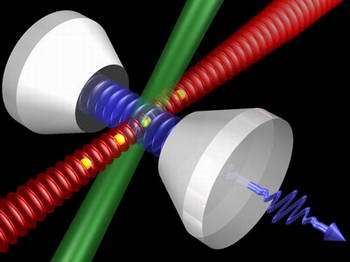
Image: Cooling atoms in a resonator: with the help of a number of laser beams (red and green) individual atoms (yellow) are trapped in the light field of an optical resonator and are brought to rest there long enough that their movement can only be determined via quantum mechanical uncertainty. (Max Planck Institute for Quantum Optics)
Controlling single atoms in an optical resonator is now one decisive step closer to becoming reality for the research team led by Professor Gerhard Rempe of the Max Planck Institute of Quantum Optics in Garching, near Munich, Germany. The scientists report in the magazine Nature that they were able to cool single rubidium atoms in every direction of motion and keep them there on average for 17 seconds, using a sophisticated array of lasers in an optical resonator. This is, by far, the longest storage time ever reached in a strongly coupled resonator system.
Trapping, cooling, and storing neutral atoms requires an elaborate process. As a first method we have, now almost classic, laser cooling in a "magneto-optical trap". Atoms are shot from six directions with laser beams whose frequency lies somewhat below the excitation energy. In this way, the particles always absorb light when they move themselves on the beam - because of the Doppler effect, they are in resonance - and then are slowed down in this direction. We call it cooling, when an individual atom or molecule has more and more movement energy taken from it.
In the experiment at the Max Planck Institute of Quantum Optics, rubidium atoms are prepared in this way and finally, in the electromagnetic field of a laser beam (what is called a "light trap"), led over a distance of 14 millimetres in an optical resonator made of two opposite concave mirrors of the very highest quality.
As soon as the atoms are between the mirrors, the scientists change the geometry of the light trap, mirroring the laser beam back onto itself. Doing this, a standing light wave builds and atoms are held in the trap’s cavities. In addition, two lasers, running across from each other, set at an angle of 45 degrees to the standing wave and 90 degrees to the resonator axis, hit the atoms (see image)
In this special setup, a number of cooling mechanisms are at work. Atom, resonator, and light trap together make up a high-grade coupled system in which an excited atom prefers emitting photons in the direction of the resonator axis. In this way, a light field builds up between the two mirrors which is extremely dependent on the position of the atom. That is because the state of the atom determines the strength of its coupling on the resonator as well as the exact frequency of the atomic transfer, because the energy level of the atoms shifts in the light trap. If the atom moves, the light field adjusts to the new situation, always with a delay which depends on the middle storage period of the photons in the resonator. Because of the delay, all the light forces which affect the atom and slow it down, are contingent on its speed. So, borrowing a term from mechanics, these energies can be called friction forces.
Cooling effects particularly appear when the frequency of the resonator is somewhat greater than the frequency of the exciting laser. In this case, the atom sends photons out of a higher energy, and with preference for the direction of motion. This creates recoil and the atom becomes slower along the axis of the resonator. The absorption of photons occurs above all when the atom moves against the laser beam. This leads to a slowing down in the direction of the laser. Both effects are due to the Doppler effect, mentioned above.
Further braking forces take place along the light trap. They are provoked, first of all, because the light field - as mentioned above - reacts with a delay to the movement of the atoms. Second of all, the change in the energy level is higher in the cavity of the wave than in the nodes. The frequency of the atomic movement is the same as that of the exciting laser only at the nodes. A warm atom stops more often near a node and is excited there. If it moves away from the node, it gains potential energy, which it gives off again during the transfer in the ground state. This process repeats itself periodically and is called, in analogy to the ancient sage, "Sisyphus cooling."
For evidence from the atom and the determination of its storage period, the photons that it scatters in the resonator are counted. A few milliseconds after turning on the "light trap" the rate of counting accelerates significantly, because an atom in the space between the mirrors is already relatively "hot". Inside of 100 microseconds there is a condition of balance and the atom reaches its final temperature, about six millionths of a Kelvin above absolute zero. It then scatters a very small amount of light, but with a constant rate.
The scientists investigated systematically how the various cooling forces had an effect on the storage times of the atoms. Atoms without cooling were held on average only 2.7 seconds, but a Sisyphus-cooled atom stayed in the resonator 17 seconds. If one chooses the appropriate frequency for the resonator and the exciting laser, the life of the stored atom increases four times. In this way it could even be possible to hold a single atom longer than one minute in an optical resonator.
Using this trick of combining different cooling methods which have different kinds of effects, the researchers were able to prepare an exactly known number of atoms in the centre of an optical resonator. The storage times, on average more than 15 seconds, allow experiments in which the interaction of individual atoms with individual photons can be checked. This is, for example, a pre-condition for the entanglement, coupling, and teleportation of quantum states between very distant atoms with the help of photons. In this way, the researchers have taken a tangible step toward creating a distributed quantum computer made of a number of strongly coupled atom resonator systems. The trapped atoms store the quantum bits, while the photons they emit carry out the computing operations.
Original work:
Stefan Nußmann, Karim Murr, Markus Hijkema, Bernhard Weber, Axel Kuhn, and Gerhard Rempe
Vacuum-stimulated cooling of single atoms in three dimensions
Nature Physics, 9. October 2005, DOI 10.1038/nphys
Source: Max Planck Society


