MIT researchers create visionary optic fibers
July 7, 2006
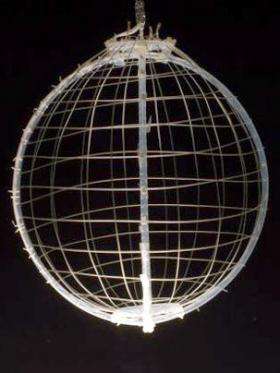
A sphere-shaped web of photo-detecting fibers developed by MIT scientists can sense the optical properties of the entire volume of space around it, as well as detect the source of incoming light. Image courtesy / Greg Hren
In a radical departure from conventional lens-based optics, MIT scientists have developed a sophisticated optical system made of mesh-like webs of light-detecting fibers. The fiber constructs, which have a number of advantages over their lens-based predecessors, are currently capable of measuring the direction, intensity and phase of light (a property used to describe a light wave) without the lenses, filters or detector arrays that are the classic elements of optical systems such as eyes or cameras.
Ultimately the researchers expect the new system will be capable of much more, with potential applications ranging from improved space telescopes to clothing that provides situational awareness to soldiers or even the visually impaired.
The transparent fiber-webs could even enable huge computer screens to be activated with beams of light instead of the touch of a finger. "We could use light to enhance interaction with computers and even gaming systems," said Professor Yoel Fink of the Department of Materials Science and Engineering and the Research Lab of Electronics, leader of the team. "It's intriguing--the idea of touching with light."
The scientists report the work in the June 25 online edition of Nature Materials, and it is featured on the cover of the July print issue of the magazine.
The human eye, digital and film cameras, and even the Hubble space telescope rely on lenses and detector surfaces (like the retina) to create images. But while these systems deliver excellent images, they are constrained by their size, weight, fragility and limited field of view.
In contrast, the fiber webs are flexible and lightweight. Plus, a fiber web in the shape of a sphere can sense the entire volume of space around it, according to Fink.
"When you're looking at something with your eyes, there's a particular direction you're looking in," says Ayman Abouraddy a research scientist in Fink's lab. "The field of view is defined around that direction. Depending on the lens, you may be able to capture a certain field of view around that direction, but that's it. Until now, most every optical system was limited by an optical axis or direction."
In addition to having an unlimited field of view, the fiber sphere can also detect the direction of incoming light. Light enters the transparent sphere at one point and exits at another, providing a directional reference back to the light source.
Fink's team has also created a flat, two-dimensional web of fibers and placed two such webs in parallel. These constructs, which can measure the intensity of incoming light, are capable of generating rough images of objects placed near them, such as the shape of a letter "E" cut stencil-like from paper and lit from behind. The image shows up on a computer screen, reconstructed from a light intensity distribution measured by the webs.
The fibers used in the webs are about 1 millimeter in diameter. They consist of a photoconductive glass core with metal electrodes that run along the length of the core, all surrounded by a transparent polymer insulator.
The fibers can detect light anywhere along their length, producing a change in current in an external electrical circuit. While one fiber on its own cannot detect the exact location of an incoming beam of light, when many fibers are arrayed in a web, their points of intersection provide the exact coordinates of the beam. A computer assimilates the data generated by the web and translates it for the user. If the fibers were woven into a textile, for instance, an embedded computer could provide information on a small display screen or even audibly.
Improving the imaging power of the fiber webs will require reducing the diameter of the fibers and creating denser webs. Fink says he's not certain whether the new technology will one day replicate human vision. "Just the idea of imaging with a transparent object is a true eye opener," he said.
Source: MIT
-
The tangled NETs of the immune system
Apr 28, 2011 |
5 / 5 (1) |
0
-
'Flexible camera' replaces lens with fiber web
Jul 07, 2009 |
4.7 / 5 (12) |
1
-
Researchers create fiber webs that see
Jul 17, 2006 |
4.3 / 5 (25) |
0
-
A bronze matryoshka doll: The metal in the metal in the metal
Feb 07, 2012 |
5 / 5 (7) |
1
-
A quantum connection between light and motion
Feb 06, 2012 |
4.9 / 5 (20) |
6
-
Engineers build first sub-10-nm carbon nanotube transistor
Feb 01, 2012 |
4.9 / 5 (30) |
30
-
Something old, something new: Evolution and the structural divergence of duplicate genes
Jan 31, 2012 |
4.6 / 5 (7) |
1
-
The hidden nanoworld of ice crystals: Revealing the dynamic behavior of quasi-liquid layers
Jan 30, 2012 |
5 / 5 (3) |
1
-
Stock market network reveals investor clustering
Jan 27, 2012 |
3.9 / 5 (23) |
8
-
Of microchemistry and molecules: Electronic microfluidic device synthesizes biocompatible probes
Jan 26, 2012 |
5 / 5 (1) |
0
-
excited U-236 decay time in the U235 fission chain
3 hours ago
-
Polar catastrophe?
6 hours ago
-
Large scale field sonication
8 hours ago
-
states and energy of paired electrons in BCS
Feb 08, 2012
-
difference between longitudinal and transverse refractive indices
Feb 08, 2012
-
Monte Carlo simulation
Feb 07, 2012
- More from Physics Forums - Atomic, Solid State, Comp. Physics
More news stories
Borexino Collaboration succeeds in spotting pep neutrinos emitted from the sun
(PhysOrg.com) -- To learn more about how the sun works, scientists study particles that are emitted from it into space due to thermonuclear reactions that occur inside; by applying known physics principles, ...
Explained: Sigma
It's a question that arises with virtually every major new finding in science or medicine: What makes a result reliable enough to be taken seriously? The answer has to do with statistical significance -- but ...
13 hours ago |
5 / 5 (8) |
20
Physics research suggests new pathways for cancer progression
Observing that certain cancer cells may exhibit greater flexibility than normal cells, some scientists believe that this capability promotes rapid tumor growth. Now computer simulations developed by Boston University Biomedical ...
11 hours ago |
5 / 5 (1) |
0
Quantum physicist explains $100K offer for proof scaled-up quantum computing is impossible
(PhysOrg.com) -- MIT researcher Scott Aaronson has certainly riled the physics community with his offer this past Friday, of $100,000 to anyone who can prove that scaled-up quantum computing is impossible. ...
Physicists build highly efficient 'no-waste' laser
A team of University of California, San Diego researchers has built the smallest room-temperature nanolaser to date, as well as an even more startling device: a highly efficient, "thresholdless" laser that ...
Feb 08, 2012 |
4.9 / 5 (19) |
5
|
'Dark plasmons' transmit energy
Microscopic channels of gold nanoparticles have the ability to transmit electromagnetic energy that starts as light and propagates via "dark plasmons," according to researchers at Rice University.
Ultraviolet protection molecule in plants yields its secrets
Lying around in the sun all day is hazardous not just for humans but also for plants, which have no means of escape. Ultraviolet (UV) radiation from the sun can damage proteins and DNA inside cells, leading ...
Hydrogen from acidic water: Researchers develop potential low cost alternative to platinum for splitting water
A technique for creating a new molecule that structurally and chemically replicates the active part of the widely used industrial catalyst molybdenite has been developed by researchers with the Lawrence Berkeley ...
Anyone can learn to be more inventive, cognitive researcher says
There will always be a wild and unpredictable quality to creativity and invention, says Anthony McCaffrey, a cognitive psychology researcher at the University of Massachusetts Amherst, because an "Aha moment" is rare and ...
FDA-approved drug rapidly clears amyloid from the brain, reverses Alzheimer's symptoms in mice
Neuroscientists at Case Western Reserve University School of Medicine have made a dramatic breakthrough in their efforts to find a cure for Alzheimer's disease. The researchers' findings, published in the journal Science, show t ...
New method makes culture of complex tissue possible in any lab
Scientists at the University of California, San Diego have developed a new method for making scaffolds for culturing tissue in three-dimensional arrangements that mimic those in the body. This advance, published online in ...