Liquid alloy shows solid-like crystal structure at surface
July 7, 2006 Liquid alloy shows solid-like crystal structure at surface

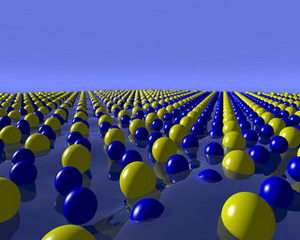
This image represents periodically ordered gold (yellow) and silicon (blue) atoms within the surface-frozen monolayer of liquid gold-silicon eutectic alloy.

A substance used in nanotechnology contains unusual structures at its surface, a team of researchers led by Oleg Shpyrko, Distinguished Postdoctoral Fellow at the U.S. Department of Energy's Argonne National Laboratory has learned.

The research results, developed at the Center for Nanoscale Materials at Argonne, are published today in the journal Science.

The substance in question is a gold-silicon eutectic alloy, 82 percent gold and 18 percent silicon. The term eutectic means that the combination melts at a temperature lower than that of the melting temperature of either of its components. For most eutectic alloys, the difference between the melting point of the alloy and those of its pure components is about 100 degrees Celsius; the gold-silicon eutectic alloy melts about 1,000 °C lower than either of its components, at 360 °C (680 °F).

But that's not the only unusual thing about the gold-silicon eutectic alloy. In a crystalline solid, atoms are arranged in an orderly, periodic fashion, and in a liquid, arrangements of atoms are disordered. It's been known for about 10 years that many metallic liquids show two or three distinct atomic layers near the surface, and usually there is no crystalline-like order within these layers. However, Shpyrko and his colleagues found that the gold-silicon eutectic alloy has seven or eight layers near its surface. In trying to understand this unexpected development, they found also that the top-most surface layer includes a crystal-like structure, similar to that normally found only in solid substances.

Understanding characteristics of novel surface phases like this surface-frozen monolayer is important for the growing realm of nanotechnology, in which the basic unit of measurement is a billionth of a meter.

“By the time you reduce the size of an object or device down to one nanometer, practically everything is surfaces and interfaces,” Shpyrko said. “We need to understand what the new laws of physics and chemistry that govern the surface structures are.”

Gold and silicon are especially important to understand because they are used in computer technology. Gold is an oxide-resistant “noble” metal that is easily shaped into tiny computer chip interconnects, and silicon is the principal component of most semiconductor devices.

“If you think about it, you have gold and silicon in contact with each other in about every electronic device,” Shpyrko said.

Shpyrko began the research as a doctoral student at Harvard University and finished it at Argonne. He used Argonne's Advanced Photon Source, which provides the most brilliant X-ray beams available in the Western Hemisphere, to perform several tests on the material: X-ray specular reflectivity, which provides information about atomic structure normal to the surface; X-ray grazing incidence diffraction, which provides information about in-plane structure; X-ray diffuse scattering, which provides information about waves and other dynamics at the surface; and X-ray crystal truncation rod, which measures thickness and structure of the crystalline surface layer.

Co-authors on the Science article were Reinhard Streitel, Venkatachalapathy S.K. Balagurusamy, Alexei Y. Grigoriev and Prof. Peter S. Pershan of Harvard University; Prof. Moshe Deutsch of Bar-Ilan University in Israel; Benjamin M. Ocko of Brookhaven National Laboratory; and Mati Meron and Binhua Lin of The University of Chicago.

Source: Argonne National Laboratory


print this article email this article download pdf blog this article bookmark this article     Stumble it Digg this share on Facebook retweet share on Reddit add to delicious
Rate this story - 4.4 /5 (44 votes)


July 7, 2006 all stories

Comments: 0

4.4 /5 (44 votes)
  • Stumble this up

  • Digg this

  • share this

  • hide
  • Related Stories

  • Liquid Alloy Shows Solid-Like Crystal Structure at Surface
    created Aug 22, 2006 | popularity not rated yet | comments 0
  • Engineers, doctors develop novel material that could help fight arterial disease
    created Nov 25, 2009 | popularity not rated yet | comments 0
  • Smart drug delivery system -- Gold nanocage covered with polymer (w/ Video)
    created Nov 01, 2009 | popularity not rated yet | comments 0
  • Physicist wins Packard Fellowship
    created Oct 16, 2009 | popularity not rated yet | comments 0
  • Building better bone replacements with bacteria
    created Sep 07, 2009 | popularity not rated yet | comments 0


  • hide
  • Relevant PhysicsForums posts

  • Ceramic Powder processing progress - urgent
    created 15 hours ago
  • Thin Film Laboratory resources
    created Nov 27, 2009
  • Theoretical air URGENT
    created Nov 26, 2009
  • photoconductivity of polymers
    created Nov 25, 2009
  • More from Physics Forums - Materials & Chemical Engineering

Other News

Nanowire Formation

Nanowires key to future transistors, electronics

Nanotechnology / Nanophysics

created Nov 26, 2009 | popularity 4.8 / 5 (8) | comments 2

(PhysOrg.com) -- A new generation of ultrasmall transistors and more powerful computer chips using tiny structures called semiconducting nanowires are closer to reality after a key discovery by researchers ...


Water droplets direct self-assembly process in thin-film materials

Nanotechnology / Nanomaterials

created Nov 23, 2009 | popularity 5 / 5 (4) | comments 2

You can think of it as origami - very high-tech origami. Researchers at the University of Illinois have developed a technique for fabricating three-dimensional, single-crystalline silicon structures from thin films by coupling ...


Using superconducting probes to get a picture of what it's like inside CNTs

Nanotechnology / Nanophysics

created Nov 20, 2009 | popularity 4.4 / 5 (9) | comments 0

(PhysOrg.com) -- "Carbon nanotubes are exciting for fundamental physics, and for potential technological applications," Nadya Mason tells PhysOrg.com. "However, we are generally limited in the way that we can study them. ...


Peptides control crystal growth with 'switches, throttles and brakes'

Peptides control crystal growth with 'switches, throttles and brakes'

Nanotechnology / Bio & Medicine

created Nov 23, 2009 | popularity 4.8 / 5 (5) | comments 0

(PhysOrg.com) -- By producing some of the highest resolution images of peptides attaching to mineral surfaces, scientists have a deeper understanding how biomolecules manipulate the growth crystals. This research ...


Fast, easy, and highly sensitive arsenic detection with gold nanoparticles

Nanotechnology / Nanomaterials

created Nov 25, 2009 | popularity 5 / 5 (1) | comments 0

(PhysOrg.com) -- Mention of arsenic poisoning usually brings to mind underhanded murder. However, the danger of arsenic poisoning from contaminated drinking water is far greater. Low concentrations of arsenic are found in ...