Life's Building Blocks Are Common In Space
October 11th, 2005 Life's Building Blocks Are Common In Space

A team of NASA exobiology researchers revealed today organic chemicals that play a crucial role in the chemistry of life are common in space.
"Our work shows a class of compounds that is critical to biochemistry is prevalent throughout the universe," said Douglas Hudgins, an astronomer at NASA's Ames Research Center, Moffett Field, Calif. He is principal author of a study detailing the team's findings that appears in the Oct. 10 issue of the Astrophysical Journal.

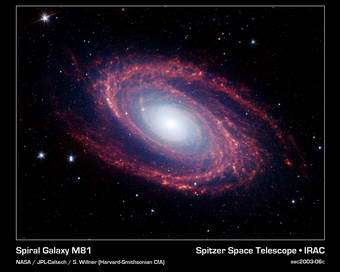
Image: NASA Spitzer Space Telescope image of the spiral galaxy M81, located some 12 million light years from Earth. The infrared radiation emitted by polycyclic nitrogen-containing aromatic hydrocarbon (PANH) molecules is shown in red. This emission is excited by star (and planet) formation along the edges of the spiral arms.

"NASA's Spitzer Space Telescope has shown complex organic molecules called polycyclic aromatic hydrocarbons (PAHs) are found in every nook and cranny of our galaxy. While this is important to astronomers, it has been of little interest to astrobiologists, scientists who search for life beyond Earth. Normal PAHs aren't really important to biology," Hudgins said. "However, our work shows the lion's share of the PAHs in space also carry nitrogen in their structures. That changes everything."

"Much of the chemistry of life, including DNA, requires organic molecules that contain nitrogen," said team member Louis Allamandola, an astrochemist at Ames. "Chlorophyll, the substance that enables photosynthesis in plants, is a good example of this class of compounds, called polycyclic aromatic nitrogen heterocycles, or PANHs. Ironically, PANHs are formed in abundance around dying stars. So even in death, the seeds of life are sewn," Allamandola said.

The NASA team studied the infrared "fingerprint" of PANHs in laboratory experiments and with computer simulations to learn more about infrared radiation that astronomers have detected coming from space. They used data from the European Space Agency's Infrared Space Observatory satellite.

Source: NASA


print this article email this article download pdf blog this article bookmark this article     Digg this Stumble it share on Facebook share on Reddit add to delicious save to Yahoo! bookmarks
not rated yet


October 11th, 2005 all stories
Space & Earth /

Comments: 0
Rank: not rated yet

  • Stumble this up

  • Digg this

  • Share it:
  • share on Facebook
  • share on MySpace
  • share on Slashdot
  • rss-newsfeed
  • share on Google
  • share on Reddit
  • add to delicious
  • save to Yahoo! bookmarks
  • share on Windows Live
  • Add to Mixx!
Rating: not rated yet

  • Related Stories

  • Formation of the smallest droplet of acid
    created Jun 19, 2009 | popularity not rated yet | comments 0
  • Scientists Develop New Method to Find Alien Oceans, Earth-like Planets (w/Videos)
    created May 26, 2009 | popularity not rated yet | comments 0
  • Spacewalkers equip Hubble with new computer
    created May 15, 2009 | popularity not rated yet | comments 0
  • James Webb Space Telescope unfolds by animation (w/Video)
    created May 13, 2009 | popularity not rated yet | comments 0
  • Europe is about to take an astronomical lead over U.S.
    created May 07, 2009 | popularity not rated yet | comments 0

Tags


  • Physicists Demonstrate Quantum Memory with Matter Qubits
    Physicists Demonstrate Quantum Memory with Matter Qubits
    Physics / General Physics
    created Jul 03, 2009 | popularity 4.4 / 5 (17) | comments 1
  • 'Holey' Nanosheets for Wastewater Dye Removal
    Nanotechnology / Nanomaterials
    created Jul 01, 2009 | popularity 5 / 5 (5) | comments 1
  • Jellyfish Robot Swims Like its Biological Counterpart
    Jellyfish Robot Swims Like its Biological Counterpart
    Electronics / Robotics
    created Jun 26, 2009 | popularity 4.4 / 5 (8) | comments 1
  • Could Maxwell's Demon Exist in Nanoscale Systems?
    Could Maxwell's Demon Exist in Nanoscale Systems?
    Physics / General Physics
    created Jun 24, 2009 | popularity 4.4 / 5 (18) | comments 29
  • Living Safely with Robots, Beyond Asimov's Laws
    Living Safely with Robots, Beyond Asimov's Laws
    Electronics / Robotics
    created Jun 22, 2009 | popularity 4.6 / 5 (52) | comments 40
  • Other News

    Steam billows from the cooling towers at a nuclear power generating station in Byron

    Tropical zone expanding due to climate change: study

    Space & Earth / Earth Sciences

    created 9 minutes ago | popularity not rated yet | comments 0

    Climate change is rapidly expanding the size of the world's tropical zone, threatening to bring disease and drought to heavily populated areas, an Australian study has found.


    US ambitions to send astronauts back to the moon as a prelude to missions to Mars have been put in doubt

    Forty years ago man first walked on the moon

    Space & Earth / Space Exploration

    created 21 hours ago | popularity 4.3 / 5 (4) | comments 2

    Forty years ago on July 20, 1969, American astronaut Neil Armstrong realized the oldest dream of human civilizations when he became the first man to walk on the moon.


    The least sea ice in 800 years

    The least sea ice in 800 years

    Space & Earth / Earth Sciences

    created Jul 01, 2009 | popularity 4.1 / 5 (64) | comments 60

    New research, which reconstructs the extent of ice in the sea between Greenland and Svalbard from the 13th century to the present indicates that there has never been so little sea ice as there is now. The ...


    Gas around young galaxy

    Intense heat killed the Universe's would-be galaxies, researchers say

    Space & Earth / Astronomy

    created Jul 01, 2009 | popularity 3.4 / 5 (21) | comments 27

    (PhysOrg.com) -- Our Milky Way galaxy only survived because it was already immersed in a large clump of dark matter which trapped gases inside it, scientists led by Durham University's Institute for Computational ...


    Scientists' Drill Hits Magma: Only Third Time on Record

    Scientists' Drill Hits Magma: Only Third Time on Record

    Space & Earth / Earth Sciences

    created Jun 29, 2009 | popularity 4.7 / 5 (22) | comments 20

    (PhysOrg.com) -- Scientists drilling a borehole deep into Iceland’s rocky crust to explore new methods of using geothermal energy hit a major roadblock on Thursday: Their drill ran into molten rock at a depth ...