Proposed 'starshade' observatory could image continents on exo-solar planets
A NASA institute charged with supporting novel space concepts that push the envelope with existing technology has chosen a University of Colorado at Boulder proposal to image distant planets around other stars for a second round of funding.
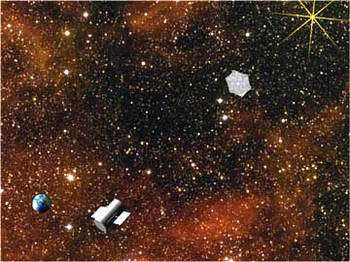
The project is for an orbiting, soccer-field sized "starshade" shaped like a daisy that would funnel light from distant planets between its petals to a second spacecraft trailing 50,000 miles behind.
Known as the New Worlds Observer, the project was selected for initial funding by NIAC in 2004 as a giant pinhole camera in space.
The $400,000 award will go to CU-Boulder Professor Webster Cash of the Center for Astrophysics and Space Astronomy from NASA's Institute for Advanced Concepts, or NIAC.
The starshade would block out intense light from the parent stars of planets outside the solar system while allowing planet light to creep around the starshade's edge and funneling it into a trailing spacecraft for analysis, Cash said. The observatory would allow scientists to map and catalogue planetary systems around nearby stars -- including those with "warm, close-in orbits around parent stars" similar to Earth and Venus -- to frozen, giant planets at the edges of distant solar systems, he said.
"Using photometry and spectroscopy, we could identify planetary features like oceans, continents, polar caps and cloud banks, and even detect biomarkers like methane, water, oxygen and ozone," said Cash. "We could knock off a new planetary system every week, and we could build it tomorrow using existing technology. It's the kind of mission I dreamed about as a kid, and one that nobody would ever forget."
Cash gave a presentation on the New Worlds Imager at the annual NIAC meeting at the Omni Interlocken Hotel in Broomfield, Colo., Oct. 10 and Oct. 11.
Spearheaded by CU-Boulder, the New Worlds Imager project also includes researchers from Princeton University, the Massachusetts Institute of Technology, Ball Aerospace of Boulder, Northrop Grumman Corp. of Los Angeles and the Carnegie Institution in Washington, D.C.
NIAC was created in 1998 to solicit revolutionary concepts from people and organizations outside the space agency that could advance NASA's missions. The winning concepts, chosen because they "push the limits of known science and technology," are expected to take at least a decade to develop if they eventually are selected for a mission flight, according to NASA.
"We are thrilled to team up with imaginative people from industry and universities to discover innovative systems that meet the tremendous challenge of space exploration and development," said NIAC Director Robert Cassanova. Cassanova also is a member of the Universities Space Research Association, which administers NIAC for the space agency.
The other four proposals selected by NIAC in 2005 for Phase Two funding include the development of tiny robots for planetary surface investigation, an infrared observatory on the moon, a genetically engineered organism that could survive on Mars and giant, laser-trapped mirrors in space.
In 1999, Cash headed a winning NIAC proposal for a new, powerful x-ray telescope technology that will allow astronomers to peer into black holes. That telescope package is now under development by NASA as the multi-million dollar MAXIM mission and is slated for launch next decade.
Source: University of Colorado at Boulder; Image: NASA


