Live wires

July 10, 2006
Reaching Out

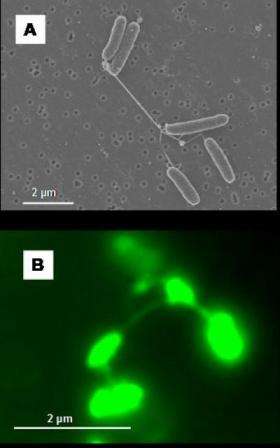
Bacteria, such as this strain of Shewanella, will under particular environmental conditions sprout nanowires that can shuttle electricity to its neighboring cells. (Top: scanning electron microscopic image; bottom: fluorescence-stained micrograph.) Credit: Pacific Northwest National Laboratory

When Yuri Gorby discovered that a microbe which transforms toxic metals can sprout tiny electrically conductive wires from its cell membrane, he reasoned this anatomical oddity and its metal-changing physiology must be related.

A colleague who had heard Gorby's presentation at a scientific meeting later reported that he, too, was able to coax nanowires from another so-called metal-reducing bacteria species and futher suggested the wires, called pili, could be used to bioengineer electrical devices.

It now turns out that not only are the wires and their ability to alter metal connected--but that many other bacteria, including species involved in fermentation and photosynthesis, can also form wires under a variety of environmental conditions.

"Earth appears to be hard-wired," said Gorby, staff scientist at the Department of Energy's Pacific Northwest National Laboratory, who documents the seeming ubiquity of electrically conductive microbial life in the July 10 advance online Proceedings of the National Academy of Science.

In a series of experiments, Gorby and colleagues induced nanowires in a variety of bacteria and demonstrated that they were electrically conductive. The bacterial nanowires were as small as 10 nanometers in diameter and formed bundles as wide as 150 nanometers. They grew to be tens of microns to hundreds of microns long.

The common thread involved depriving a microbe of something it needed to shed excess energy in the form of electrons. For example, Shewanella, of interest in environmental cleanup for its ability to hasten the weathering of toxic metals into benign ones, requires oxygen or other electron acceptors for respiration, whereas Synechocystis, a cyanobactetrium, combines electrons with carbon dioxide during photosynthesis.

Bereft of these "electron acceptors," bacterial nanowires "will literally reach out and connect cells from one to another to form an electrically integrated community," Gorby said.

"The physiological and ecological implications for these interactions are not currently known," he said, "but the effect is suggestive of a highly organized form of energy distribution among members of the oldest and most sustainable life forms on the planet."

In one clever twist, Gorby grew pili from mutant strains developed by collaborators that were unable to produce select electron transport components called cytochromes. Sure enough, the nanowires of the mutants were poor conductors.

"These implicate cytochromes as the electrically conductive components of nanowires, although this has yet to be conclusively demonstrated," Gorby said.

To measure currents as precisely as possible, Gorby and colleagues from the University of Southern California have built a microbial fuel cell laboratory at PNNL. The small bacteria-powered batteries, cultured under electron-acceptor limitations and fueled by lactate or light, now produce very little power, as measured by a voltmeter hooked to a laptop computer.

Co-author and PNNL scientist Jeff Mclean, who manages the microbial fuel cell laboratory, said that small changes in fuel cell design and culture conditions have already shown large improvements in the efficiency of the fuel cells. For example, so-called biofilms--a highly interconnected bacterial community--put out much more energy than other configurations.

Source: Pacific Northwest National Laboratory

4.4 /5 (34 votes)  

Rank 4.4 /5 (34 votes)
Tags

Related Stories
Relevant PhysicsForums posts
  • polymer nanocomposites
    created7 hours ago
  • Corrosion Tests on Magnesium
    created20 hours ago
  • polyethylene copper nanocomposite
    createdFeb 09, 2012
  • Output of xrd analysis
    createdFeb 08, 2012
  • Transport phenomena problem based on problems 18.B11 and 19B.6 from Bird, stewart, lw
    createdFeb 06, 2012
  • Help with material selection - Car Piston
    createdFeb 05, 2012
  • More from Physics Forums - Materials & Chemical Engineering

More news stories

What lies beneath: Mapping hidden nanostructures

The ability to diagnose and predict the properties of materials is vital, particularly in the expanding field of nanotechnology. Electron and atom-probe microscopy can categorize atoms in thin sheets of material, ...

Nanotechnology / Nanophysics

created 4 minutes ago | popularity not rated yet | comments 0

'Dark plasmons' transmit energy

Microscopic channels of gold nanoparticles have the ability to transmit electromagnetic energy that starts as light and propagates via "dark plasmons," according to researchers at Rice University.

Nanotechnology / Nanophysics

created 16 hours ago | popularity 5 / 5 (5) | comments 0 | with audio podcast

Nanotube therapy takes aim at breast cancer stem cells

Wake Forest Baptist Medical Center researchers have again proven that injecting multiwalled carbon nanotubes (MWCNTs) into tumors and heating them with a quick, 30-second laser treatment can kill them.

Nanotechnology / Bio & Medicine

created 21 hours ago | popularity 5 / 5 (1) | comments 0 | with audio podcast

New kind of solar cell could capture significantly more energy than current cells

New solar cells could increase the maximum efficiency of solar panels by over 25%, according to scientists from the University of Cambridge.

Nanotechnology / Nanophysics

created Feb 08, 2012 | popularity 4.5 / 5 (11) | comments 14 | with audio podcast

Nanoshell whispering galleries improve thin solar panels

Visitors to Statuary Hall in the U.S. Capitol Building may have experienced a curious acoustic feature that allows a person to whisper softly at one side of the cavernous, half-domed room and for another on ...

Nanotechnology / Nanomaterials

created Feb 07, 2012 | popularity 4.3 / 5 (6) | comments 6 | with audio podcast


The power of estrogen -- male snakes attract other males

A new study has shown that boosting the estrogen levels of male garter snakes causes them to secrete the same pheromones that females use to attract suitors, and turned the males into just about the sexiest ...

Could Venus be shifting gear?

(PhysOrg.com) -- ESA’s Venus Express spacecraft has discovered that our cloud-covered neighbour spins a little slower than previously measured. Peering through the dense atmosphere in the infrared, the ...

Experts reveal how plants don't get sunburn

(PhysOrg.com) -- Experts at the University of Glasgow have discovered how plants survive the harmful rays of the sun.

Team isolates nerve cells involved in storing long term memory and gene proteins associated with them

(Medical Xpress) -- A research team in Taiwan has succeeded in isolating two nerve cells in fruit fly brains that are believed to be the major players in allowing for the formation of long term memories. Furthermore, ...

Fool's gold may prove an unlikely alternative to overexploited catalytic materials

Catalytic materials, which lower the energy barriers for chemical reactions, are used in everything from the commercial production of chemicals to catalytic converters in car engines. However, with current catalytic materials ...

Measurements from high-energy collisions lead to better understanding of why meson particles disappear

For several years, physicists at the Relativistic Heavy Ion Collider (RHIC) at Brookhaven National Laboratory (BNL), USA, have studied an unusual state of matter called the quark–gluon plasma, which they ...