It's 2025. Where Do Most People Live?
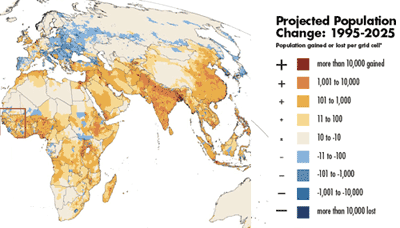
Researchers at the Center for Climate Systems Research (CCSR), a part of The Earth Institute, have developed a high-resolution map of projected population change for the year 2025.
The innovative map shows a world with large areas of population loss in parts of Eastern Europe and Asia, but significant gains elsewhere. (see full map)
The work, Mapping the Future, is the result of collaboration between CCSR, Hunter College and Population Action International (PAI) and was released this spring in conjunction with an update of PAI’s Web feature, People in the Balance, investigating the relationship between human population and critical natural resources.
The map indicates that the greatest increases in population density through 2025 are likely to occur in areas of developing countries that are already quite densely populated. In addition, the number of people living within 60 miles of a coastline is expected to increase by 35 percent over 1995 population levels, exposing 2.75 billion people worldwide to the effects of sea level rise and other coastal threats posed by global warming.
The map also projects that much of southern and Eastern Europe and Japan will experience significant and wide-spread population decline. Surprisingly, the map further suggests small areas of projected population decline for many regions in which they might be least expected: sub-Saharan Africa, Central and South America, the Philippines, Nepal, Turkey, Cambodia, Burma and Indonesia — areas that have to date been experiencing rapid-to-modest national population growth.
"By bridging these two areas of demography — mapping and long-range, aggregate projections — we're getting a better idea of where people are likely to live in the future and why," said Stuart Gaffin, associate research scientist at CCSR and lead scientist on the project. "Hopefully, work like ours will play a central role in improving environmental policies around the world and in reducing natural hazard risks faced by the most vulnerable parts of society."
Where most projections show future global population for each of more than 200 countries, Mapping the Future displays the projected population for each of nine million cells distributed across the globe. Known as "downscaling," this new arena of spatial analysis and demography is expected to be of particular interest to conservationists, climate specialists and others who need to know where people will live, and in what numbers, in coming decades and in extremely fine detail. The data may also provide a "best guess" of regional populations that might be most susceptible to natural disasters in the future.
"We already have a pretty good idea of how the population of individual countries is likely to change in coming years," said Gaffin. "This map pushes the frontier on projecting high-resolution, sub-national populations so we can begin to examine how internal population dynamics might play out against other environmental, ecological and socio-economic concerns."
To produce the map, Gaffin and his colleagues extrapolated population changes that occurred between 1990 and 1995 out to 2025 in each grid cell. They selected from two methods to arrive at the best and most likely fit consistent with the UN's "medium variant" projection for each country’s population: one based on a particular cell's changing fractional share of the overall national population and another based on the cell's share of national growth during the 1990s.
Source: Earth Institute at Columbia University


