How parachute spiders invade new territory
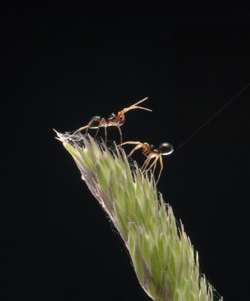
Researchers have developed a new model that explains how spiders are able to ‘fly’ or ‘parachute’ into new territory on single strands of silk – sometimes covering distances of hundreds of miles over open ocean.
By casting a thread of silk into the breeze spiders are able to ride wind currents away from danger or to parachute into new areas. Often they travel a few metres but some spiders have been discovered hundreds of miles out to sea. Researchers have now found that in turbulent air the spiders’ silk moulds to the eddies of the airflow to carry them further.
The team at Rothamsted Research, a sponsored institute of the Biotechnology and Biological Sciences Research Council (BBSRC), realised that the existing 20 year old models to explain this phenomenon – known as ‘ballooning’ – failed to adequately deal with anything other than perfectly still air. Called Humphrey’s model it made assumptions that the spider silk was rigid and straight and the spiders were just blobs hanging on the bottom. It could not explain why spiders were able to travel long distances over water, to colonise new volcanic islands or why they were found on ships. The new Rothamsted mathematical model allows for elasticity and flexibility of a ballooning spider’s dragline – and when a dragline is caught in turbulent air the model shows how it can become highly contorted, preventing the spider from controlling the distance it travels and propelling it over potentially epic distances.
Dr Andy Reynolds, one of the scientists at Rothamsted Research, explained: “Researchers knew that spiders could use ballooning to cover long distances but no previous model has adequately explained how this worked. By factoring in the flexibility of the dragline that the spiders cast into the breeze have shown how it can contort and twist with turbulence, affecting its aerodynamic properties and carrying its rider unpredictable distances. Spiders are key predators of insects and can alleviate the need for farmers to spray large quantities of pesticide. But they can only perform this function in the ecosystem if they arrive at the right time. With our mathematical model we can start to examine how human activity, such as farming, affects the dispersal of spider populations.”
Dr Dave Bohan, a member of the research team, commented on how mathematical models and traditional bioscience observation come together: “To really understand the factors at play on ballooning spiders we need to watch them in action. We have already observed spiders ballooning through still air and we are now planning to take them into a wind tunnel to watch how they handle turbulent flows. Once we have done that we can refine the model further.”
Professor Julia Goodfellow, Chief Executive of BBSRC, the organisation which funded the project, said: “The exciting thing about this research is that it not only explains a long-standing question but also shows how ecologists, mathematicians and physical scientists can draw on each others strengths. The future face of bioscience is highly interdisciplinary and will require more collaboration between, for example, mathematicians and ecologists working together to answer biological questions.”
Source: Biotechnology and Biological Sciences Research Council


