Quantum Computer: Laser tweezers sort atoms
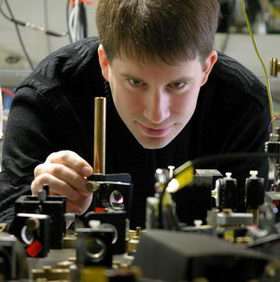
July 12th, 2006 Laser tweezers sort atoms

(c) Frank Luerweg / Uni Bonn

Physicists of the University of Bonn have taken one more important hurdle on the path to what is known as a quantum computer: by using 'laser tweezers' they have succeeded in sorting up to seven atoms and lining them up. The researchers filmed this process and report on their breakthrough in the next issue of the prestigious journal Nature (13th July 2006).

In the experiment the research team headed by Dr. Arno Rauschenbeutel and Professor Dieter Meschede decelerated several caesium atoms for a period of several seconds so that they were hardly moving, then loaded them onto a 'conveyor belt' consisting of lasers. This conveyor belt is made up of a standing light wave composed of many peaks and troughs – possibly comparable to a piece of corrugated iron. 'Unfortunately it cannot be predicted which trough precisely the atoms will land in,' Arno Rauschenbeutel explains. 'It's rather like pouring several eggs from a big dish into an egg carton – which section each egg rolls into is a matter of chance.'

However, anyone wishing to calculate with atoms must be able to place them exactly. 'All the atoms on the conveyor belt have to have the same distance from each other,' is how Arno Rauschenbeutel sketches the challenge. 'Only then can we get them to interact in a controlled way in what is called a quantum gate.' By lining up gate operations like these it would already be possible to carry out simple quantum calculations.

The Bonn physicists therefore subsequently 'sorted' the atoms in their experiment on the conveyor belt. They did this by first taking a photo to record their positions. They next set the conveyor belt moving – and with it the caesium atoms 'trapped' in the troughs. In this way they transported the wrongly placed atoms to their 'laser tweezers' – this is basically nothing more than another conveyor belt consisting of laser beams which is oriented orthogonally to the first conveyor belt. 'When we set the tweezers' light wave in motion, we can lift the wrongly placed atoms off the conveyor belt,' Arno Rauschenbeutel explains. 'Then we move the conveyor belt to the desired position and simply pop the atom back in.'

The film shows how well this works: the tweezers select two atoms consecutively from the belt and put them back on again in such a way that they are exactly the same distance from each other and from a third atom. 'Sorting seven atoms in this way takes us about two seconds,' Dr. Rauschenbeutel says.

The next aim of the Bonn physicists is to construct a quantum gate. For this purpose they want to 'write' quantum information onto two caesium atoms and then place them between two tiny mirrors. The intention is that they should interact there with each other, i.e. exchange information by emitting and absorbing fluorescent light. If this is successful, it will be the next milestone for the Bonn researchers on their way to the quantum computer.

Citation: An atom-sorting machine. Yevhen Miroshnychenko, Wolfgang Alt, Igor Dotsenko, Leonid Fцrster, Mkrtych Khudaverdyan, Dieter Meschede, Dominik Schrader, Arno Rauschenbeutel. Nature, 13th July 2006 (Vol. 442, No 7099)

Source: University of Bonn


print this article email this article download pdf blog this article bookmark this article     Digg this Stumble it share on Facebook share on Reddit add to delicious save to Yahoo! bookmarks
4.3/5 after 133 votes


July 12th, 2006 all stories
Physics / General Physics

Comments: 0
Rank: 4.3/5 after 133 votes

  • Stumble this up

  • Digg this

  • Share it:
  • share on Facebook
  • share on MySpace
  • share on Slashdot
  • rss-newsfeed
  • share on Google
  • share on Reddit
  • add to delicious
  • save to Yahoo! bookmarks
  • share on Windows Live
  • Add to Mixx!
Rating: 4.3/5 after 133 votes

  • Related Stories

  • Study offers new recipe for oxygen on icy moons
    created Mar 27, 2006 | popularity not rated yet | comments 0
  • IBEX spacecraft detects fast neutral hydrogen coming from the moon
    created Jun 18, 2009 | popularity not rated yet | comments 0
  • New study reveals structure of the HIV protein shell
    created Jun 12, 2009 | popularity not rated yet | comments 0
  • THEMIS: 'Singing' electrons help create and destroy 'killer' electrons
    created May 07, 2009 | popularity not rated yet | comments 0
  • Meteorites discovered to carry interstellar carbon
    created May 04, 2006 | popularity not rated yet | comments 0

Tags


  • Physicists Demonstrate Quantum Memory with Matter Qubits
    Physicists Demonstrate Quantum Memory with Matter Qubits
    Physics / General Physics
    created Jul 03, 2009 | popularity 4.4 / 5 (17) | comments 1
  • 'Holey' Nanosheets for Wastewater Dye Removal
    Nanotechnology / Nanomaterials
    created Jul 01, 2009 | popularity 5 / 5 (5) | comments 1
  • Jellyfish Robot Swims Like its Biological Counterpart
    Jellyfish Robot Swims Like its Biological Counterpart
    Electronics / Robotics
    created Jun 26, 2009 | popularity 4.4 / 5 (8) | comments 1
  • Could Maxwell's Demon Exist in Nanoscale Systems?
    Could Maxwell's Demon Exist in Nanoscale Systems?
    Physics / General Physics
    created Jun 24, 2009 | popularity 4.4 / 5 (18) | comments 29
  • Living Safely with Robots, Beyond Asimov's Laws
    Living Safely with Robots, Beyond Asimov's Laws
    Electronics / Robotics
    created Jun 22, 2009 | popularity 4.6 / 5 (52) | comments 40
  • Other News

    Scientists create first electronic quantum processor

    Scientists create first electronic quantum processor

    Physics / General Physics

    created Jun 28, 2009 | popularity 4.8 / 5 (53) | comments 40

    A team led by Yale University researchers has created the first rudimentary solid-state quantum processor, taking another step toward the ultimate dream of building a quantum computer.


    Science journals

    How to Spot an Influential Paper Based on its Citations

    Physics / General Physics

    created Jul 04, 2009 | popularity 4 / 5 (9) | comments 6

    (PhysOrg.com) -- At first it may seem that the number of citations received by a published scientific paper is directly related to that paper's quality of content. The higher the quality, the more people read ...


    Fermilab's CDF observes Omega-sub-b baryon

    Fermilab's CDF observes Omega-sub-b baryon

    Physics / General Physics

    created Jun 29, 2009 | popularity 4.7 / 5 (17) | comments 7

    (PhysOrg.com) -- At a recent physics seminar at the Department of Energy’s Fermi National Accelerator Laboratory, Fermilab physicist Pat Lukens of the CDF experiment announced the observation of a new particle, ...


    New insights, and a new angle, on high-temperature superconductivity

    New insights, and a new angle, on high-temperature superconductivity

    Physics / Superconductivity

    created Jun 29, 2009 | popularity 4.8 / 5 (13) | comments 6

    (PhysOrg.com) -- A Princeton-led research team has revealed surprising information about how electron behavior influences the conduction of electricity in a class of high-temperature superconductors. An increased ...


    The art of invisibility and the perfect cat's eye

    The art of invisibility and the perfect cat's eye

    Physics / Optics & Photonics

    created Jun 30, 2009 | popularity 4 / 5 (8) | comments 6

    (PhysOrg.com) -- In recent years scientists have explored the impossible by developing invisibility or 'cloaking' devices, but can the same technology also help make things more visible?