Paint-on semiconductor outperforms chips
July 12th, 2006 Paint-on semiconductor, Image: Ted Sargent

Paint-on semiconductor, Image: Ted Sargent

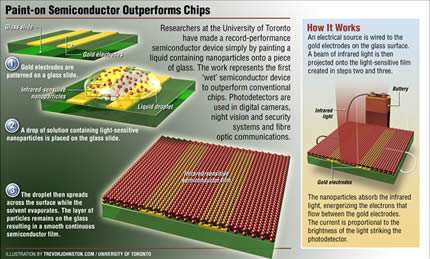
Researchers at the University of Toronto have created a semiconductor device that outperforms today's conventional chips -- and they made it simply by painting a liquid onto a piece of glass. The finding, which represents the first time a so-called "wet" semiconductor device has bested traditional, more costly grown-crystal semiconductor devices, is reported in the July 13 issue of the journal Nature.

"Traditional ways of making computer chips, fibre-optic lasers, digital camera image sensors – the building blocks of the information age – are costly in time, money, and energy," says Professor Ted Sargent of the Edward S. Rogers Sr. Department of Electrical and Computer Engineering and leader of the research group. Conventional semiconductors have produced spectacular results -- the personal computer, the Internet, digital photography -- but they rely on growing atomically-perfect crystals at 1,000 degrees Celsius and above, he explains.

The Toronto team instead cooked up semiconductor particles in a flask containing extra-pure oleic acid, the main ingredient in olive oil. The particles are just a few nanometres (one billionth of a metre) across. The team then placed a drop of solution on a glass slide patterned with gold electrodes and forced the drop to spread out into a smooth, continuous semiconductor film using a process called spin-coating. They then gave their film a two-hour bath in methanol. Once the solvent evaporated, it left an 800 nanometre-thick layer of the light-sensitive nanoparticles.

At room temperature, the paint-on photodetectors were about ten times more sensitive to infrared rays than the sensors that are currently used in military night-vision and biomedical imaging. "These are exquisitely sensitive detectors of light," says Sargent, who holds a Canada Research Chair in Nanotechnology. "It's now clear that solution-processed electronics can combine outstanding performance with low cost."

The U of T development could be of critical importance to both research and industry, according to John D. Joannopoulos, a Professor at MIT. "The ability to realize low-cost, paintable, high-performance designer semiconductors for use as short-wavelength infrared detectors and emitters is of enormous value for a wide range of communications, imaging and monitoring applications," says Joannopoulos, the Francis Wright Davis Professor of Physics and director of the Institute for Soldier Nanotechnologies at the Massachusetts Institute of Technology.

"The key to our success was controlled engineering at the nanometre lengthscale: tailoring colloidal nanocrystal size and surfaces to achieve exceptional device performance," says lead author Gerasimos Konstantatos, a doctoral researcher at UofT. "With this finding, we now know that simple, convenient, low-cost wet chemistry can produce devices with performance that is superior compared to that of conventional grown-crystal devices."

Source: University of Toronto


print this article email this article download pdf blog this article bookmark this article     Digg this Stumble it share on Facebook share on Reddit add to delicious save to Yahoo! bookmarks
4.4/5 after 93 votes


July 12th, 2006 all stories
Nanotechnology / Nanomaterials

Comments: 0
Rank: 4.4/5 after 93 votes

  • Stumble this up

  • Digg this

  • Share it:
  • share on Facebook
  • share on MySpace
  • share on Slashdot
  • rss-newsfeed
  • share on Google
  • share on Reddit
  • add to delicious
  • save to Yahoo! bookmarks
  • share on Windows Live
  • Add to Mixx!
Rating: 4.4/5 after 93 votes


Tags


  • Physicists Demonstrate Quantum Memory with Matter Qubits
    Physicists Demonstrate Quantum Memory with Matter Qubits
    Physics / General Physics
    created Jul 03, 2009 | popularity 4.4 / 5 (17) | comments 1
  • 'Holey' Nanosheets for Wastewater Dye Removal
    Nanotechnology / Nanomaterials
    created Jul 01, 2009 | popularity 5 / 5 (5) | comments 1
  • Jellyfish Robot Swims Like its Biological Counterpart
    Jellyfish Robot Swims Like its Biological Counterpart
    Electronics / Robotics
    created Jun 26, 2009 | popularity 4.4 / 5 (8) | comments 1
  • Could Maxwell's Demon Exist in Nanoscale Systems?
    Could Maxwell's Demon Exist in Nanoscale Systems?
    Physics / General Physics
    created Jun 24, 2009 | popularity 4.4 / 5 (18) | comments 29
  • Living Safely with Robots, Beyond Asimov's Laws
    Living Safely with Robots, Beyond Asimov's Laws
    Electronics / Robotics
    created Jun 22, 2009 | popularity 4.6 / 5 (52) | comments 40
  • Other News

    A 'quantum of sol' -- how nanotechnology could hold the key to a solar-powered future

    A 'quantum of sol' -- how nanotechnology could hold the key to a solar-powered future

    Nanotechnology / Nanomaterials

    created Jun 30, 2009 | popularity 3.9 / 5 (15) | comments 16

    (PhysOrg.com) -- A new generation of 'nano-structured' millimetre-sized solar cells that could convert the sun's energy to electricity more than twice as efficiently as current technology, is the subject of ...


    Australian researchers are set to begin human trials of a tiny nano-cell that acts as a "Trojan horse" against cancer

    Hi-tech 'Trojan horse' can kill cancer cells: researchers

    Nanotechnology / Bio & Medicine

    created Jun 29, 2009 | popularity 4.7 / 5 (12) | comments 7

    Australian researchers are set to begin human trials of a tiny nano-cell that acts as a "Trojan horse" against cancer cells, a breakthrough they say may curb the need for debilitating chemotherapy.


    'Holey' Nanosheets for Wastewater Dye Removal

    Nanotechnology / Nanomaterials

    created Jul 01, 2009 | popularity 5 / 5 (5) | comments 1

    (PhysOrg.com) -- Researchers have discovered that extremely thin sheets of nickel oxide with hexagonally shaped holes can absorb hazardous dyes from wastewater nearly as well as the best traditional methods, but are recyclable. ...


    Harnessing Nanoparticles To Track Cancer Cell Changes

    Nanotechnology / Bio & Medicine

    created Jul 03, 2009 | popularity not rated yet | comments 1

    The more dots there are, the more accurate a picture you get when you connect them. Cancer researchers adopting that philosophy have developed a new imaging technology that could give scientists the ability to simultaneously ...


    Computer-Guided Nanoparticle Therapy Destroys Tumors

    Nanotechnology / Bio & Medicine

    created Jun 29, 2009 | popularity 5 / 5 (11) | comments 0

    Gold nanoshells are among the most promising new nanoscale therapeutics being developed to kill tumors, acting as antennas that turn light energy into heat that cooks cancer to death. Now, a multi-institutional research team ...