Tiny tremors and earthquakes provide intriguing clues about seismic activity
The elusive science of earthquake prediction has been reinvigorated in recent years with the discovery of "non-volcanic tremors"--faint vibrations that originate deep inside active fault zones. Since 2002, these mysterious signals have been recorded in seismically active sections of Japan, the Pacific Northwest and California's San Andreas Fault.
Seismologists believe that non-volcanic tremors may eventually prove useful in forecasting major earthquakes. But to accomplish that, they first have to figure out exactly where the signals are located--a daunting task, because the vibrations are not impulsive, and hence their origin is difficult to locate.
Now, for the first time, seismologists from Stanford University and the University of Tokyo say they have finally pinpointed the source and likely cause of at least part of the tremor. Writing in the July 13 edition of the journal Nature, the research team concludes that some of the non-volcanic signals emanating from a Japanese fault zone are probably the by-products of "silent earthquakes"--slow-moving temblors that displace the ground without shaking it.
"Silent earthquakes do not generate seismic waves, so you don't feel them," said Gregory C. Beroza, professor of geophysics at Stanford and co-author of the Nature study. "However, it's possible that they foreshadow powerful seismic temblors of magnitude 8 and larger. Therefore, knowing when a silent event has occurred could contribute to seismic hazard forecasting. We believe that non-volcanic tremor signals may be useful in monitoring silent quakes, which aren't that easy to detect."
Subduction zones
Japanese seismologists discovered non-volcanic tremors four years ago in the Nankai trough, an active fault zone in southwest Japan that's rocked by giant earthquakes every century or so--most recently in 1946 when a magnitude 8.2 event killed an estimated 1,300 people. The trough is in a seismically active subduction zone where the Philippine tectonic plate continuously slides under Shikoku Island on the Eurasian plate at a rate of about 2 inches [5 centimeters] a year.
"The shallow part of the plate interface has been locked since 1946, so we've had 60 years of strain accumulation there," Beroza said. "That means we have to start worrying about another big earthquake occurring again."
Tremors in Nankai trough are unpredictable and episodic, he added: "Over the course of a year, there will be relatively quiet periods punctuated by active periods where tremors are happening all the time."
These active periods can go on for days or weeks, but why they occur at all is a matter of speculation. One explanation is that the signals are generated by otherwise silent earthquakes that occur where the tectonic plates meet. "Under this hypothesis, tremor is the weak seismological signature of [a silent quake] that is otherwise too slow to generate detectable seismic waves," the authors wrote.
To determine if this is scenario is correct, the research team had to pinpoint the precise depths at which tremors occur in the fault zone. To do that, Beroza and his colleagues focused on "low-frequency earthquakes" (LFEs)--tiny seismic pulses of magnitude 2 or smaller that were first identified by Japanese scientists in 1999. LFEs last less than a second and are routinely accompanied by non-volcanic tremors.
"Earthquakes generate distinct signals known as compressional and shear waves (P- and S-waves)," Beroza said. "But LFEs are so small that before our study, they were located primarily by the S-waves alone."
To find out the exact depth of the low-frequency earthquakes, Stanford doctoral candidate David R. Shelly--lead author of the Nature study--analyzed more than 1,000 LFE seismograms recorded in the Nankai trough between June 2002 and July 2005.
"By looking carefully at the S-waves of these events and aligning them mathematically, David was able to determine their arrival time very accurately," Beroza explained. "Once you know when the S-waves arrive, you can look for the faster-moving P-waves. Combining the two allowed him to really nail down the locations of these LFEs."
Silent earthquakes
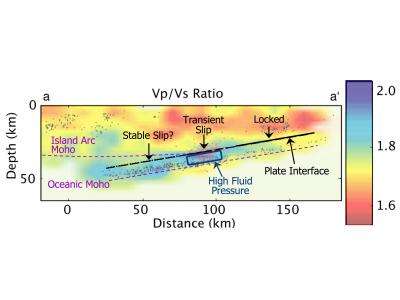
Shelly's analysis revealed that the low-frequency earthquakes and non-volcanic tremors were occurring simultaneously in a section of the fault where the tectonic plates come together to form a pocket of high fluid pressure.
"We believe that as the pressure and temperature increase here, minerals in the plate become more densely packed and start giving off water," Beroza explained. "As these fluids are liberated, they generate LFEs and tremor and also lubricate the plate interface, which allows silent earthquakes to happen."
A silent temblor might generate thousands of low-frequency earthquakes and tremors in the high-pressure pocket, he added. "As the slow slip moves in little fits and starts over a period of a few days or weeks, you can imagine it producing lots of tremors and LFEs."
The high-pressure pocket where silent quakes form is particularly significant because it lies next to the locked portion of the fault zone where magnitude 8 mega-thrust events periodically occur.
"Each time a silent quake happens, it loads the locked part of the plate interface," Beroza said. "So it's reasonable to expect that a big mega-thrust earthquake would more likely be triggered during a silent event."
Silent quakes, therefore, could provide important clues about when the locked portion of the plate will rupture, Beroza added, noting that low-frequency earthquake data may be one of the most efficient ways of pinpointing where silent quakes originate.
"By mapping out where the LFEs are occurring, we should be able to tell where the silent slip is happening," he said. "That means low-frequency earthquakes could potentially contribute to seismic hazard forecasting by providing a new method for monitoring slow-slip events at depth.
"This study marks the first time that a direct relationship between silent slip and low-frequency earthquakes has ever been documented, and the location of LFEs has never been determined this accurately before."
Predictable and mysterious
Low-frequency quakes may prove particularly useful in the Pacific Northwest subduction zone along the coast of Washington State, where silent quakes and tremors are known to occur every 14 months. The unusual predictability of these events could make tremors useful tools for calibrating how much stress is regularly loaded onto the locked portion of the fault, where a devastating magnitude 9 earthquake is expected to strike sometime in the next 300 years.
In central California, scientists have discovered a correlation between non-volcanic tremors and tiny earthquakes of magnitude 2.1 or smaller on the San Andreas Fault. One study revealed that an increase or decrease in the number of tremors is matched by a similar increase or decrease in tiny earthquakes several weeks later. These tremors and micro-quakes occurred on a section of the fault that was struck by magnitude 7.8 temblor 150 years ago and has been locked ever since. Could a sudden increase in the number of tremors signal an increased probability of another big one occurring?
"We don't know what these tremors are," Beroza said. "The San Andreas Fault isn't a subduction zone, like Japan or the Pacific Northwest, and a silent earthquake accompanying the tremors there hasn't been detected. It shows that we still have a lot to learn about both non-volcanic tremors and low-frequency earthquakes."
Source: By Mark Shwartz, Stanford University


