Taking Soil Science to Outer Space
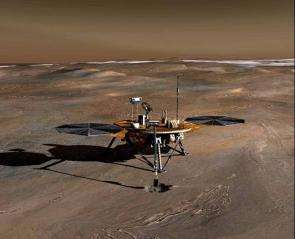
July 13, 2006 Phoenix Lander heading to Mars in 2007.

Phoenix Lander heading to Mars in 2007.

The answer to the question about life on Mars may very well come from analyzing an unsuspecting source—the soil, specifically the icy layer of soil underneath the red planet’s surface. By analyzing the properties of Mars’ frozen layer of soil during NASA’s next lander mission, scientists will be able to better understand and theorize about life on Mars.

A synopsis of the project will be presented by Douglas R. Cobos, Ph.D., on Monday, July 10, 2006, during the 18th World Congress of Soil Science in Philadelphia.

By exposing this frozen soil layer to the sun, researchers are hopeful to measure the properties of the liquid water before it turns to a vapor. According to Cobos, the discovery of this liquid water would be a “big finding and best case scenario for the Martian research community.” This liquid water – the pre-cursor for life says Cobos – could even point to “life in a dormant state on Mars.”

Cobos is a research scientist and engineer at Decagon Devices, Pullman, WA. NASA is working with Decagon, a soil science equipment manufacturer, on designing a probe to take soil and atmospheric measurements during the Phoenix 2007 Scout Mission. Galon Campbell, founder of the company and a soil scientist, designed the probe and, together with Cobos and Colin Campbell, is a co-author of the paper being presented in Philadelphia during the international World Congress of Soil Science.

Cobos said the physics on Mars is such that ice tends to go directly from the solid form into a vapor.

“If we can measure this liquid water using our specialized sensor mounted on the robotic arm of the lander, we’ll be able to turn over the data to the planetary scientists to analyze the climate and conditions on Mars,“ says Cobos. These scientists will use the data to determine if life ever arose on Mars or if it could sustain life in the future.

“We’re waiting to see what’s up there. The best-case scenario would be to dig, probe around and finally have conclusive proof that there can be liquid water on Mars,“ he says. “It’s pretty exciting to actually have our sensor bolted to the arm of the lander.”

Cobos, who has been working on the lander’s sensor for two years, just returned from the Jet Propulsion Lab where they mounted the sensor to the arm of the lander and calibrated it. The Phoenix Lander is planned to take off in late 2007 and arrive on Mars to begin its discoveries in early 2008.

For information, go to: http://www.18wcss.org.

Source: Soil Science Society of America


Rate this story - 4 /5 (6 votes)


July 13, 2006 all stories

Comments: 0

4 /5 (6 votes)

  • hide
  • Related Stories

  • How to Find Signs of Life on Mars
    created Dec 18, 2009 | popularity not rated yet | comments 0
  • The Meandering Channels of Mars
    created Dec 10, 2009 | popularity not rated yet | comments 0
  • Farms, Fertilizers and Greenhouse Gas Emissions
    created Dec 10, 2009 | popularity not rated yet | comments 0
  • Spotting evidence of directed percolation
    created Nov 17, 2009 | popularity not rated yet | comments 0
  • Taking a Bite of Antarctic Ice
    created Nov 16, 2009 | popularity not rated yet | comments 0


  • hide
  • Relevant PhysicsForums posts

  • Is anthropogenic global warming a scientific theory?
    created Dec 27, 2009
  • Human...nature
    created Dec 24, 2009
  • Fusion or fission within the Earth?
    created Dec 22, 2009
  • West Mata - Explosive Deep-Ocean Volcano
    created Dec 20, 2009
  • More from Physics Forums - Earth

Other News

As the World Churns

As the World Churns

Space & Earth / Earth Sciences

created 10 hours ago | popularity 4.4 / 5 (10) | comments 16

(PhysOrg.com) -- "Terra firma." It's Latin for "solid Earth." Most of the time, at least from our perspective here on the ground, Earth seems to be just that: solid. Yet the Earth beneath our feet is actually ...


Voyager makes an interstellar discovery

Voyager makes an interstellar discovery

Space & Earth / Space Exploration

created Dec 26, 2009 | popularity 4.7 / 5 (53) | comments 17

The solar system is passing through an interstellar cloud that physics says should not exist. In the Dec. 24th issue of Nature, a team of scientists reveal how NASA's Voyager spacecraft have solved the mystery.


Climate change puts ecosystems on the run, researchers say

Climate change puts ecosystems on the run, researchers say

Space & Earth / Environment

created Dec 27, 2009 | popularity 2 / 5 (12) | comments 19

(PhysOrg.com) -- Global warming is causing habitats to move across the landscape. Can the creatures living there keep up? If they can't, some species may die out, researchers say.


Glider robot a sleek ocean explorer

Space & Earth / Earth Sciences

created Dec 27, 2009 | popularity 4.6 / 5 (9) | comments 2

The sea was heaving, the skies gray. The captain of the research ship was worried about the weather. About 120 miles off the coast of Spain, three Rutgers University scientists had a narrow window of opportunity to find and ...


Cassini Spacecraft to Monitor North Pole on Titan

Cassini Spacecraft to Monitor North Pole on Titan

Space & Earth / Space Exploration

created 10 hours ago | popularity 5 / 5 (6) | comments 0

(PhysOrg.com) -- Though there are no plans to investigate whether Saturn's moon Titan has a Santa Claus, NASA's Cassini will zoom close to Titan's north pole this weekend.