First direct observations of spinons and holons
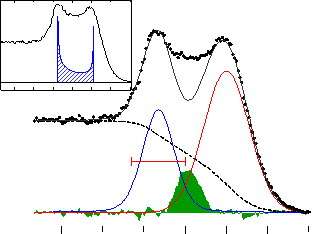
The theory has been around for more than 40 years, but only now has it been confirmed through direct and unambiguous experimental results. Working at the Advanced Light Source (ALS) of the U.S. Department of Energy's Lawrence Berkeley National Laboratory, a team of researchers has observed the theoretical prediction of electron "spin-charge separation" in a one-dimensional solid. These results hold implications for future developments in several key areas of advanced technology, including high-temperature superconductors, nanowires and spintronics.
Just as the body and wheels of a car are thought to be intrinsic parts of a whole, incapable of separate and independent actions, i.e., the body goes right while the wheels go left, so, too, are electrical charge and spin intrinsic components of an electron. Except, according to theory, in one-dimensional solids, where the collective excitation of a system of electrons can lead to the emergence of two new particles called "spinons" and "holons." A spinon carries information about an electron's spin and a holon carries information about its charge, and they do so as separate and independent entities. Numerous experiments have tried to confirm the creation of spinons and holons, referred to as spin-charge separation, but it took the technological advantages offered at ALS Beamline 7.0.1, also known as the Electronic Structure Factory (ESF), to achieve success.
In a paper published in the June 2006 issue of the journal Nature Physics, researchers have reported the observation of distinct spinon and holon spectral signals in one-dimensional samples of copper oxide, SrCuO2, using the technique known as ARPES, for angle-resolved photoemission spectroscopy. The research was led by Changyoung Kim, at Yonsei University, in Seoul, Korea, ALS scientist Eli Rotenberg, and Zhi-Xun Shen of Stanford University, a leading authority on the use of ARPES technology. Co-authoring the Nature-Physics paper with them were Bum Joon Kim and Hoon Koh, plus S.J. Oh, H. Eisaki, N. Motoyama, S. Uchida, T. Tohyama, and S. Maekawa.
"There have been claims of observing the two peak spectral structures of spin-charge separation in the past, but they turned out to be wrong or have plenty of ambiguity. This was primarily because those results were obtained from complicated materials and were not theoretically backed up," said Kim, who has spent several years investigating the spin-charge separation phenomenon. "Our observations using ARPES are direct and the results are unambiguous because they were obtained from a simple material that left little room for misinterpretation. Also, our results are theoretically backed up."
Said Shen, "Our results confirming the idea of spin-charge separation are important because they reveal deep insights into the quantum system - and the beauty and subtleties associated with it. From this study we know more about how the collective behavior of a system of particles can be so fundamentally different from that of the constituent individuals."
The idea behind spin-charge separation is that electrons behave differently when their range of motion is restricted to a single dimension, as opposed to three or even two dimensions. When moving through one dimension, for example, the electrons are lined up head-to-tail, making the repulsive force between their negative electrical charges overridingly dominant. The restricted movement of electrons through one-dimensional material was expected to give rise to collective effects that would be strong enough to break the information flow of spin and charge from a single electron.
ARPES is an excellent tool for observing spin-charge separation and other collective effects involving electrons. In this technique, x-rays are flashed on a sample causing electrons to be emitted through the photoelectric effect. Measuring the kinetic energy of emitted electrons and the angles at which they are ejected identifies their velocity and scattering rates. This in turn yields a detailed picture of the electron energy spectrum. Ordinarily, the removal of an electron from a crystal creates a hole, a vacant positively-charged energy space. This hole carries information on both the spin and the charge, as observed in a single peak of an ARPES spectrum. If spin-charge separation occurs, the hole decays into a spinon and a holon and two peaks in the ARPES spectrum are observed.
ALS Beamline 7.0.1 utilizes a state-of-the-art undulator magnetic insertion device to generate beams of x-rays with properties similar to that of a laser. These coherent and tunable x-ray beams are a hundred million times brighter than those from the best x-ray tubes and provide an exceptionally high degree of angular resolution for ARPES experiments.
Said Rotenberg, who manages the beamline and oversees research at the ESF experimental station, "At the ESF we have the advantage of being able to survey relatively large amounts of reciprocal space to locate where the interesting correlated effects are occurring. Our data not only shows a clear separation of ARPES spectral peaks, it can also be compared to theory to obtain spectral functions, which, in principle, can provide detailed information about the dynamics of spinons and holons."
High-temperature superconducting copper oxides, or cuprates, with their ability to lose all electrical resistance at transition temperatures far above those of metal superconductors, have become valuable tools for research even though scientists still do not know why they work. Central to many of the leading theories that attempt to explain high-temperature superconductivity in cuprates is the existence of spin-charge separation in one-dimensional systems.
Said Kim, "Our experimental confirmation of this spin- charge separation should provide more confidence in these theories."
Another area in which spinons and holons could play an important role is in the development of nanowires, one-dimensional hollow tubes through which the movement of electrons is so constrained that quantum effects dominate. Nanowires are expected to be key components in future nanotechnologies, including optoelectronics, biochemical sensing, and thermoelectrics.
Said Rotenberg, "The transport of electrons through nanowires will be subject to spin-charge separation and it will be very helpful to have experimental as well as theoretical understanding of this phenomenon as nanowire technology advances."
The creation of spinons and holons in one-dimensional systems is also expected to have an impact on the future of spintronics, a technology in which the storage and movement of data will be based on the spin of electrons, rather than just on charge, as with our current electronic technology. Spin-based electronic devices promise to be smaller, faster and far more versatile than today's devices.
Source: Lawrence Berkeley National Laboratory


