Evidence for more dust than ice in comets
October 13, 2005
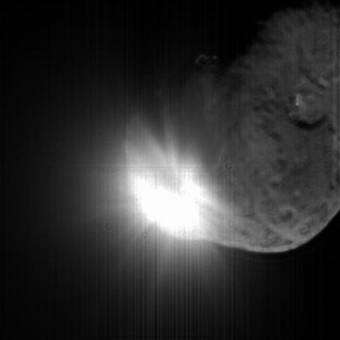
Ejecta plume from Tempel 1, 13 seconds after impact

Observations of Comet 9P/Tempel 1 made by ESA’s Rosetta spacecraft after the Deep Impact collision suggest that comets are ‘icy dirtballs’, rather than ‘dirty snowballs’ as previously believed.

Image: Ejecta plume from Tempel 1, 13 seconds after impact

Comets spend most of their lifetime in a low-temperature environment far from the Sun. Their relatively unchanged composition carries important information about the origin of the Solar System.

On 4 July this year, the NASA Deep Impact mission sent an ‘impactor’ probe to hit the surface of Comet 9P/Tempel 1 to investigate the interior of a cometary nucleus.

The 370 kg copper impactor hit Comet Tempel 1 with a relative velocity of 10.2 kilometres per second. The collision was expected to generate a crater with a predicted diameter of about 100-125 metres and eject cometary material. It vaporised 4500 tonnes of water, but surprisingly released even more dust.

Tempel 1's icy nucleus, roughly the size of central Paris, is dynamic and volatile. Possibly the impact would also trigger an outburst of dust and gas, and produce a new active area on the comet’s surface.

Just before impact, the Hubble Space Telescope spotted a new jet of dust streaming from the icy comet. No one knows for sure what causes these outbursts.

Rosetta, with its set of very sensitive instruments for cometary investigations, used its capabilities to observe Tempel 1 before, during and after the impact.

At a distance of about 80 million kilometres from the comet, Rosetta was in the most privileged position to observe the event.

European scientists using Rosetta's OSIRIS imaging system observed the comet’s nucleus before and after the impact. OSIRIS comprises a narrow-angle camera (NAC) and a wide-angle camera (WAC). Both cameras imaged the extended dust coma from the impact in different filters.

OSIRIS measured the water vapour content and the cross-section of the dust created by the impact. The scientists could then work out the corresponding dust/ice mass ratio, which is larger than one, suggesting that comets are composed more of dust held together by ice, rather than made of ice comtaminated with dust. Hence, they are now ‘icy dirtballs’ rather than ‘dirty snowballs’ as previously believed.

The scientists did not find evidence of enhanced outburst activity of Comet 9P/Tempel 1 in the days after the impact, suggesting that, in general, impacts of meteoroids are not the cause of cometary outbursts. Scientists also hope to make a 3D reconstruction of the dust cloud around the comet by combining the OSIRIS images with those taken from ground observatories.

Source: ESA


Rank 3 /5 (1 vote)
Tags

Relevant PhysicsForums posts

More news stories

Humans may have helped the decline of African rainforests 3000 years ago

(PhysOrg.com) -- Large areas of rainforests in Central Africa mysteriously disappeared over three thousand years ago, to be replaced by savannas. The prevailing theory has been that the cause was a change ...

Space & Earth / Environment

created 21 hours ago | popularity 4.3 / 5 (12) | comments 12 | with audio podcast report

Could Venus be shifting gear?

(PhysOrg.com) -- ESA’s Venus Express spacecraft has discovered that our cloud-covered neighbour spins a little slower than previously measured. Peering through the dense atmosphere in the infrared, the ...

Space & Earth / Space Exploration

created 17 hours ago | popularity 5 / 5 (7) | comments 7 | with audio podcast

NASA budget will axe Mars deal with Europe: scientists

US President Barack Obama's budget proposal to be submitted next week for 2013 will cut NASA's budget by 20 percent and eliminate a major partnership with Europe on Mars exploration, scientists said Thursday.

Space & Earth / Space Exploration

created 20 hours ago | popularity 5 / 5 (2) | comments 18

Two new moons for Jupiter

Advances in technology have lead to the discovery of new planets outside of our Solar System, and now even new moons in our own backyard.

Space & Earth / Space Exploration

created 17 hours ago | popularity 4 / 5 (1) | comments 7

Mars Science Laboratory computer issue resolved

(PhysOrg.com) -- Engineers have found the root cause of a computer reset that occurred two months ago on NASA's Mars Science Laboratory and have determined how to correct it.

Space & Earth / Space Exploration

created 18 hours ago | popularity 4.7 / 5 (6) | comments 3 | with audio podcast


Anonymous knocks CIA website offline (Update)

The website of the Central Intelligence Agency was inaccessible on Friday after the hacker group Anonymous claimed to have knocked it offline.

New error-correcting codes guarantee the fastest possible rate of data transmission

Error-correcting codes are one of the triumphs of the digital age. They’re a way of encoding information so that it can be transmitted across a communication channel — such as an optical fiber o ...

Google users warned of threat to smartphone wallets

Users of Google smartphone wallets were being warned on Friday that there is a way to crack pass codes intended to thwart thieves from going on illicit shopping sprees.

New power source discovered

(PhysOrg.com) -- Researchers at the Massachusetts Institute of Technology (MIT) and RMIT University have made a breakthrough in energy storage and power generation.

The power of estrogen -- male snakes attract other males

A new study has shown that boosting the estrogen levels of male garter snakes causes them to secrete the same pheromones that females use to attract suitors, and turned the males into just about the sexiest ...

Small modular reactor design could be a 'SUPERSTAR'

(PhysOrg.com) -- Though most of today's nuclear reactors are cooled by water, we've long known that there are alternatives; in fact, the world's first nuclear-powered electricity in 1951 came from a reactor ...