Researchers strive to make robotic systems more decisive
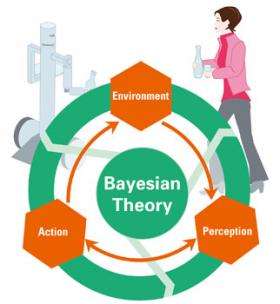
The Max Planck Institute for Biological Cybernetics is a partner in the Integrated Research Project BACS (Bayesian Approach to Cognitive Systems), which is being sponsored by the EU and will run until 2010. In this project, researchers are investigating the extent to which Bayes' theorem can be used in artificial systems capable of managing complex tasks in a real world environment. The Bayesian theorem is a model for rational judgment when only uncertain and incomplete information is available.
We are sitting in a soccer stadium and discover our neighbor sitting in the 10th row. We recognize him with no difficulty at all, even though he is wearing sunglasses and a cap in his club colors. Complex recognition processes like this work because the brain, sensory organs and nerve pathways are able to pick up stimuli and process them. The ability to classify things (categorization) appears to be a fundamental characteristic of human intelligence, and one that gives robots a real "headache". In situations in which a robot has no access to knowledge of a pre-defined environment, and pre-programmed control is therefore not possible, the robot will tend to fail miserably in its task. But it is precisely autonomous robots capable of acting in response to a given situation that could be of great use to humans.
This is the focus of BACS (Bayesian Approach to Cognitive Systems), an Integrated Project under the 6th Framework Program of the European Commission which has been allocated EUR 7.5 million in funding. The BACS project brings together researchers and commercial companies working on artificial perception systems potentially capable of dealing with complex tasks in everyday settings.
The basis of this research is Bayes' theorem. Thomas Bayes was an English mathematician and Presbyterian monk who lived in the 18th century. The theorem named after him describes alternatives for calculating the likelihood of events occurring using conditional probability. It is a model for rational judgment when only uncertain and incomplete information is available. Bayes' theorem is applicable to all questions relating to learning from experience.
In the 50 months for which the BACS collaboration will run, the ten project partners will use the theorem to model neuronal functions and cognitive processes. The aim is to gain a better understanding of perception and action in living beings, to optimize existing learning algorithms, and to realize intelligent artificial systems.
The scientific work being carried out under BACS makes robots with new capabilities a real prospect: robots capable of handling incomplete information, analyzing their environment, acquiring context-specific knowledge, interpreting the data and, together with humans, taking decisions. Specific implementations with market potential are already planned. A prospective implementation with market potential is a system that can assist drivers of passenger cars and trucks by employing probabilistic control functions and driving strategies. This should make driving safer for both drivers and pedestrians. Another area of interest is 3D modelling and surveillance of safety-critical applications such as monitoring structural changes in buildings or mines and safety-relevant infrastructure elements in power lines. European industry can use Bayes' alternative calculation models to good advantage; they have applications both in major companies in the automotive industry and mobile telephony, for example, and in small and medium-size companies active in niche markets such as healthcare, inspection, monitoring or even market forecasts.
It will be the task of the participating researchers at the MPI to design artificial perception systems and models for face and body movement, based on perception experiments with human subjects. The development of new 3D animation technology will help to understand how humans recognize facial expressions and can make use of them in non-verbal communication with artificially animated dialog partners as employed, for example, in information enquiry systems. A further task is to develop animated facial mirror images for the investigation of self-perception, and to test their use in rehabilitation programs in hospitals.
The Project brings together ten partners situated in Germany, Switzerland, France and Portugal. It is coordinated by Prof. Siegwart of the Eidgenössische Technische Hochschule Zürich. The share in the project of the Department for Cognitive Human Psychophysics at the MPI for Biological Cybernetics, headed by Prof. Heinrich Bülthoff, amounts to 850.000 €.
Source: Max-Planck-Institute for Biological Cybernetics


