Samsung Develops World's First 512-Megabit DDR2 with 70nm Process Technology
October 13, 2005 Samsung Develops World's First 512-Megabit DDR2 with 70nm Process Technology

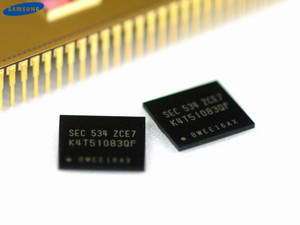
Samsung Electronics announced that it has completed development of the world-first 512-Megabit (Mb) DDR2 SDRAM using 70-nanometer process, the smallest process technology yet applied to a DRAM device.

The new 70nm technology maintains continuity with the 80nm and 90nm processes Samsung now uses in most DRAM production today. However, the number of chips yielded per wafer will be at least 100%amp; higher than could be obtained with 90nm technology.

After completing the first sub-micron DRAM process in 2002, Samsung introduced an 80nm version in 2003 and today has set another industry milestone with the new 70nm version for DRAM fabrication.

Several technological innovations leading to the new 70nm process technology for DRAM, include Samsung's Metal-Insulator-Metal (MIM) capacitor technology, and 3D transistor architecture known as Sphere-shaped Recess Channel Array Transistor (S-RACT). These advancements, respectively presented at the VLSI Symposiums of 2004 and 2005, have been applied to overcome the limitations of stacked DRAM cells and vastly improve the data refresh function, critical to the 70nm 512Mb DRAM.

Samsung plans to continue to follow an aggressive time-to-market DRAM implementation for leading nanometer process technologies as it did with its introduction of the 90nm process in mid-2004 and the 80nm in the second half of 2005. The 70nm process technology is scheduled to be used in production beginning in the second half of 2006 for 512M, 1G and 2G densities.

Market research firm, Gartner Dataquest revealed in a May 2005 report that the world DRAM market would be worth US$26.2 billion this year and continue rising to reach US$29.1 billion in 2008. Moreover, next-generation game consoles scheduled for release, most new 3G mobile phones, and Microsoft's new PC operating software program "Vista" are noted as key factors fueling market demand next year. These developments are expected to contribute to continued diversification and growth of the DRAM market worldwide.

Source: Samsung


print this article email this article download pdf blog this article bookmark this article     Stumble it Digg this share on Facebook retweet share on Reddit add to delicious
Rate this story - 2.5 /5 (2 votes)


October 13, 2005 all stories

Comments: 0

2.5 /5 (2 votes)
  • Stumble this up

  • Digg this

  • share this

  • hide
  • Related Stories


Other News

All eyes on Murdoch as newspapers ponder digital future

Technology / Internet

created 55 minutes ago | popularity not rated yet | comments 0

Is Rupert Murdoch bluffing? Making a bold high-stakes gamble that will save the troubled newspaper industry? Or pursuing a pipe dream that can only end in failure?


A system of space solar power system (SSPS)

Japan eyes solar station in space as new energy source

Technology / Energy

created Nov 08, 2009 | popularity 4.8 / 5 (22) | comments 28

It may sound like a sci-fi vision, but Japan's space agency is dead serious: by 2030 it wants to collect solar power in space and zap it down to Earth, using laser beams or microwaves.


Road trains may be coming soon to Europe

Road trains may be coming soon to Europe (w/ Video)

Technology / Engineering

created Nov 13, 2009 | popularity 4.8 / 5 (12) | comments 17

(PhysOrg.com) -- Road trains linking vehicles together in a traveling convoy are planned for Europe. With only the lead vehicle being actively driven, the road trains would allow commuters to sleep, read a ...


Cars sit in traffic on a highway

Netherlands to levy 'green' road tax by the kilometre

Technology / Hi Tech

created Nov 13, 2009 | popularity 3 / 5 (4) | comments 8

The Dutch government said Friday it wants to introduce a "green" road tax by the kilometre from 2012 aimed at cutting carbon dioxide emissions by 10 percent and halving congestion.


Google Go

Google Go gets going (w/ Video)

Technology / Software

created Nov 11, 2009 | popularity 4.3 / 5 (11) | comments 6

(PhysOrg.com) -- Google has introduced its new experimental programming language Go, which aims to combine speedy application development through simplified coding with high-speed program execution.