Scientists develop cancer nanobomb
University of Delaware researchers are opening a new front in the war on cancer, bringing to bear new nanotechnologies for cancer detection and treatment and introducing a unique nanobomb that can literally blow up breast cancer tumors.
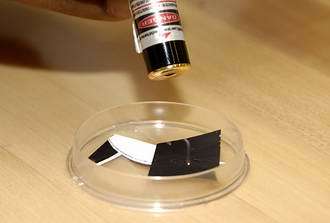
Image: Laser light ignites bundles of nanotubes, which explode like tiny cluster bombs.
Balaji Panchapakesan, assistant professor of electrical and computer engineering at UD, has recently reported on the discoveries in the journals NanoBiotechnology and Oncology Issues.
He is the lead investigator for a team that includes Eric Wickstrom, professor of biochemistry and molecular biology at Thomas Jefferson University in Philadelphia and his student Greg Cesarone, and UD graduate students Shaoxin Lu, Kousik Sivakumar and postdoctoral researcher Kasif Teker.
Panchapakesan said this is basic research in the very early stages of inquiry and that it would take extensive testing and years of clinical trials before the nanobombs could actually be used in medical applications to treat human beings.
"Make no mistake, we are focused on eradicating cancer," Panchapakesan said, explaining that the nanobombs are the result of work over the past two years with carbon nanotubes, which are atoms of carbon arranged in tubular form.
Originally, he said, the research team was looking at the use of the carbon nanotubes as drug delivery vehicles. Because they are smaller than the size of a single cell, the nanotubes can provide for the highly selective injection of drugs into individual cells.
As they undertook various experiments, however, the team made a startling discovery. "When you put the atoms in different shapes and forms, they take on different properties at the nanoscale," Panchapakesan said. "We were experimenting with the molecules and considering optical and thermal properties, and found we could trigger microscopic explosions of nanotubes in wide variety of conditions."
Explosions in air of loosely packed nanotubes have been seen before in an oxygen environment, creating ignition. However, the work reported by Panchapakesan uses the localized thermal energy imbalance to set off explosions that are intrinsic in nature.
Panchapakesan said the nanobombs are just that, tiny bombs on the nanoscale. "They work almost like cluster bombs," he said. "Once they are exposed to light and the resulting heat, they start exploding one after another."
The bombs are created by bundling the carbon nanotubes. With a single nanotube, the heat generated by the light is dissipated by surrounding air. In bundles, the heat cannot dissipate as quickly and the result is "an explosion on the nanoscale," Panchapakesan said.
When the UD researchers saw the explosions, they realized it might be possible to use the microscopic bombs to kill cancer cells. They recreated the explosions in solutions including water, phosphate and salt, which meant the nanobombs could be used in the human body. In fact the explosions were more dramatic in saline solutions, Panchapakesan said.
"The nanobomb is very selective, very localized and minimally invasive," Panchapakesan said. "It might cause what I would call nanopain, like a pin prick."
He believes the nanobomb holds great promise as a therapeutic agent for killing cancer cells, with particular emphasis on breast cancer cells, because its shockwave kills the cancerous cells as well as the biological pathways that carry instructions to generate additional cancerous cells and the small veins that nourish the diseased cells. Also, it can be spread over a wide area to create structural damage to the cancer cells that are close by.
The nanobombs are superior to a variety of current treatments because they are powerful, selective, non-invasive, nontoxic and can incorporate current technology, including microsurgery.
Laser light ignites bundles of nanotubes, which explode like tiny cluster bombs.
An advantage over other carbon nanotube treatments being considered by scientists is that with nanobombs, the carbon nanotubes are destroyed along with the cancer cells. Once the nanobombs are exploded and kill cancer cells, macrophages can effectively clear the cell debris and the exploded nanotube along with it.
Other treatments retain the carbon nanotubes and nanoparticles intact. If the material finds its way to the kidney or accumulates in the blood vessels, the nanoparticles might cause blockage and create problems, Panchapakesan said. Furthermore, the nanobomb route is probably the only way to use nanotubes without any cytotoxicity as the nanotubes are destroyed completely.
Current surgical techniques are not precise and cancerous cells are often left behind. In addition, cancers in some part of the body, such as arteries and veins, are sometimes considered inoperable. Nanobombs can be used to target any remaining cancerous cells and can be used in any part of the body, allowing the creation of nanobomb therapy for a wide variety of cancers.
Panchapakesan said the method is far better than modern chemotherapy, which is non-selective, kills normal cells as well as cancerous cells and leads to a decline in the quality of life for the patient. "This is valuable in patient management, pain management and overall quality of life," he said.
Furthermore, Panchapakesan said, the nanobomb is a "very simple technique" and as such will likely prove to be "more robust and with the best chance to succeed."
Panchapakesan added, "We are just getting started in this area. There is plenty of work ahead to successfully translate this into clinical medicine."
In addition to treatment, he believes nanotechnology can provide new tools for cancer diagnosis through the use of tiny nanosensors.
"In the future, my vision is that people will have at-home kits that can detect cancer. After work they will be able to go to a clinic, be treated with nanobombs and go home," Panchapakesan said. While these initial experiments are on breast cancer cells, he is also working to extend his method to prostate cancer and pancreatic cancer.
He also foresees nano-bio-robots or nano-surgical tools that can be placed inside the body to remove tumors in areas previously inaccessible using traditional treatment methods.
Panchapakesan said the team's findings are the result of interdisciplinary research. "Different sciences come together to make this work," he said, citing cancer biology, physics, electrical and computer engineering and chemistry.
"Interdisciplinary research provides for fresh perspectives and brings about new ideas, which is probably the way to go in the future."
Source: University of Delaware


