Our Suns fiery outbursts seen in 3D
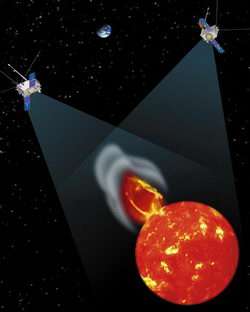
UK solar scientists are eagerly awaiting the launch of NASAs STEREO mission which will provide the first ever 3D views of the Sun. STEREO (Solar TErrestrial RElations Observatory) comprises two nearly identical observatories that will orbit the Sun to monitor its violent outbursts Coronal Mass Ejections (CMEs) and the space weather it creates that can impact the Earth, satellites and astronauts. STEREO is due for launch on August 1st 2006.
Professor Richard Harrison of the CCLRC Rutherford Appleton Laboratory (RAL), part of the UK team working on STEREO said "Whilst our Sun may seem a calm familiar object in the sky, in reality it is rather more manic! It generates constantly changing knots of magnetic fields that twist and churn and, occasionally, snap like an over-stretched rubber band producing CME outbursts. At the moment, we cannot recognise the tell-tale signals that precede an outburst, but we expect STEREO will change that."
In order to understand and, most importantly, predict and protect against the effects of the Suns outbursts, such as CMEs, we need to monitor our parent star very closely. CMEs are powerful eruptions that can blow up to 10 billion tonnes of material from the Suns atmosphere into space. Typically, CMEs send about 1 billion tonnes of material into space, travelling at one million miles per hour. They can create major disturbances in the interplanetary medium (the dust, plasma and gas in the space between the planets) and if they reach Earth, trigger severe magnetic storms that affect satellites, communications, power grids and aircraft. CME-driven shocks also play a significant role in accelerating solar energetic particles that can damage spacecraft and harm astronauts. Despite their significance, scientists dont fully understand the origin and evolution of CMEs yet.
Dr Chris Davis, also of RAL, said "Understanding CMEs is key to the future of human activities in space, including the many activities in daily life that rely on communication and navigation satellites. As satellite technology becomes more miniaturised, the smaller microchips are actually more vulnerable to killer electrons the very energetic particles that a CME shock can produce."
STEREO will provide key data on CMEs and will be the first mission to watch CMEs directly as they head towards the Earth (which can happen as frequently as 4 times a week during the active phase of the Suns cycle). STEREO comprises two nearly identical observatories that will be placed in orbits almost the same as that of the Earth around the Sun (their orbits will be 346 and 388 days).
Dr Chris Eyles of the University of Birmingam said "One spacecraft will slowly move ahead of the Earth, the other lag behind - the resulting offset will allow the two spacecraft to have depth perception and give them stereo vision such as humans have."
UK scientists and engineers have contributed to STEREO by building the HI (Heliospheric Imager) cameras for the SECCHI (see Notes below) package on each observatory. HI is a wide angled imaging system (meaning it has a broad field of view) and will be studying how CMEs propagate, particularly those that are likely to affect the Earth. HI was funded by the Particle Physics and Astronomy Research Council investment of 1.88million. CCLRC Rutherford Appleton Laboratory is responsible for the scientific exploitation of the heliospheric imagers as well as providing the detectors used in all of STEREO's camera systems. Both heliospheric imagers were built in the UK at the University of Birmingham.
Commenting on the mission objectives, PPARCs CEO Professor Keith Mason said "Predicting the timing and strength of solar eruptions is clearly important if we want to mitigate the threat of CMEs and STEREOs twin observatories will be our sentinels, providing a unique insight into the evolution of these huge outbursts."
Professor Mason added "The UK has a strong history in solar physics and STEREO builds on the legacy of extremely successful satellites such as YOHKOH and SOHO, which have changed our understanding of the Earths parent star. The STEREO mission is a prime example of how we can make the most of British expertise by joining with international agencies such as NASA."
Source: PPARC


