Dartmouth researcher proposes the use of high-altitude airships for astronomy
July 17, 2006 Dartmouth researcher proposes the use of high-altitude airships for astronomy

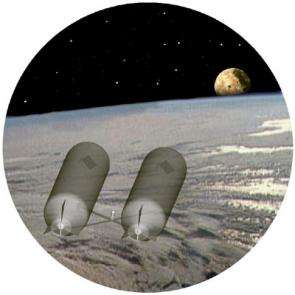
An illustration of the type of high-altitude catamaran that could carry an astronomical telescope. (Credit: Southwest Research Institute and Dartmouth College)

Dartmouth astronomy professor Robert Fesen appreciates NASA's Hubble Telescope, which he says has proven to be a terrific astronomical observatory since it was launched in 1990. But, he adds, there may be a vastly cheaper way to obtain nearly as sharp images of stars and galaxies that doesn't require space shuttle flights or teams of astronauts to launch or repair it.

Fesen has written a new report advocating the use of newly developed military and telecommunications high altitude, station-keeping vehicles for astronomy. He suggests that the time has come to develop and launch what he calls a "Hubble Junior" by placing a relatively modest-sized telescope on one of these stratospheric platforms to conduct astronomical observations.

"A lot of the basic technology exists to make this happen," he says. "High-altitude airships are currently being developed for telecommunications and for the military. I want people to begin thinking about the possibility of doing first-rate optical science like that done from Hubble but at stratospheric altitudes like that flown by the U2 airplane and at a cost of a few million dollars rather than a few billion."

Six years ago, he and some colleagues from NASA, Johns Hopkins University, and the Southwest Research Institute did a feasibility study on this very topic. They determined that it was indeed possible, as long as the payload (the electronics, the mirror for the telescope, and the pointing system) wasn't too heavy. Since then, the technology has greatly advanced, making the notion of using a high-altitude airship for a stratospheric astronomical observatory a real possibility.

An airship, says Fesen, is a propeller-driven balloon. Two blimp-shaped balloons strapped together in catamaran fashion and solar powered could fly at altitudes of 75,000-85,000 feet, or about twice that of commercial airplanes. A one-half- to one-meter size telescope mirror (about 20-40 inches) lofted to these altitudes would place it above more than 95 percent of the Earth's atmosphere, thereby affording nearly razor sharp images of planets, stars, and galaxies.

Fesen is a big fan and a user of the Hubble Telescope. Its 2.4-meter mirror captures beautifully sharp images from its 300-mile-from-Earth orbit. But, he says that a Hubble Junior, at an altitude of just 85,000 feet (16 miles), which would place it above all clouds and weather that plague Earth-bound telescopes, could also acquire nearly as crisp and clear images as Hubble does.

"A one-meter-mirror telescope Hubble Junior, although not as powerful as the real Hubble, could complement Hubble's contributions to our understanding of the heavens. And since it would be more nimble because it's closer to home and simpler to operate, a Hubble Junior could react faster to and follow unexpected supernova explosions, close flybys of asteroids, and other transient astronomical events."

Fesen presented his paper, a roadmap of where the science is and what the possibilities are, at a conference sponsored by SPIE, the International Society for Optical Engineering in late May. He has since posted his paper online.

"What I did was just outline the recipe," he says. "It's now time to start cooking."

Source: Dartmouth College


print this article email this article download pdf blog this article bookmark this article     Stumble it Digg this share on Facebook retweet share on Reddit add to delicious
Rate this story - 4.7 /5 (3 votes)


July 17, 2006 all stories

Comments: 0

4.7 /5 (3 votes)
  • Stumble this up

  • Digg this

  • share this

  • hide
  • Related Stories

  • 'Dropouts' pinpoint earliest galaxies
    created Nov 06, 2009 | popularity not rated yet | comments 0
  • Unsettled Youth: Spitzer Observes a Chaotic Planetary System
    created Nov 04, 2009 | popularity not rated yet | comments 0
  • Opening up a colorful cosmic jewel box
    created Oct 29, 2009 | popularity not rated yet | comments 0
  • X-Ray Jets from Galaxies
    created Oct 19, 2009 | popularity not rated yet | comments 0
  • Hubble observes LCROSS impact: Preliminary analysis shows no clear evidence for hydroxyl
    created Oct 12, 2009 | popularity not rated yet | comments 0


  • hide
  • Relevant PhysicsForums posts

  • The shape of our solar system's orbits.
    created Nov 07, 2009
  • Above or Below the Line of Nodes
    created Nov 07, 2009
  • Supernova vs. Nova?
    created Nov 07, 2009
  • Supernova's Gamma Rays and Comets
    created Nov 06, 2009
  • More from Physics Forums - General Astronomy

Other News

NASA satellites make a movie and get rainfall, wind info on Ida

NASA satellites make a movie and get rainfall, wind info on Ida (w/ Video)

Space & Earth / Earth Sciences

created 59 minutes ago | popularity not rated yet | comments 0

NASA satellites are amazing examples of technology. The TRMM satellite peers into tropical cyclones and can tell how much rain is falling per hour and where. QuikScat uses microwave technology to measure Ida's ...


L-R: Chiwetel Ejiofor, Amanda Peet and John Cusack at the premiere of "2012"

NASA on crusade to debunk 2012 apocalypse myths

Space & Earth / Space Exploration

created 49 minutes ago | popularity not rated yet | comments 0

The world is not coming to an end on December 21, 2012, the US space agency insisted Monday in a rare campaign to dispel widespread rumors fueled by the Internet and a new Hollywood movie.


NASA's GOES Project offers real-time hurricane alley movies

NASA's GOES Project offers real-time hurricane alley movies

Space & Earth / Earth Sciences

created 39 minutes ago | popularity not rated yet | comments 0

People love to get the big picture of hurricane alleys, and thanks to the GOES Project at NASA's Goddard Space Flight Center in Greenbelt, Md., they can now get real-time satellite animations of the eastern ...


Antarctica glacier retreat creates new carbon dioxide store

Antarctica glacier retreat creates new carbon dioxide store

Space & Earth / Earth Sciences

created 5 hours ago | popularity 5 / 5 (2) | comments 0

Large blooms of tiny marine plants called phytoplankton are flourishing in areas of open water left exposed by the recent and rapid melting of ice shelves and glaciers around the Antarctic Peninsula. This ...


NASA's TRMM Satellite sees most of Ida's heaviest rain stayed off coasts

NASA's TRMM Satellite sees most of Ida's heaviest rain stayed off coasts

Space & Earth / Earth Sciences

created 1hour ago | popularity not rated yet | comments 0

NASA and the Japanese Space Agency's Tropical Rainfall Measuring Mission (TRMM) satellite flew over Ida and captured her rainfall when she passed by Nicaragua, Honduras and Belize this weekend. TRMM data revealed ...