Scientists Gaining Clearer Picture of Comet Makeup and Origin
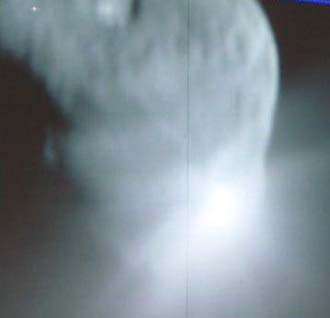
Scientists are getting their best understanding yet of the makeup of comets – not only of the materials inside these planetary building blocks, but also of the way they could have formed around the Sun in the solar system’s earliest years.
When NASA’s Deep Impact spacecraft slammed into comet Tempel 1 on July 4, 2005, the collision sent tons of pristine materials into space and gave astronomers from around the world, using ground- and space-based telescopes, the first look “inside” a comet. From that sample, over the past several months, scientists who used the imaging spectrometer on NASA’s Spitzer Space Telescope have refined their models of what a comet is made of and how it comes together.
The Spitzer observation team, led by Dr. Carey Lisse of the Johns Hopkins University Applied Physics Laboratory in Laurel, Md., wrote about its findings last week on the Science Express Web site.
“Spitzer’s spectral observations of the impact at Tempel 1 not only gave us a much better understanding of a comet’s makeup, but we now know more about the environment in the solar system at the time this comet was formed,” Lisse says.
From its orbit in space, Spitzer’s infrared spectrograph closely observed the materials ejected from Tempel 1 when Deep Impact's probe dove into the comet’s surface. Astronomers spotted the signatures of solid chemicals never seen before in comets, such as carbonates (chalk) and smectite (clay), metal sulfides (like Fool’s Gold), and carbon-containing molecules called polycyclic aromatic hydrocarbons, found in barbecue grills or automobile exhaust on Earth.
Lisse says the clay and carbonates were surprises because they typically require liquid water to make – and liquid water isn’t found in the regions of deep space where comets form. Also surprising was the superabundance of crystalline silicates, material formed only at red-hot temperatures found inside the orbit of Mercury.
"In the same body, you have material formed in the inner solar system, where water can be liquid, and frozen material from out by Uranus and Neptune,” Lisse says. “Except for the lightest elements, the total abundances of atoms in the comet are practically the same as makes up the Sun. It implies there was a great deal of churning in the primordial solar system, with high- and low-temperature materials mixing over great distances."
Planets, comets and asteroids were all born out of a thick and dusty mix of chemicals that surrounded the young Sun. Because comets formed in the outer, colder regions of our solar system, some of this early planetary material remains frozen inside them. By refining their list of comet ingredients, theoreticians can begin testing models of planet formation.
More than 80 telescopes on and above Earth observed Deep Impact's rendezvous with Tempel 1, and their findings are shedding light on the comet’s broader history in the solar system. Lisse’s team is also comparing Spitzer’s discoveries with those from NASA's Stardust mission, which last January returned particles from the coma (or atmosphere) of comet Wild 2 back to Earth.
“We can compare the inferred composition of Tempel 1 to the Stardust sample returns and obtain a ‘ground truth,’ ” Lisse says. “From this we can create a Rosetta stone, which we’ll use to better understand the materials seen in our own solar system as well as around other stars.”
Twelve of the 14 species found by Spitzer match up with preliminary Stardust analyses, Lisse says, but several mysteries remain. For example, the Stardust samples do not yet include definitive evidence of the carbonate and clay minerals found in Tempel 1.
“There’s no reason to think Tempel 1 represents all comets,” he says. “Deep Impact only hit and excavated Tempel 1 in one precise location, and Stardust only sampled the surface of one comet at one point in its orbit. We'll need additional missions to comets – such as robotic landing spacecraft or sample-return probes – to help us complete the picture.”
NASA’s Jet Propulsion Laboratory (JPL), Pasadena, Calif., manages the Spitzer Space Telescope mission for NASA's Science Mission Directorate, Washington. Science operations are conducted at the Spitzer Science Center. Spitzer's infrared array camera was built by NASA's Goddard Space Flight Center, Greenbelt, Md.
Source: Johns Hopkins University


